Why Retail IT Needs Uptime SLAs: A Manager's Guide
- Sosa Solutions NYC
- Jul 23
- 9 min read

Why uptime SLAs are the backbone of retail IT reliability
Retail IT runs on a simple, unforgiving rule: when systems go down, revenue stops. An uptime SLA, or service level agreement, is a formal contract between your business and a service provider that specifies exactly how available a system must be, what counts as a breach, and what financial remedy you receive when the provider falls short. For retail IT managers, these agreements are not paperwork formalities. They are the mechanism that turns vague vendor promises into documented, enforceable commitments.
The real value of an SLA lies not in the uptime percentage printed on the contract but in the accountability structure it creates. A vendor who knows they owe you service credits for every hour of unplanned downtime behaves differently than one operating without consequences. That shift from reactive to proactive vendor behavior is what retail IT teams actually need.
Key components every retail uptime SLA should define:
Uptime percentage target: the minimum availability guarantee, expressed as a percentage of total time in a given period
Allowable downtime: the maximum outage time the agreement permits before a breach is triggered
Measurement window: whether uptime is calculated monthly, quarterly, or annually
Exclusions: scheduled maintenance windows, force majeure events, and outages caused by your own infrastructure
Financial remedies: service credits, typically expressed as a percentage of monthly fees, issued when the provider misses the target
Response and resolution commitments: how quickly the vendor must acknowledge and fix an issue
Reporting obligations: how uptime data is logged, shared, and audited
How uptime percentages translate into real downtime
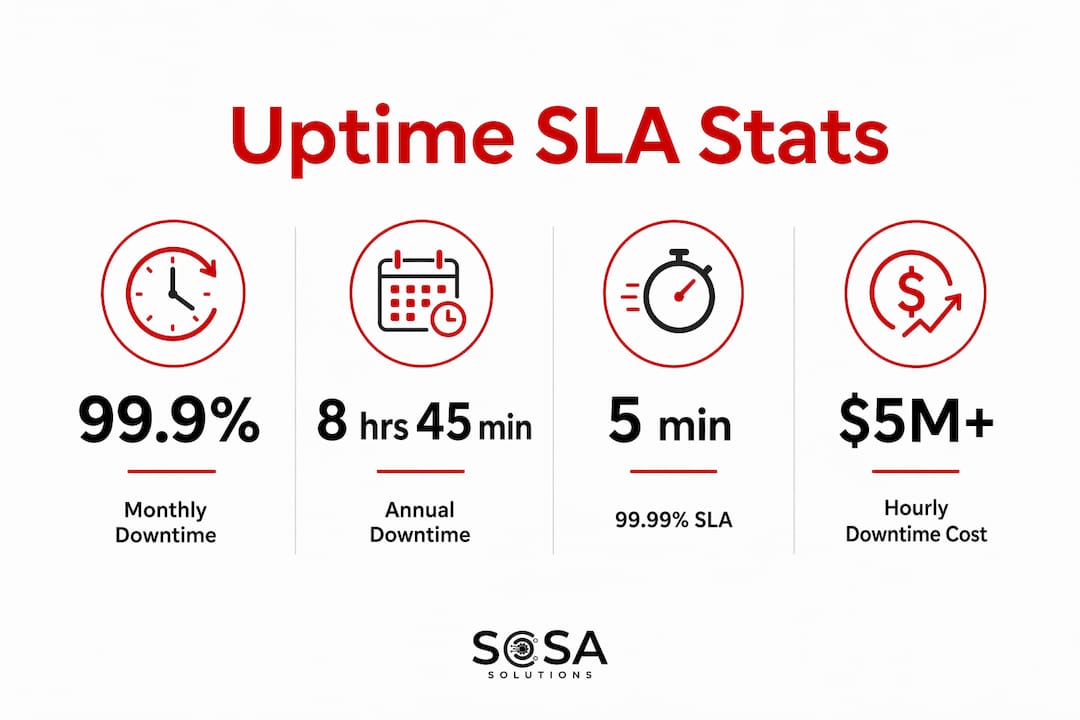
The math behind uptime SLAs is straightforward, but the implications are easy to underestimate. A guarantee of 99.9% sounds close to perfect. In practice, it allows up to 8 hours and 45 minutes of downtime every year, or roughly under an hour per month. For a retailer running a busy store on Black Friday, 43 minutes of POS failure is not a minor inconvenience.
SLA level | Annual downtime | Monthly downtime |
99.9% (“three nines”) | ~8 hrs 45 min | ~43 min |
99.99% (“four nines”) | — | under 5 minutes |
99.999% (“five nines”) | — | — |
Moving from 99.9% to 99.99% cuts monthly downtime from 43 minutes to under 5 minutes. That is a meaningful difference for any retailer whose checkout systems, inventory platforms, or e-commerce backend need to stay live during peak hours. The jump to 99.999% availability is where cost and benefit start to diverge sharply. Five nines limits annual downtime to only a few minutes, but the infrastructure investment required often outpaces the operational benefit for most mid-market retailers.
One critical distinction: uptime percentage is not the same thing as reliability. An SLA is a commercial contract that defines financial liability for downtime, not a technical guarantee that outages will never happen. Vendors can meet the letter of a 99.9% SLA and still leave you with a painful outage at the worst possible moment, because the agreement compensates you after the fact rather than preventing the failure. That is why SLA accountability must be paired with your own monitoring, redundancy, and incident response planning.
Pro Tip: When evaluating SLA tiers, calculate the actual downtime minutes per month at each level and map them against your busiest trading hours. A 99.9% SLA that allows 43 minutes of monthly downtime may be acceptable for a back-office system but entirely wrong for your POS or payment gateway.
Why retail IT environments demand stricter uptime commitments
Retail IT is not a single system. It is a web of interdependent platforms: point-of-sale terminals, customer relationship management tools, inventory management software, e-commerce storefronts, payment processors, and digital signage, all running simultaneously and all capable of failing independently or together. When one layer breaks, the customer-facing experience often collapses entirely.

The complexity of modern retail tech stacks is itself a primary driver of outage risk. Fragmented systems, multiple third-party dependencies, and limited integration across platforms make real-time visibility nearly impossible for most internal teams. Many retail IT departments are already stretched thin managing day-to-day operations, which means they are responding to problems rather than preventing them.
The financial exposure is not abstract. For large retailers, downtime costs routinely exceed $5 million per hour, according to ITIC survey data. Even for smaller operations, the average hourly cost of downtime exceeds $300,000 for small and medium-sized businesses. Those figures include direct lost sales, but the indirect costs run deeper: abandoned carts, failed data collection, damaged customer trust, and staff time diverted from serving customers to troubleshooting systems.
Black Friday is the clearest illustration of why uptime SLAs matter in retail specifically. IT-intensive assets like self-checkout systems and CRM integrations are most likely to buckle under peak load, precisely when your team has the least capacity to respond. A well-structured SLA with a provider who has contractual skin in the game changes that dynamic. It also gives your IT team a documented escalation path rather than an informal phone call when something breaks at 11 PM on the biggest shopping night of the year.
Common causes of downtime in retail IT environments include:
Primary ISP or network failure: a single internet provider going down can take POS terminals and payment processing offline across an entire store or region
Third-party service outages: payment processors, cloud platforms, and SaaS vendors each introduce their own failure risk
Hardware failure at the edge: POS terminals, receipt printers, and self-checkout kiosks fail under heavy use
Software updates gone wrong: patches and version upgrades applied during low-traffic windows can introduce unexpected conflicts
Correlated failures: when a single point of failure, like a core network switch, takes down multiple dependent systems simultaneously
The risk of correlated outages is particularly underappreciated. A primary ISP failure does not just affect one system; it can simultaneously disable POS terminals, payment processing, inventory lookups, and customer-facing digital displays. Retail IT managers who rely on a single vendor SLA for network connectivity are exposed to exactly this scenario. Layered SLAs across diverse providers, combined with autonomous failover, are the structural answer.
How to set and evaluate uptime SLAs that actually work for retail
The first step is mapping your systems by operational criticality. Not every retail IT component needs a 99.99% SLA. Your payment processing gateway and POS network sit at the top of the stack; a back-office reporting tool does not. Matching SLA tier to business impact keeps costs rational and focuses your vendor negotiations where they matter most.
When you sit down to evaluate or negotiate an SLA, the headline uptime percentage is only the starting point. These are the terms that determine whether the agreement actually protects you:
Response time versus resolution time: a four-hour response SLA means the vendor acknowledges the ticket within four hours, not that the system is back online. Insist on separate, explicit resolution time commitments for critical systems.
Exclusion clauses: read every carve-out carefully. Scheduled maintenance, force majeure, and “customer-caused” outages are standard exclusions, but some vendors define these broadly enough to escape accountability for most real outages.
Service credit structure: credits typically range from 5–15% of monthly fees for significant downtime events. Understand the threshold that triggers a credit and whether the credit covers your actual revenue exposure or just a fraction of your service fee.
Measurement methodology: confirm how uptime is calculated and who controls the data. A vendor measuring their own uptime from a single internal probe has an obvious conflict of interest.
Peak period provisions: negotiate enhanced commitments for Black Friday, Cyber Monday, and other high-traffic windows. Some providers offer dedicated support teams or additional redundancy during these periods.
Audit and reporting rights: you need access to uptime logs, not just a monthly summary the vendor produces themselves.
Aligning SLA expectations with your actual operating hours is a step many retail IT managers skip. A 99.9% SLA calculated on a 24/7 basis distributes that 43 minutes of monthly downtime across all hours. If your store operates 7 AM to 11 PM, you want the SLA to reflect availability during those hours specifically, not overnight windows when a brief outage has no customer impact. This is a negotiable point, and it is worth raising.
Pro Tip: Before signing any SLA, run your current monitoring data through the vendor’s uptime calculation formula. If your existing systems would have breached the proposed SLA in the past 12 months, you know either the target is too aggressive or the vendor’s infrastructure needs scrutiny before you commit.

For ongoing compliance, retail IT troubleshooting best practices recommend treating SLA monitoring as a continuous process rather than a quarterly review. Set up automated alerts tied to the same thresholds your SLA uses, so you catch potential breaches in real time rather than discovering them in a vendor report three weeks later.
The operational benefits of proactive uptime SLA management
Proactive SLA management produces measurable gains, not just contractual protection. Structured uptime SLAs with clear accountability have been shown to significantly reduce incident resolution times and increase first-time fix rates for major global retailers. The mechanism is straightforward: when vendors know their performance is tracked against documented targets, they invest in faster escalation paths and better monitoring tools.
Retailers with 24/7 monitoring and rapid incident response consistently show fewer outages and higher revenue retention. The connection is direct: catching a degraded system before it fails completely is always cheaper than recovering from a full outage. Proactive monitoring also generates the data you need to enforce SLA credits when a vendor falls short.
The risks of inadequate SLAs are equally concrete. Without documented commitments, outage responses become uncoordinated. Vendors point fingers at each other, your team lacks a clear escalation path, and recovery times stretch from minutes into hours. A retailer running a fragmented tech stack with no SLA governance is, as one industry analysis put it, flying blind.
Strategies that retail IT teams use to hit their SLA targets consistently:
Multi-probe monitoring: deploy monitoring from multiple geographic locations rather than a single internal check. Binary up/down monitoring from one location generates false alarms and misses regional failures that affect real customers.
Layered failover: maintain backup connectivity through a secondary ISP or cellular failover so that a primary network failure does not cascade into a full store outage.
Eliminating single points of failure: audit your infrastructure for components where one failure takes down multiple systems. Redundant switches, load-balanced servers, and mirrored databases each reduce correlated outage risk.
Automated incident ticketing: connect your monitoring platform directly to your ticketing system so that SLA clock starts the moment an alert fires, not when someone manually logs the issue.
Regular SLA reviews: schedule quarterly reviews with each vendor to compare your monitoring data against their reported uptime. Discrepancies are common and worth resolving before they become disputes.
Understanding IT support response time is closely tied to SLA performance. A vendor who responds in four hours but resolves in twelve has technically met their response commitment while leaving your store offline for most of a business day. Tracking both metrics separately, and holding vendors to both, is what separates a functional SLA program from one that looks good on paper.
For retail IT managers building or rebuilding their IT infrastructure for maximum uptime, the SLA framework should be designed alongside the infrastructure itself, not added after the fact. The systems you choose, the vendors you contract, and the monitoring tools you deploy all need to align with the availability targets you are committing to your business.
When an SLA breach does occur, the legal and contractual implications deserve attention — understanding the guide to online pallet ordering can offer insight into structuring robust retail agreements. Service credits are the standard remedy, but they rarely cover the full cost of a major outage. Your SLA should specify the process for claiming credits, the timeline for payment, and whether repeated breaches trigger escalating penalties or contract termination rights. Retailers who treat SLA breach clauses as boilerplate often discover, during an actual dispute, that the fine print significantly limits their recourse.
Key Takeaways
Uptime SLAs give retail IT managers the documented accountability, financial remedies, and monitoring framework needed to protect revenue and customer experience from the cost of unplanned downtime.
Point | Details |
SLA tiers carry real downtime differences | A 99.9% SLA allows 43 minutes of monthly downtime; 99.99% cuts that to under 5 minutes. |
Retail downtime costs are severe | For large retailers, hourly downtime costs routinely exceed $5 million; for SMBs, the average exceeds $300,000 per hour. |
Accountability beats percentage alone | An SLA’s value is in documented financial remedies and vendor accountability, not just the uptime number. |
Peak periods need explicit SLA terms | Negotiate enhanced commitments for Black Friday and other high-traffic windows, not just annual averages. |
Multi-probe monitoring is the standard | Single-location uptime checks generate false alarms; deploy monitoring from multiple locations to enforce SLA compliance accurately. |
Is your retail IT infrastructure built for the uptime your SLAs require?
Sosasolutionsnyc works with retail businesses across New York and Florida to build IT environments that can actually meet the uptime commitments in their SLAs. From store opening IT solutions to ongoing managed support, the team at Sosasolutionsnyc designs infrastructure with redundancy, monitoring, and vendor accountability built in from day one. If your current setup leaves you dependent on a single provider with no failover and no real SLA enforcement, that is a risk worth addressing before your next peak season.
Recommended
Comments