Retail IT Vendor Assessment: A 2026 Guide for Managers
- Sosa Solutions NYC
- Jul 21
- 11 min read

A retail IT vendor assessment is a structured due diligence process that evaluates third-party technology partners on security, compliance, operational resilience, and financial stability — not just features and price. The goal is to surface risks before they become incidents: a payment processor with weak encryption, a POS vendor whose SOC 2 report covers only corporate headquarters but not the data centers your stores actually use, or a logistics platform with no documented exit clause. This is the process that separates retailers who discover vendor problems in a contract review from those who discover them during a breach.
A retail IT vendor assessment typically covers these core risk domains:
Information security posture: encryption standards, access controls, patch management
Regulatory compliance: PCI DSS certification, SOC 2 reports, state and federal data privacy obligations
Operational resilience: uptime guarantees, disaster recovery plans, support SLAs
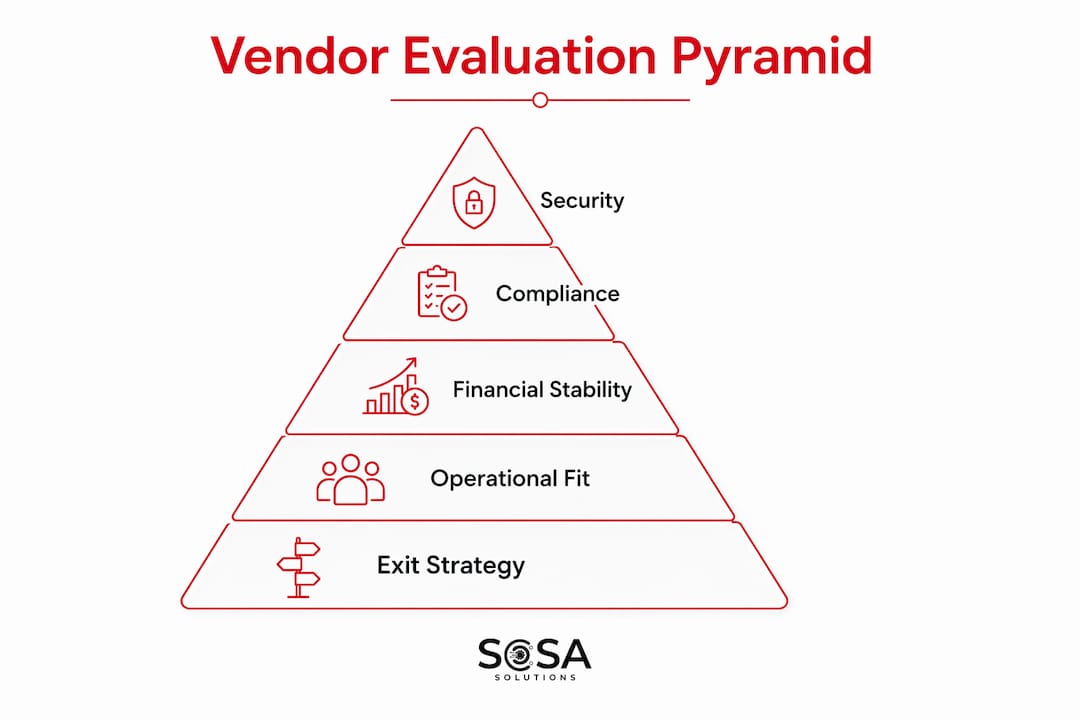
Financial stability: vendor viability, ownership structure, insurance coverage
Data protection: how the vendor handles, stores, and deletes customer and transaction data
Subcontractor management: whether the vendor’s own suppliers introduce additional risk
The distinction between a basic vendor evaluation and a risk-focused assessment is worth stating plainly. Evaluation compares vendors on capability and cost. Assessment asks whether a vendor is safe to trust with your data, your systems, and your customers. Most retail IT teams do the first. The ones that avoid costly incidents do both.
Why retail IT vendor assessments matter more than you think
Retail environments carry a specific combination of risks that makes third-party vendor management especially consequential. You’re handling payment card data, customer personally identifiable information, and real-time inventory systems, often across dozens or hundreds of store locations. A single vendor with inadequate security controls can expose every one of those touchpoints simultaneously.
The business objectives a formal vendor assessment achieves include:
Identifying security vulnerabilities in vendor systems before they reach your network
Confirming that vendors meet PCI DSS, SOC 2, and applicable state privacy requirements
Assessing whether a vendor can maintain operations during peak retail periods like the holiday season
Supporting business continuity planning by understanding vendor dependencies
Creating documented evidence of due diligence for auditors and regulators
Building a governance structure for ongoing vendor performance and risk monitoring
Poor vendor risk management in retail has a predictable pattern. A vendor gets approved based on a sales demo and a price negotiation. Nobody asks for a SOC 2 report. Nobody checks whether the vendor’s subcontractors have access to cardholder data. Then a breach happens, and the retailer discovers they have no contractual right to audit the vendor and no clear path to migrate their data. The vendor management lifecycle exists precisely to prevent that sequence.
Key criteria and frameworks for evaluating retail IT vendors

The criteria you score vendors against should reflect what they actually touch in your environment. A payment processing vendor warrants heavier security and compliance weighting than a marketing analytics tool. Weighted scoring matrices — where you score vendors on a 1–5 or 0–10 scale across criteria, then multiply by a weight reflecting operational criticality — are the standard method for making those distinctions explicit and defensible.
Evaluation criterion | CIS Controls alignment | ISO/IEC 27002 alignment |
Security posture and controls | CIS Controls 1–6 (asset and access management) | Clauses 5.19 through 5.22 (supplier relationships) |
Incident response capability | CIS Control 17 (incident response) | Clause 5.22 (incident notification process) |
Data protection practices | CIS Control 3 (data protection) | — |
Compliance certifications | CIS Control 4 (service provider management) | Clause 5.19 (supplier relationships) |
Subcontractor oversight | CIS Control 4 | Clause 5.19 through 5.22 (supplier relationships) |
Business continuity | CIS Control 17 (incident response plan) | — |
The CIS Controls framework gives retail IT teams a prioritized, actionable set of cybersecurity practices to evaluate against. ISO/IEC 27002 provides a broader information security management structure, covering supplier relationships explicitly in its clause 5.19 through 5.22 series. Neither framework is a questionnaire you hand to vendors. They are the architecture you use to design your questions and decide what evidence you need.
SOC 2 reports are the most commonly requested evidence in retail IT assessments, but they require careful interpretation. Verifying SOC 2 scope is critical: the report must cover the specific services and data centers relevant to your operations, not just the vendor’s corporate headquarters. A SOC 2 Type II report covering a vendor’s main office tells you almost nothing about the security of the cloud environment processing your transactions.
What types of vendor assessments does a retail IT team actually run?
The four-stage vendor management lifecycle structures how assessments evolve from initial selection through ongoing governance:
Initial risk categorization: Classify the vendor by data sensitivity and operational impact before investing assessment resources.
Due diligence: Collect and review documentation including SOC 2 reports, penetration test results, insurance certificates, and financial statements.
Risk mitigation: Negotiate contract terms, security addenda, and remediation timelines for identified gaps.
Continuous monitoring: Re-assess periodically and whenever the vendor’s risk profile changes, such as when they expand access to new data or experience a security incident.
The distinction between onboarding assessments and continuous assessment is practical, not just conceptual. Onboarding assessments are thorough and time-intensive. Continuous assessments are lighter, triggered by events: a vendor acquires a new subcontractor, your contract renews, or a public breach affects a vendor in the same technology category. Documentation you should collect at each stage includes:
SOC 2 Type I or Type II reports (with scope verification)
PCI DSS Attestation of Compliance for payment-adjacent vendors
Penetration testing results from the past 12 months
Business continuity and disaster recovery plans
Subcontractor lists and their security certifications
Incident response procedures and notification timelines
How to conduct a retail IT vendor assessment effectively
Start by defining scope and risk criticality before you send a single questionnaire. Tiered classification based on data sensitivity and operational impact, such as separating Tier 1 vendors with direct access to payment systems from Tier 2 vendors with limited data exposure, lets you allocate assessment depth proportionally. A Tier 1 vendor warrants a full security review, financial analysis, and on-site or virtual audit. A Tier 2 vendor may need only a security questionnaire and compliance certificate review.
The step-by-step process for a retail IT vendor assessment:
Define the vendor’s role, data access, and operational dependencies
Assign a risk tier based on sensitivity and impact
Select evaluation criteria and weights appropriate to that tier
Send a structured security questionnaire aligned to CIS Controls or ISO/IEC 27002
Collect and verify documentary evidence (SOC 2 reports, certifications, financials)
Score responses using a weighted matrix to produce a comparable risk rating
Identify gaps and negotiate remediation or contract protections
Document findings, decisions, and any accepted residual risks
Schedule the next review date based on risk tier
Pro Tip: Never rely solely on questionnaire responses. Static questionnaires give you a snapshot of what a vendor claims. Proof of Concept trials that simulate peak retail conditions, such as Black Friday transaction volumes, reveal whether vendor support and system performance actually hold up under stress. Combine both methods for a complete picture.
Automated vendor risk platforms can accelerate data collection and flag obvious gaps, but they cannot replace conversations with your own operational and financial teams about what a vendor failure would actually cost. A platform might score a vendor’s security posture as acceptable while your store operations team knows that vendor’s support response times are already causing problems during peak hours.

Exit strategies deserve explicit attention during every assessment. Failing to negotiate clear data portability rights and exit procedures before signing a contract is one of the most common and costly mistakes in retail IT vendor management. By the time you want to leave a vendor, you have no leverage. Build the exit terms in while you still do.
How CIS Controls and ISO 27002 work in real retail assessments
The CIS Controls framework was designed to translate cybersecurity best practices into prioritized, measurable actions. For retail IT vendor assessments, it provides a concrete checklist: does the vendor maintain an accurate inventory of authorized devices (Control 1)? Do they enforce multi-factor authentication for privileged access (Control 6)? Can they demonstrate a tested incident response plan (Control 17)? A global retailer documented exactly this approach in a CIS Controls case study, using the framework to build a repeatable vendor assessment program that could be applied consistently across hundreds of technology partners.
ISO/IEC 27002 operates at a higher level of abstraction, providing principles and guidance rather than a prescriptive checklist. Its supplier relationship clauses (5.19 through 5.22) directly address how organizations should define security requirements for vendors, monitor vendor compliance, and manage changes in vendor services. Retailers using ISO/IEC 27002 as their assessment backbone typically translate its clauses into specific evidence requests: a vendor’s information security policy, their supplier management procedure, and their incident notification process.
The practical outcome of deploying these frameworks is consistency. Without a framework, different team members assess vendors differently, and comparison across vendors becomes subjective. With a framework, every vendor answers the same questions, evidence is collected against the same standards, and scoring reflects the same criteria. That consistency also matters when regulators or auditors ask how you selected and approved your technology partners.
Common challenges and pitfalls in retail IT vendor assessments
The most frequent failure is treating vendor assessment as a one-time checkbox rather than an ongoing process. A vendor that passes your initial assessment can acquire a poorly secured subcontractor six months later, expand into new data processing activities, or suffer a breach that changes their risk profile entirely. Assessments that never get repeated leave retailers exposed to risks that emerged after the contract was signed.
Questionnaire fatigue is a real operational problem. Large retailers managing dozens or hundreds of vendors can find themselves drowning in questionnaire responses that nobody has time to review properly. The fix is tiering: reserve detailed questionnaires for high-risk vendors and use lighter-touch monitoring for lower-risk ones. Applying the same depth of scrutiny to every vendor wastes resources and produces worse outcomes than a tiered approach.
Scope errors in SOC 2 reviews catch retail IT teams off guard more often than they should. A vendor presents a clean SOC 2 Type II report, and the team approves them without checking whether the report covers the specific environment processing the retailer’s data. If the report covers only the vendor’s primary data center and your data lives in a secondary facility or a subcontracted cloud environment, the report provides no assurance about the actual risk.
Neglecting financial stability as an assessment criterion creates a different category of risk. A vendor with excellent security controls but deteriorating finances can disappear mid-contract, taking your data and your operational continuity with them. Financial review, including checking for recent ownership changes, outstanding litigation, and insurance coverage, belongs in every Tier 1 assessment.
Best practices for effective retail IT vendor assessment in 2026
Build your evaluation framework before you issue any RFP or vendor request. Scoring criteria developed after receiving vendor responses tend to reflect the responses rather than your actual requirements. Defining criteria first keeps the process honest and defensible.
Involve both IT and business operations teams in the assessment. IT can evaluate security controls and technical architecture. Operations can tell you whether a vendor’s support SLAs are realistic given how your stores actually run. Finance can assess vendor stability. Assessments conducted only within IT miss the business context that determines whether a risk is actually acceptable.
For retail IT partnership analysis, document every decision, including risks you accept. Regulators and auditors are not looking for perfect vendors. They are looking for evidence that you understood the risks and made deliberate, documented decisions about them. An undocumented risk acceptance is a liability. A documented one with a rationale and a review date is defensible governance.
Treat vendor assessment as a living program, not a project. Assign ownership, set review schedules tied to risk tiers, and build triggers for out-of-cycle reviews. A vendor monitoring program that flags changes in vendor security posture, financial health, or compliance status gives you the early warning you need to act before a problem becomes a crisis.
Pro Tip: When reviewing a liquidation supplier comparison checklist or any vendor shortlist, confirm that your scoring criteria are weighted before you see vendor responses. Post-hoc weighting almost always favors the vendor that presented best, not the one that poses the least risk.
Tools and technologies that support vendor assessment
Vendor risk management platforms automate the collection and scoring of security questionnaires, track evidence expiration dates, and aggregate risk signals from external sources like breach databases and financial filings. They are most valuable for retailers managing large vendor populations where manual tracking becomes unworkable.
Security questionnaire standards like the Standardized Information Gathering (SIG) questionnaire from Shared Assessments provide a common language between retailers and vendors, reducing the back-and-forth of custom questionnaire development. Many enterprise retailers use SIG as a baseline and add retail-specific questions covering PCI DSS controls and point-of-sale security.
For retail IT asset management, integration between vendor risk platforms and your IT asset inventory helps map which vendors have access to which systems, making risk tiering more accurate and keeping the vendor registry current as your technology environment changes.
Governance, risk, and compliance (GRC) platforms like ServiceNow GRC or OneTrust connect vendor assessment workflows to broader risk registers, contract management systems, and audit trails. For retailers with mature IT governance programs, this integration means vendor risks appear alongside operational and financial risks in a single view, rather than living in a separate spreadsheet.
Compliance and regulatory requirements specific to retail IT vendors
PCI DSS is the non-negotiable baseline for any vendor that touches payment card data. Under PCI DSS 4.0.1, retailers are responsible for ensuring that their service providers maintain compliance, which means your vendor assessment must verify current Attestation of Compliance documents and confirm the scope covers the services you use. Vendors who process, store, or transmit cardholder data on your behalf are subject to the same PCI DSS requirements as you are, and your assessment needs to confirm they meet them.
State privacy laws add another layer. California’s CCPA, Virginia’s CDPA, and similar laws in other states require retailers to have data processing agreements with vendors who handle consumer personal information. Your assessment process should confirm that these agreements exist, that they reflect the vendor’s actual data handling practices, and that the vendor can support your obligations to respond to consumer data requests.
NIST SP 800-161, the supply chain risk management framework from the National Institute of Standards and Technology, provides federal-level guidance on managing cybersecurity risks in technology supply chains. While it was developed for federal agencies, its risk identification and mitigation practices translate directly to retail IT vendor assessment programs, particularly for retailers that supply government agencies or operate in regulated sectors.
For retailers in New York, the NY SHIELD Act imposes data security requirements that extend to third-party vendors handling New York residents’ private information. Vendor assessments for any technology partner processing that data must confirm the vendor maintains reasonable security practices as defined under the Act. Florida’s Information Protection Act carries similar obligations for vendors handling Florida consumer data, which is directly relevant to retailers operating in both markets that Sosasolutionsnyc serves.
Key Takeaways
A retail IT vendor assessment is a structured, repeatable process that evaluates technology partners on security, compliance, operational resilience, and financial stability to protect retail operations from third-party risk.
Point | Details |
Risk-focused, not feature-focused | Vendor assessment evaluates security, compliance, and operational risk, not just capability and price. |
Four-stage lifecycle | Effective programs follow risk categorization, due diligence, risk mitigation, and continuous monitoring. |
Framework-driven criteria | CIS Controls and ISO/IEC 27002 provide the structure for consistent, defensible assessment criteria. |
SOC 2 scope verification | Always confirm a SOC 2 report covers the specific services and data centers relevant to your operations. |
Ongoing, not one-time | Re-assess vendors when their risk profile changes, not only at contract signing or annual renewal. |
Ready to assess your retail IT vendors with confidence?
Sosasolutionsnyc works with retail businesses across New York and Florida to build vendor assessment programs that actually protect store operations. Whether you’re opening a new location or auditing your existing technology partners, the team at Sosasolutionsnyc brings the retail-specific IT expertise to make the process practical and repeatable.
Store opening IT solutions in New York and Florida include vendor vetting, infrastructure readiness, and compliance verification from day one. For retailers already operating, retail IT support services cover ongoing vendor monitoring, risk reviews, and the technical oversight your team needs to stay ahead of third-party risk.
Recommended
Comments