Change Management in Retail: A 2026 Guide for Leaders
- Sosa Solutions NYC
- Jul 22
- 10 min read

Change management in retail is the structured, execution-focused approach to transitioning people, processes, and systems through transformation so that new strategies actually deliver results. Up to 70% of retail change initiatives fail primarily because organizations underinvest in capability building rather than technology. Structured change management makes programs six times more likely to meet their objectives compared to ad hoc approaches.
The ADKAR model (Awareness, Desire, Knowledge, Ability, and Reinforcement) is the most widely applied framework in retail change management. It works because it forces the human transition to keep pace with the technical one, rather than letting the technology sprint ahead while people scramble to catch up.
Three things define effective retail change management:
People first: Technology is the trigger, but adoption is the goal. Frontline employees, store managers, and corporate teams all need different support.
Execution discipline: Change management in retail is not a communications exercise. It is a structured, measurable operational process.
Sustained reinforcement: Without feedback loops and post-launch support, employees revert to old habits within weeks.
What kinds of transformations trigger retail change management?
Retail organizations face a wider variety of change scenarios than most industries, and each one carries its own adoption risks. The most common triggers include:
ERP implementations: Replacing or upgrading enterprise resource planning systems touches inventory, finance, and store operations simultaneously, affecting nearly every role.
Unified commerce shifts: Merging e-commerce and point-of-sale systems into a single platform requires retraining staff across both digital and physical channels.
Loyalty program rollouts: New customer loyalty platforms change how frontline associates interact with shoppers at checkout and throughout the store.
E-commerce replatforming: Moving to a new digital commerce platform disrupts fulfillment workflows, content management, and customer data processes.
Supply chain adaptations: Shifts in vendor management, automated replenishment, or warehouse systems ripple through store-level receiving and inventory practices.
Store opening procedures: Launching new locations requires standing up IT infrastructure, training staff on systems, and aligning operations before day one.
AI and automation adoption: Introducing agentic systems or automated forecasting tools creates cultural friction, particularly among employees who view automation with apprehension.
Each scenario affects frontline employees and corporate teams differently. A loyalty platform rollout may feel minor to a headquarters analyst but completely changes a cashier’s daily workflow. That gap between HQ design and floor-level reality is where most retail change initiatives break down.
Why is change management so difficult in retail environments?
Retail is structurally harder to change than almost any other industry. The reasons are specific and worth naming plainly.
Decentralized operations mean that a decision made at headquarters must be executed across dozens, hundreds, or thousands of physical locations. There is no single room where you can gather everyone and explain the new process. Each store has its own culture, its own informal leaders, and its own interpretation of corporate directives.
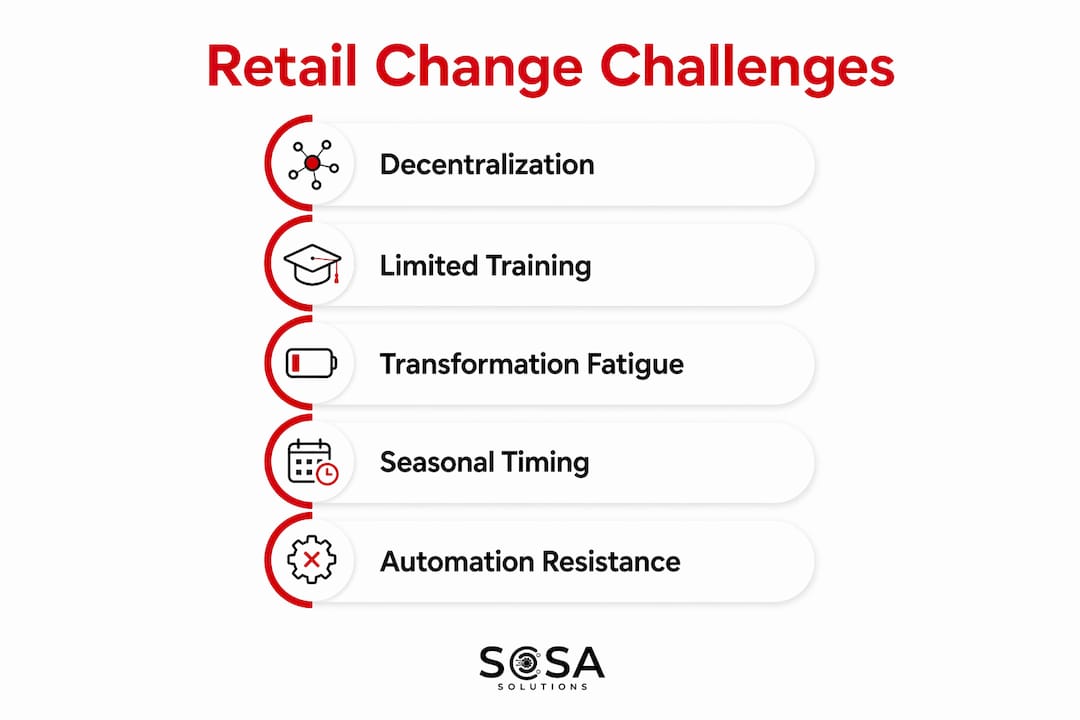
Limited training windows are a constant constraint. Frontline employees work in shifts, often part-time, with no dedicated time for learning. A two-hour training session that works fine for a corporate team is logistically impossible for a store associate who starts at 6 AM and is on the floor by 6:15.
Transformation fatigue builds quickly in retail. When employees experience a new system rollout every six to twelve months, each new initiative carries the weight of every previous one that was poorly executed or quietly abandoned. Skepticism is not irrational. It is earned.
Seasonal constraints make timing critical. Launching a major system change in october or november, heading into the holiday peak, is a reliable way to guarantee low adoption and high frustration. The same initiative that would succeed in february can collapse in december.
Cultural resistance to automation is growing. As AI tools become more common in retail operations, employees increasingly worry about job displacement. Change management must address that fear directly, not sidestep it.
Pro Tip: Map your change timeline against your retail calendar before anything else. If your go-live date lands within eight weeks of a peak season, push it. The cost of a delayed launch is almost always lower than the cost of a failed one.
Five core pillars for making retail change initiatives stick
Retail change management succeeds when it involves multiple specific pillars beyond just a communications plan.
Leadership engagement: Store managers and field leaders must visibly champion the change, not just relay corporate messaging. When a store manager says “I believe in this,” adoption rates climb. When they say nothing, employees assume the initiative will fade.
Clear, role-specific communication: Generic announcements do not move people. A warehouse associate needs to know how the new system changes their receiving process. A cashier needs to know what happens at checkout. Communication must be translated into daily workflow terms for each role.
Role-based training: Training designed for a store manager is not the same as training for a stock associate. Identifying change champions on the floor, employees who learn quickly and influence peers, accelerates adoption far beyond what top-down training alone can achieve.
Capability building: The goal is not awareness of the new system. The goal is demonstrated ability to use it correctly under real operating conditions. That requires coaching, practice, and time.
Sustained reinforcement: Post-launch feedback loops are what separate successful transformations from ones that quietly revert to the old way within 90 days.
Pro Tip: Measure adoption by behavior, not by training completion. A 95% training completion rate means nothing if associates are still using the old process on the floor. Observe actual behavior at the point of execution.
The ADKAR model structures these pillars into a sequence. Awareness comes first (why is this changing?), then Desire (what is in it for me?), then Knowledge (how do I do it?), then Ability (can I actually do it?), and finally Reinforcement (what keeps me doing it?). Skipping any step produces predictable failure at the next one.
Pillar | Primary Metric | Common Failure Point |
Leadership engagement | Manager participation rate | Leaders relay, not champion |
Role-specific communication | Message comprehension by role | One-size-fits-all messaging |
Change champions | Floor adoption rate | Champions not identified or supported |
Capability building | Demonstrated proficiency | Training ends at go-live |
Sustained reinforcement | 90-day adoption retention | No post-launch support structure |
How retail leaders actually drive change on the ground
Leadership in retail change management is not about sending the right email. It is about showing up on the floor, asking the right questions, and making it safe for employees to admit they are struggling with the new process.
Store managers carry the heaviest load. They are responsible for running daily operations while simultaneously absorbing a transformation that was designed, in many cases, without their direct input. Retail change fails when it is designed in a headquarters vacuum without accounting for frontline workflows. The most effective leaders close that gap by translating corporate goals into store-level language and advocating upward when the rollout timeline is unrealistic.

Field leaders and district managers play a connective role. They see patterns across multiple locations and can identify which stores are struggling and why. That intelligence, fed back to the project team, allows rapid course correction before a localized problem becomes a systemic one.
Leadership actions that directly reduce resistance include:
Participating visibly in training, not just sponsoring it
Holding brief, regular check-ins with store teams during the transition period
Acknowledging when a rollout is harder than expected, rather than projecting false confidence
Removing operational barriers that make the new process harder than the old one
Recognizing and rewarding early adopters publicly
Empathy is not soft leadership. A manager who understands that a cashier’s anxiety about a new POS system is real, not dramatic, will get better adoption than one who treats resistance as a compliance problem.
What frameworks and dimensions shape retail change success in 2026?
The ADKAR model remains the most practical framework for retail because it is sequential and measurable. Each stage produces a specific outcome, and a failure at any stage points directly to the intervention needed.
Structured change management makes retail transformation programs six times more likely to succeed than ad hoc approaches, yet the majority of organizations still treat it as a communications add-on rather than an execution discipline.
Four dimensions determine whether a retail change program delivers lasting results:
Readiness: Have leaders, managers, and frontline staff been assessed for their capacity to absorb this change at this time? Readiness is not assumed. It is measured.
Role-based impact: Every role affected by the change needs a specific impact assessment. What changes for a store associate is different from what changes for a supply chain planner.
Adoption: Are people actually using the new system or process in their daily work? Adoption is observed, not self-reported.
Reinforcement: What mechanisms exist to sustain the new behavior after go-live? Without reinforcement, reversion is the default.
Unified digital platforms with a single source of truth reduce the errors that come from manual workflows and fragmented systems during transitions. A centralized IT management approach gives distributed retail teams the infrastructure consistency they need to absorb change without compounding technical disruptions.
Pro Tip: Treat your change management program as an execution discipline with its own project plan, milestones, and accountable owners. A change plan that lives inside a PowerPoint deck and has no owner is not a plan.
How employee engagement and communication drive retail adoption
Communication is the most consistently underestimated element of retail change management. Not because leaders do not communicate, but because they communicate the wrong things to the wrong people at the wrong time.
Frontline employees need to know three things: why the change is happening, what specifically changes about their job, and where to go when something goes wrong. Corporate announcements that explain the business rationale but skip the workflow specifics leave store associates with anxiety and no direction. The retail IT support structure behind a rollout needs to be visible and accessible from day one.
Employee engagement during change is not about enthusiasm. It is about involvement. When associates are asked for input during the design phase, when their feedback is visibly acted on, and when informal floor leaders are given a formal role in the rollout, adoption accelerates. Peer validation carries more weight on the retail floor than any corporate video. A trusted colleague saying “this actually works” moves people faster than a headquarters directive.
Feedback mechanisms matter as much as initial communication. Weekly pulse checks, open-door sessions with store managers, and a clear escalation path for problems all signal that the organization is listening, not just broadcasting.
How do you measure whether retail change management is working?
Activity metrics are the wrong measurement. Training sessions delivered, emails sent, and kickoff meetings held tell you what happened, not whether it worked.
The right indicators are behavioral and operational. Adoption rate measures the percentage of employees using the new system or process correctly in their daily work. Proficiency rate measures whether they are using it well, not just using it. Time to full adoption tracks how long it takes from go-live to consistent, correct usage across all affected locations. Business impact metrics, such as inventory accuracy, transaction speed, or customer satisfaction scores, connect the change initiative to the outcomes that justified it.
Resistance signals are equally measurable. Workaround behaviors, where employees use the old process alongside or instead of the new one, are the clearest indicator that adoption has stalled. Error rates in the new system often spike immediately post-launch and should decline steadily over 30–90 days. If they do not, the training or the system design needs adjustment.
A structured retail IT project management approach builds these measurement checkpoints into the project plan rather than treating evaluation as an afterthought.
What retail change management successes and failures actually look like
The pattern in successful retail transformations is consistent: the organization invested in people readiness before go-live, identified floor-level champions early, and maintained active support for at least 90 days post-launch. The technology was rarely the differentiating factor.
A loyalty platform rollout that succeeds typically involves store managers who were trained weeks before their teams, a small group of associate champions who piloted the system and could answer peer questions, and a help desk that was staffed and responsive from day one. The associates who struggled got individual coaching, not a second group training session.
Failed retail change initiatives share a different pattern. The project team focused on the technical implementation timeline and treated the training as a checkbox. Store managers received the same materials as their associates, with no additional context or preparation time. Go-live happened on schedule, adoption was assumed, and within 60 days the new system was being used inconsistently across locations. The common IT failures in retail that compound these situations, from system instability to inadequate support coverage, accelerate the reversion to old behaviors.
The most instructive failures involve changes designed entirely at headquarters without input from store operations. When the new process does not account for the physical layout of a store, the pace of a busy shift, or the skill level of a part-time associate, it fails on the floor regardless of how well it tested in a conference room.
How to overcome resistance to change from retail employees and customers
Resistance in retail is almost always rational. Employees resist when they do not understand why the change is happening, when the new process is harder than the old one, or when they have been burned by previous rollouts that were abandoned. Customers resist when a change disrupts a familiar experience without an obvious benefit.
The most effective approaches to reducing resistance are specific:
Explain the “why” in terms that matter to the person hearing it. A cashier does not care about the business case for unified commerce. They care about whether the new checkout process will make their shift harder or easier.
Involve resistors early. The employee who is most vocal about why the new system will not work is often the most influential person on the floor. Bring them into the pilot. Their conversion carries more weight than any manager’s endorsement.
Make the new way easier than the old way. If the new process requires more steps than the one it replaces, resistance is not a change management problem. It is a design problem. Fix the process before scaling the rollout.
Address customer-facing changes with transparency. When a loyalty program changes or a checkout process shifts, customers who understand why are far more forgiving than those who encounter the change without warning.
Sustain support past go-live. Most resistance peaks in the first two to four weeks after launch. Organizations that pull back support at go-live lose the window when intervention is most effective.
Sosasolutionsnyc works with retail businesses in New York and Florida to ensure the IT infrastructure behind change initiatives is ready before the people side begins. A loyalty platform rollout that crashes on day one because the network was not provisioned correctly sets back adoption by weeks. Getting the technical foundation right is what makes the human transition possible.
If you are planning a store opening, a system rollout, or a technology upgrade, store opening IT solutions from Sosasolutionsnyc give your team the infrastructure readiness to execute change without the technical disruptions that derail adoption.
Key Takeaways
Retail change management succeeds when organizations treat it as an execution discipline, not a communications program, and invest in people readiness before, during, and after go-live.
Point | Details |
Failure rate is high | Up to 70% of retail change initiatives fail primarily due to insufficient capability building, not technology. |
Structured approach multiplies success | Structured change management makes programs six times more likely to meet their objectives than ad hoc transitions. |
ADKAR drives adoption | The ADKAR model aligns human transitions to technical pace through Awareness, Desire, Knowledge, Ability, and Reinforcement. |
Champions accelerate buy-in | Identifying change champions on the floor drives peer-level adoption faster than top-down directives alone. |
Reinforcement prevents reversion | Post-launch feedback loops sustain adoption and prevent employees from reverting to old behaviors within 90 days. |
Recommended
Comments