What Is an IT Service Agreement? A Business Guide
- Sosa Solutions NYC
- Jul 15
- 8 min read

An IT service agreement is a legally binding contract that defines the scope of services, payment terms, data protection responsibilities, and dispute resolution procedures between a business and its IT provider. Business owners often search for “what is it service agreement” when they realize a handshake deal with their IT vendor left them exposed after a system failure or billing dispute. The industry standard term is “IT services agreement,” and it functions as the master contract governing the entire relationship. Getting this document right from the start protects your operations, your data, and your budget.
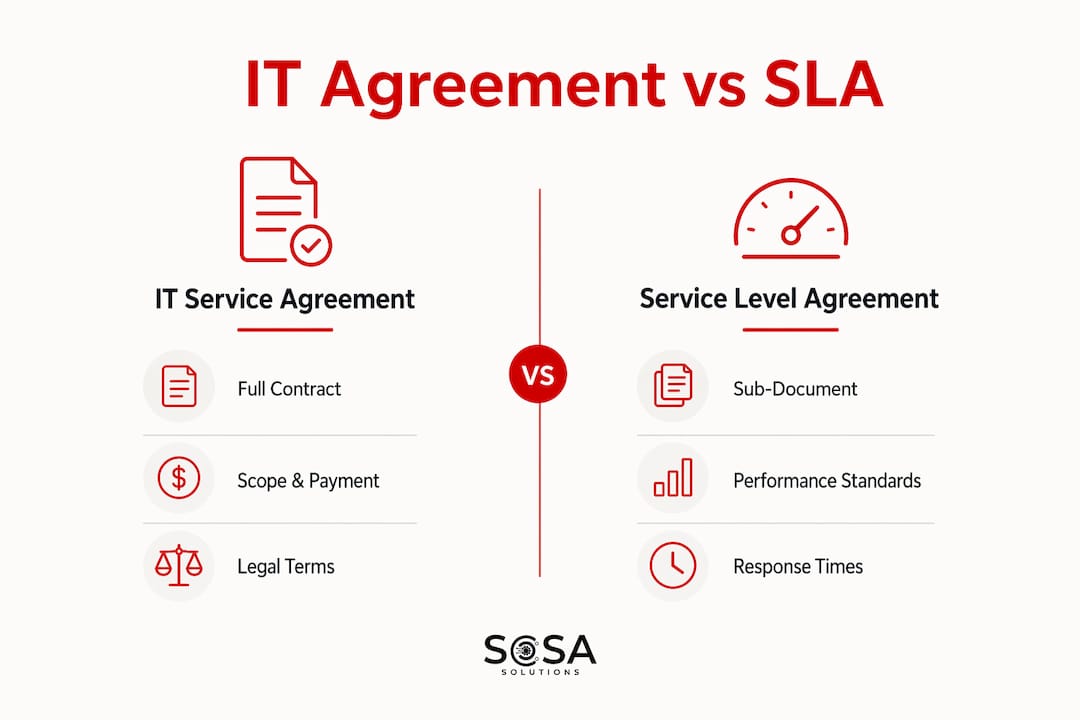
What is an IT service agreement and how does it differ from an SLA?
An IT services agreement is a legally binding contract that defines scope, payment terms, data protection, intellectual property, and dispute resolution between a business and IT provider. Think of it as the rulebook for the entire relationship. Every obligation, right, and remedy lives in this document.
A Service Level Agreement, or SLA, is a sub-document that sits inside the master IT service contract. The SLA specifies measurable performance standards: uptime guarantees, response times, and resolution targets. The IT service agreement sets the relationship; the SLA measures how well the provider performs within it.

Business owners frequently confuse SLAs with the full IT support agreement. The distinction matters legally. SLAs without clear incorporation in a master agreement may be treated as operational guidelines rather than enforceable contracts. That means your provider could miss a 99.9% uptime target with no legal consequence if the SLA was never formally tied to the master contract.
There is also a layer of terminology below the SLA that trips up managers. A Service Level Objective (SLO) is an internal target your provider sets for itself. A Service Level Indicator (SLI) is the actual metric used to measure performance, such as the percentage of tickets resolved within four hours. Understanding these distinctions enables more effective vendor performance management.
Core components of an IT service contract
Scope of work: Exactly which systems, locations, and tasks the provider covers
Payment terms: Rates, billing cycles, and conditions for price adjustments
Data security: Who owns data, how it is stored, and breach notification timelines
Intellectual property: Who owns custom code, configurations, or tools built during the engagement
Termination clauses: Notice periods, grounds for early exit, and transition assistance
Dispute resolution: Whether disputes go to mediation, arbitration, or litigation
Element | IT Service Agreement | Service Level Agreement |
Purpose | Governs the full relationship | Defines performance standards |
Legal standing | Master contract | Sub-document or exhibit |
Content | Scope, payment, IP, termination | Uptime, response time, SLOs, SLIs |
Enforceability | Independently binding | Binding only when incorporated into master |
Review frequency | At contract renewal or major change | Annually or when business scales |
When and why does your business need an IT service agreement?
Businesses need IT service agreements for two primary scenarios: ongoing managed IT services and project-based engagements like cloud migrations or infrastructure upgrades. Without a written contract, scope creep becomes almost inevitable. A provider who agreed to “handle your network” may interpret that as monitoring only, while you assumed it included hardware replacement.
The risks of operating without a formal IT support agreement go beyond billing surprises. Compliance failures are a real exposure. If your provider mishandles customer data and no contract specifies their security obligations, your business may bear the regulatory liability. Modern data protection regulations require documented accountability, and a well-drafted agreement creates that paper trail.
The benefits of IT service agreements for SMBs are especially pronounced for retail businesses, where point-of-sale downtime directly translates to lost revenue. A clear IT service contract specifies exactly how fast your provider must respond to a register outage and what compensation applies if they miss that target.
Common scenarios that require a formal agreement:
Signing up for managed IT services covering your entire office or store network
Hiring a provider to migrate your data to a cloud platform
Engaging a vendor for a new store opening with system setup and infrastructure readiness
Contracting remote helpdesk support for staff across multiple locations
Outsourcing cybersecurity monitoring and incident response
Pro Tip: Before signing any IT service contract, ask the provider to walk you through their escalation process for a critical outage. If they cannot describe it clearly, that gap will show up in your agreement and in your operations.
How to create an IT service agreement that holds up
Getting IT service agreements right from the start is more cost-effective than litigating failures later. The drafting phase is where most businesses make mistakes that cost them years down the road.
Clarity in scope is the single most important drafting principle. Vague language like “general IT support” or “high availability” creates disputes because each party defines those terms differently. Ambiguity is the main source of tension in IT partnerships. A well-drafted agreement defines every term that could be interpreted two ways.
Security and data handling clauses are no longer optional. Modern regulatory demands, including state-level data privacy laws and federal sector-specific rules, require businesses to document how their vendors handle sensitive information. Your IT service agreement must name the specific security standards the provider follows, such as SOC 2 or NIST frameworks, and specify breach notification timelines.
Common drafting pitfalls to avoid:
Leaving the SLA as a separate, unsigned document: Always formally incorporate the SLA into the master agreement with explicit reference language.
Omitting exit strategy clauses: Exit strategy clauses, including termination rights and transition assistance, protect your business from operational paralysis when changing providers.
Ignoring post-termination confidentiality: Your provider will have access to sensitive systems. Specify what happens to that access and data after the contract ends.
Using undefined performance language: Replace “prompt response” with “response within two business hours for Priority 1 issues.”
Skipping dispute resolution procedures: Define whether disputes go to mediation first, which jurisdiction applies, and who pays legal fees.
Pro Tip: Review your IT service agreement every time your business adds a location, changes its software stack, or hires more than 10 additional staff. The contract that fit your operation at 20 employees may leave you exposed at 75.
For retail-specific guidance, the IT support contracts for retail stores guide covers how to tailor these agreements for point-of-sale environments and multi-location operations.
How to manage and update IT service agreements over time
An IT service agreement is not a file-and-forget document. Business needs change, technology changes, and a contract written two years ago may no longer reflect your actual operations. Treating the agreement as a living document is the difference between a contract that protects you and one that creates liability.
Follow these steps to keep your agreements current:
Schedule an annual review. SLAs should be revisited at least annually or when business needs scale to ensure metrics stay aligned with operations rather than outdated goals. Put the review date in your calendar the day you sign.
Separate operational guidelines from contract terms. Your provider may issue runbooks, escalation matrices, or support playbooks. These are useful, but they are not legally binding unless formally incorporated into the master agreement.
Document every amendment in writing. Verbal agreements to change scope or pricing are unenforceable. Any modification to the IT service contract must be signed by both parties.
Trigger a review after major business events. Opening a new store, switching to a cloud-based POS system, or acquiring another business all change your IT footprint. Each event warrants a contract review.
Benchmark SLA metrics against current industry standards. A 99% uptime guarantee was acceptable five years ago. Many providers now offer 99.9% or higher. If your SLA has not kept pace, renegotiate.
Coordinate with your IT provider proactively. Do not wait for a failure to surface a gap. Schedule quarterly check-ins to discuss whether the agreement still reflects your actual service needs.
For businesses running retail operations in New York or Florida, retail IT troubleshooting best practices offers a practical framework for identifying gaps between what your agreement promises and what your operations actually require.
Key Takeaways
A strong IT service agreement defines every obligation, performance standard, and exit right in writing before work begins, making it the single most effective tool for preventing IT disputes and protecting business continuity.
Point | Details |
Agreement vs. SLA | The IT service agreement is the master contract; the SLA is a sub-document measuring performance within it. |
Legal incorporation matters | An SLA not formally tied to the master contract may be unenforceable, leaving you without legal recourse. |
Clarity prevents disputes | Define every ambiguous term, including response times and uptime, with specific, measurable language. |
Exit clauses protect operations | Termination and transition assistance clauses prevent operational paralysis when switching providers. |
Annual reviews are required | Revisit SLA metrics every year or after major business changes to keep the contract aligned with reality. |
Why I think most businesses sign IT agreements too fast
Business owners treat the IT service agreement like a formality. They skim it, sign it, and file it. Then six months later, they are in a dispute over whether “network support” includes their VoIP phones, and neither side can agree because the contract never said.
The contracts I have seen cause the most damage are not the ones with bad terms. They are the ones with no terms at all on the things that matter most: who owns the data backups, what happens during a ransomware attack, and how the provider exits the relationship if things go wrong. Those gaps feel theoretical until they are not.
The exit clause is the one I push hardest on. Most business owners focus on what the provider will do for them. Almost none ask what happens when they want to leave. Exit strategy clauses including transition assistance and post-termination confidentiality are the provisions that determine whether a provider change is a smooth handoff or a six-month operational crisis.
My advice: treat the IT service contract negotiation as a test of the relationship. A provider who resists clear, measurable SLA language or pushes back on exit terms is telling you something important about how they will behave when things go wrong.
— Christopher
How Sosasolutionsnyc supports your IT service agreements
Sosasolutionsnyc works with small and medium-sized businesses across New York and Florida to build IT relationships that start with clear, well-structured agreements. The team understands what retail and office environments actually need from an IT provider, and that knowledge shows up in how they structure service terms, response commitments, and support coverage.

Whether you are opening a new store and need infrastructure readiness from day one, or you are reviewing an existing IT support agreement that no longer fits your operation, Sosasolutionsnyc brings the operational experience to fill those gaps. Their managed IT services cover ongoing support, proactive monitoring, and the kind of documented service commitments that protect your business when technology fails. If you are setting up a new location, their store opening IT solutions include the system setup and agreement structure you need from the start.
FAQ
What is an IT service agreement in simple terms?
An IT service agreement is a written contract between a business and its IT provider that defines what services will be delivered, at what cost, and under what conditions. It covers scope, payment, data security, and what happens if either party wants to end the relationship.
How is an IT service agreement different from a service level agreement?
The IT service agreement is the master contract governing the full relationship. The service level agreement is a sub-document that specifies measurable performance targets like uptime and response times, and it is only legally binding when formally incorporated into the master contract.
What should every IT service contract include?
Every IT service contract should include a defined scope of work, payment terms, data security obligations, intellectual property ownership, termination rights with transition assistance, and a formally incorporated SLA with specific, measurable performance metrics.
How often should an IT service agreement be reviewed?
SLAs should be reviewed at least annually or whenever the business scales significantly. Any major change, such as adding locations, switching software platforms, or growing headcount, warrants a full contract review and potential renegotiation.
What happens if my IT provider does not meet the SLA terms?
If the SLA is formally incorporated into the master IT service agreement, missed performance targets trigger the remedies defined in the contract, which may include service credits, financial penalties, or grounds for early termination. Without formal incorporation, the SLA may carry no legal weight.
Recommended
Comments