Technology Lifecycle Management: A Guide for IT Leaders

Technology lifecycle management (TLM) is the structured, end-to-end process of planning, procuring, deploying, maintaining, and securely retiring technology assets across your organization. The industry also calls this IT lifecycle management, and the two terms are interchangeable in practice. TLM differs from reactive IT support by treating every asset as part of a planned system with a defined beginning, middle, and end. Done well, it reduces security exposure, controls costs, and keeps your business running without unplanned disruptions. For business leaders and IT decision-makers, understanding what is technology lifecycle management is the first step toward replacing emergency spending with predictable, budgeted IT investment.
What is technology lifecycle management and its key stages?
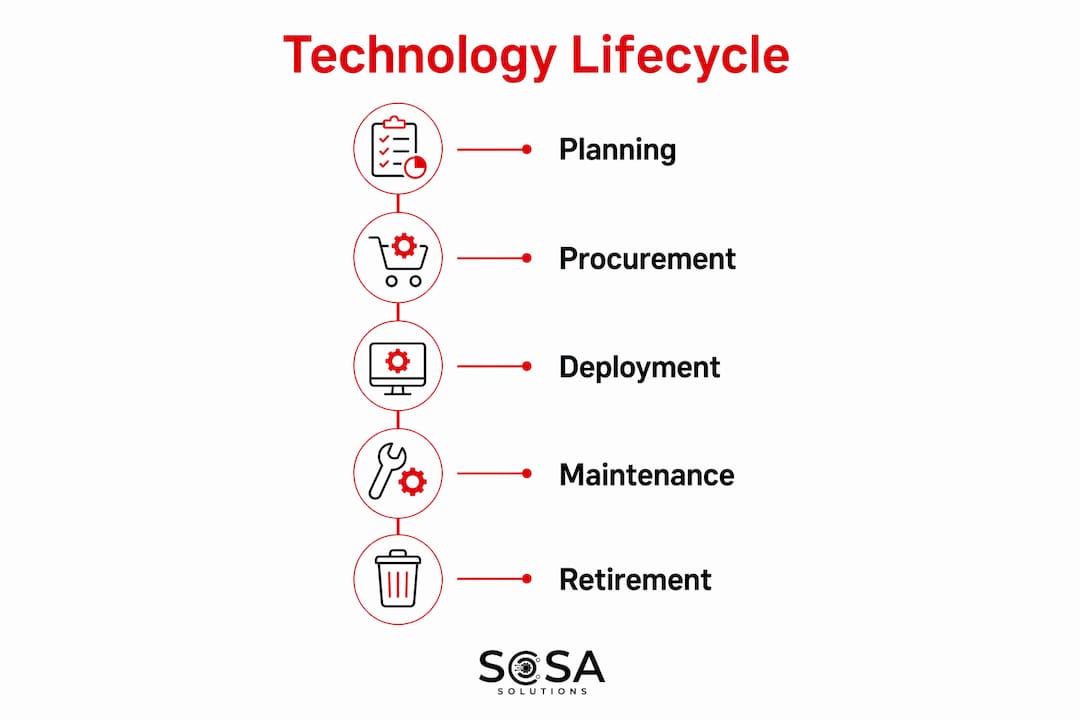
TLM covers six distinct phases, each with clear objectives and handoffs. Lifecycle phases must be continuous without gaps, meaning every asset must have clear ownership and security oversight at all times, including during transitions between stages.
Planning and budgeting. This is where TLM earns its value. IT, finance, and procurement align on what technology the business needs, when it needs it, and what it will cost. Decisions made here determine whether your organization spends proactively or reactively for the next three to five years.
Procurement and acquisition. The organization selects vendors, negotiates contracts, and purchases hardware or software licenses. Procurement decisions made without lifecycle data often result in over-purchasing, duplicate licenses, or mismatched hardware specifications.
Deployment and integration. New assets are configured, tested, and connected to existing business systems. Poor deployment practices create technical debt that compounds over the asset’s entire life. Retail businesses opening new locations, for example, face significant risk at this stage if infrastructure readiness is not validated before launch.
Active use, maintenance, and monitoring. This is the longest phase. Assets are in daily use, receiving patches, updates, and performance monitoring. Continuous monitoring during this phase catches degradation early, before it causes downtime.
Phase-out and refresh planning. As assets approach end of life, the organization plans replacements. This phase feeds directly back into planning and budgeting, creating the cycle that makes TLM predictable rather than reactive.
Decommissioning and secure disposal. Assets are wiped, retired, and disposed of in compliance with data security regulations. Skipping proper disposal creates legal liability and data breach risk. Infrastructure Technology Lifecycle Management specifically targets this phase to reduce operational risk and shrink the infrastructure footprint.
How does technology lifecycle management differ from IT asset management?
IT asset management (ITAM) and TLM are related but not the same. ITAM tracks where assets exist, while TLM adds the strategic layers of performance monitoring, budget planning, and compliant disposal. Think of ITAM as the inventory record and TLM as the operating strategy built on top of it.
ITAM answers: “What do we own, and where is it?”
TLM answers: “What do we own, when does it need to be replaced, what will that cost, and how do we retire it safely?”
ITAM is a subset of TLM, not a replacement for it.
TLM incorporates ITAM data and extends it with governance, compliance planning, and financial forecasting.
Business leaders who rely on ITAM alone get accurate inventory counts but miss the strategic picture. They cannot forecast refresh cycles, cannot plan security patch timelines, and cannot align IT spending with business growth plans. ITAM is a subset of the broader lifecycle management framework, and effective leadership understands that lifecycle management adds strategic value beyond asset tracking.
Pro Tip: If your IT team can tell you what assets you own but cannot tell you when each one needs to be replaced or what that replacement will cost, you have ITAM without TLM. That gap is where budget surprises and security incidents originate.
For retail IT leaders managing multiple locations, the distinction matters even more. A retail IT asset management approach that stops at inventory tracking leaves refresh planning, compliance, and disposal entirely unmanaged.
Why is automation critical for effective technology lifecycle management?
Manual tracking is the single biggest operational weakness in most organizations’ lifecycle programs. Spreadsheets go stale the moment someone adds a device, transfers equipment between locations, or installs new software. Manual tracking creates risks and budget forecasting challenges that compound over time.
“A complete, automated asset inventory is the foundation of successful lifecycle management. Without it, every downstream decision, from budgeting to security patching, is built on incomplete data.”
Automated tools solve this directly. Remote Monitoring and Management (RMM) platforms enable continuous lifecycle data accuracy and empower proactive technology refresh planning and risk mitigation. The practical benefits are significant:
Real-time asset discovery keeps your inventory current without manual input.
Automated patch management closes security gaps before they become incidents.
Performance monitoring flags hardware degradation before it causes downtime.
Lifecycle data feeds directly into budget forecasting, replacing guesswork with scheduled refresh cycles.
The shift from spreadsheets to automated platforms is not a technology preference. It is a risk management decision. Organizations running manual tracking cannot accurately forecast IT spend, cannot guarantee patch compliance, and cannot prove asset accountability during audits. Automated asset inventory and continuous data updates are industry best practices, not optional enhancements.
For store owners and retail IT managers, the benefits of retail IT automation extend directly into lifecycle accuracy, giving operations teams a live view of every device across every location.

Applying a systems theory approach to technology lifecycle management
A systems theory approach treats TLM as an interconnected set of components, not a linear checklist. Managing technology as interconnected components involves stakeholders, feedback loops, and governance structures that influence each other continuously. This perspective changes how organizations make decisions.
Traditional TLM View | Systems Theory TLM View |
Sequential phases with clear handoffs | Continuous feedback loops between all phases |
IT team owns the process | Cross-functional ownership across IT, finance, security, and procurement |
Asset-level decisions | System-level decisions considering interdependencies |
Reactive adjustments | Proactive governance based on feedback data |
Compliance as a final step | Compliance integrated throughout every phase |
Viewing technology lifecycle through a systems model enhances alignment with organizational strategy and improves long-term decision quality by recognizing process interdependencies. In practice, this means a hardware refresh decision is not made by IT alone. Finance models the budget impact, security evaluates the compliance implications, and procurement negotiates vendor terms simultaneously.
Enterprise architecture frameworks like TOGAF and governance models like COBIT align naturally with this systems view. Both treat technology as a business capability, not a collection of individual assets. Organizations that adopt this perspective stop asking “What hardware do we need?” and start asking “What capabilities does the business need, and what technology lifecycle plan supports them?”
Best practices for managing technology lifecycle in 2026
The most effective lifecycle programs in 2026 share one characteristic: they treat TLM as a business process, not an IT task. Cross-department collaboration among procurement, finance, security, and IT operations is the defining factor in reducing compliance risks and controlling costs.
Pro Tip: Schedule a quarterly lifecycle review with representatives from IT, finance, and security. A 90-minute meeting four times a year prevents the emergency budget requests that derail annual planning.
The practices that separate high-performing organizations from reactive ones are specific and repeatable:
Plan refresh cycles on a fixed schedule. Three to five year hardware refresh cycles are standard. Document them, budget for them, and treat them as non-negotiable capital expenses.
Integrate security into every phase. Security review at deployment, patch compliance during active use, and certified data wiping at disposal are not optional steps.
Eliminate vendor fragmentation. Integrating procurement, maintenance, support, and disposal into a single operating model reduces vendor fragmentation and improves efficiency.
Audit your licenses annually. Software license waste is one of the most common and most avoidable sources of IT budget loss.
Never leave an asset without an owner. Every device, at every stage, must have a named responsible party. Ownership gaps during transitions are where security incidents and compliance failures occur.
The goal is to shift IT spend from reactive emergency purchases to planned, budgeted expenses, minimizing license waste, security gaps, and operational disruption. Organizations that achieve this shift report more predictable IT budgets and fewer unplanned outages. For retail businesses managing store technology across New York and Florida, scheduling technology upgrades on a planned cycle is the difference between a smooth quarter and an expensive one.
Key Takeaways
Effective technology lifecycle management requires automated asset tracking, cross-department collaboration, and continuous phase oversight to shift IT spending from reactive to planned and predictable.
Point | Details |
TLM vs. ITAM | ITAM tracks assets; TLM adds strategic planning, budgeting, compliance, and disposal management. |
Six lifecycle phases | Planning, procurement, deployment, active use, phase-out, and decommissioning must be continuous with no ownership gaps. |
Automation is non-negotiable | RMM platforms replace manual spreadsheets and enable accurate forecasting and proactive risk management. |
Cross-department ownership | Finance, security, procurement, and IT must all participate for lifecycle management to reduce costs and compliance risk. |
Systems thinking improves decisions | Treating TLM as an interconnected system, not a checklist, aligns technology planning with business strategy. |
What I’ve learned from watching organizations get TLM wrong
The most common mistake I see is organizations that believe they are doing lifecycle management because they have an asset spreadsheet. They know what they own. They have no idea when it needs to be replaced, what that will cost, or who is responsible for it when it moves between departments. That is not lifecycle management. That is inventory with a false sense of security.
The second mistake is treating TLM as an IT department problem. Finance does not know the refresh schedule. Security is not involved until there is an incident. Procurement buys hardware without lifecycle data. The result is fragmented spending, compliance gaps, and IT teams constantly fighting fires they could have prevented with six months of advance notice.
What actually works is simple in concept and hard in execution: get every stakeholder in the same room, agree on a refresh schedule, automate your asset tracking, and review the data quarterly. The organizations that do this stop reacting and start planning. Their IT budgets become predictable. Their security posture improves because outdated assets get retired on schedule. Their teams spend time on growth initiatives instead of emergency repairs.
The shift from reactive to proactive is not a technology problem. It is a governance problem. Solve the governance first, and the technology follows.
— Christopher
How Sosasolutionsnyc supports your technology lifecycle needs
Sosasolutionsnyc works with small and medium-sized businesses across New York and Florida to build and maintain structured lifecycle programs that replace reactive IT spending with planned, predictable operations.

From automated asset tracking and refresh cycle planning to secure device disposal and cross-department coordination, Sosasolutionsnyc delivers managed IT services built around the full technology lifecycle. Retail businesses opening new locations benefit from infrastructure readiness planning that covers every phase from procurement through deployment. Existing operations get continuous monitoring, patch management, and budget forecasting that keeps technology aligned with business goals. If your organization is ready to move from reactive IT to a structured lifecycle program, Sosasolutionsnyc provides the expertise and tools to make that transition without disrupting daily operations.
FAQ
What is technology lifecycle management in simple terms?
Technology lifecycle management is the process of planning, buying, deploying, maintaining, and retiring technology assets in a structured, organized way. The goal is to maximize the value of each asset while controlling costs and reducing security risk.
How many phases does the technology lifecycle have?
The technology lifecycle has six phases: planning and budgeting, procurement, deployment, active use and maintenance, phase-out and refresh planning, and decommissioning. Each phase must connect to the next without ownership gaps.
What is the difference between TLM and ITAM?
IT asset management tracks what assets you own and where they are. Technology lifecycle management adds budget planning, performance monitoring, compliance management, and secure disposal, making it the broader, more strategic framework.
Why does automation matter for lifecycle management?
Manual spreadsheets go out of date immediately and cannot support accurate budget forecasting or security compliance. Automated RMM platforms provide real-time asset data, enabling proactive refresh planning and continuous patch management.
Who should own technology lifecycle management in an organization?
TLM is a shared responsibility across IT, finance, security, and procurement. No single department has all the information needed to manage the full lifecycle effectively without input from the others.
Recommended


Comments