Retail IT Provider Options: SohoITWorks Search Guide
- Sosa Solutions NYC
- Aug 5
- 10 min read
Updated: Aug 8
Updated August 8, 2026: We could not verify a current public service profile for sohoitworks.com during this review. The guidance below therefore compares retail IT service models and provider-selection criteria; it is not an independently tested ranking or a verified statement about that domain. Confirm ownership, current services, coverage, pricing, and references before engaging any provider.

The best U.S. alternative to sohoitworks.com for retail store openings and managed retail IT is Sosa Solutions. Unlike platform-first or remote-only options, Sosasolutionsnyc sends technicians on-site in New York and Florida, handles cabling, POS integration, and PCI readiness from day one, and stays on as a managed retainer after the doors open. If you need a quote or site assessment, store opening IT support is the fastest path forward.
Table of Contents
How do sohoitworks.com alternatives compare for retail IT?
Not every option that shows up when you search for sohoitworks.com alternatives is built for physical retail. The table below maps the main provider categories against the dimensions that actually matter for a store opening.
Option type | Best for | Service model | On-site availability | Pricing model | Support hours & SLA | Retail experience | Security & compliance |
Regional MSP with on-site store-opening support (e.g., Sosasolutionsnyc) | Single-store and multi-store rollouts in NY & FL | Managed service + on-site store-opening support | NY & FL regional, on-site technicians | Per-store project + monthly retainer | Business hours + priority response; defined SLA | Store opening, POS, cabling, PCI readiness | Endpoint monitoring, patching, backups |
Remote-first SaaS + local subcontractors | Remote monitoring, light retail, no physical install | SaaS dashboard + ad-hoc subcontracted field work | Nationwide in theory; subcontracted, inconsistent | Per-device or per-seat monthly | Business hours; SLA varies by subcontractor | Limited; no dedicated store-opening workflow | Varies; patching often self-managed |
National managed service with multi-store rollout capability | Enterprise chains, standardized builds | Full managed service; national field teams | Nationwide; field team depth varies by metro | Per-store project + enterprise retainer | 24/7 NOC; enterprise SLA | Multi-store rollout, POS, PCI | SOC 2, enterprise compliance stack |
Aggregator/discovery site | Initial vendor shortlisting only | Directory listing; no service delivery | None | Free to browse | None | None | None |
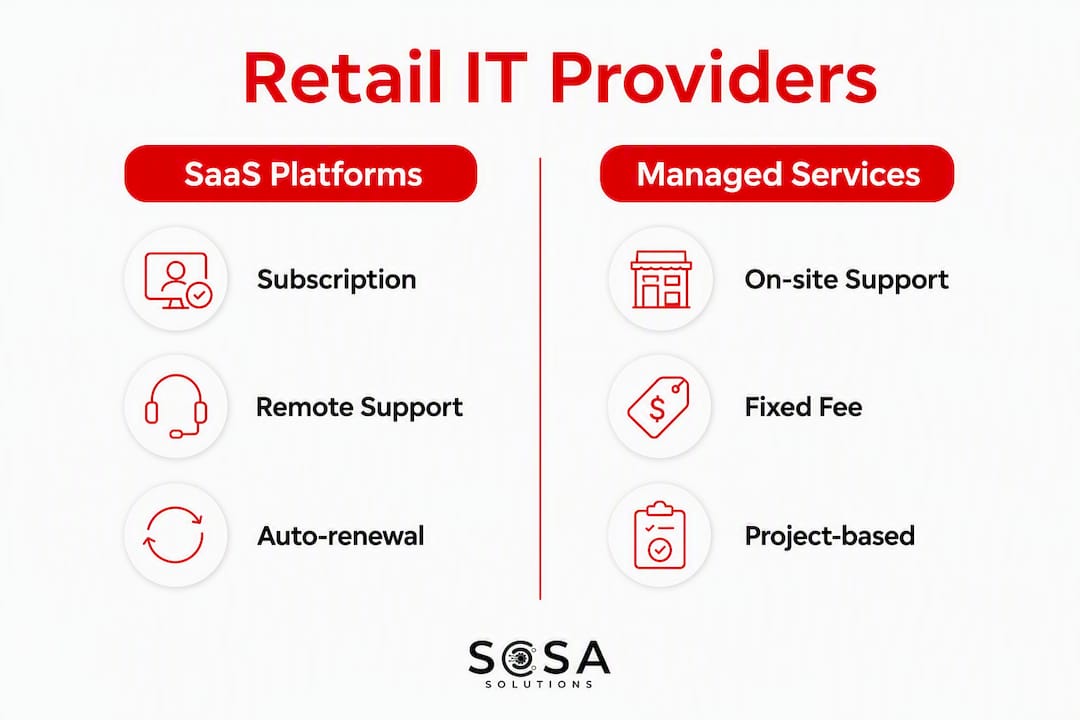
Single-store openings and fast rollouts in New York or Florida need a provider with boots on the ground, not a subcontractor dispatched from a national pool. Aggregator sites like SaaSHub speed up discovery but cannot tell you whether a vendor has actually run a store opening in your market. For multi-store national chains, an enterprise MSP with a 24/7 NOC makes sense, though the trade-off is usually a longer contract and less flexibility on scope changes.
How do you choose the right managed retail IT provider?
Core selection criteria
Start with these before you read a single proposal:
On-site readiness: Can the vendor send a technician to your specific store location, or do they subcontract? Ask for the name of the field tech, not just a zip code.
POS integration experience: Which POS systems have they deployed? Square, Lightspeed, Shopify POS, and NCR all have different network requirements.
Cabling and network infrastructure: Do they pull cable and terminate jacks in-house, or hand that off?
PCI readiness: Who owns the PCI DSS scoping and remediation steps? A vendor who says “that’s your responsibility” is a red flag.
Remote monitoring: What RMM tool do they use, and how quickly do alerts escalate to a ticket?
SLA and response times: Get the exact response-time commitment in writing. Retail IT incident response workflows differ significantly between providers.
Contract flexibility: Can you add a second location mid-term without a full renegotiation?
Questions to ask vendors on a discovery call
Can you share a recent store-opening project timeline and the site-prep checklist you used?
Who is the on-site technician for my location, and are they an employee or a subcontractor?
How do you handle POS vendor coordination on opening day?
What is your escalation path if a critical system goes down 30 minutes before store opening?
How are change orders priced, and what triggers one?
Can you provide two retail client references in my state?
Red flags to watch for
No documented on-site capability for your specific metro
SLA language that says “best effort” rather than a defined response window
Zero retail client references
Vague change-order language (“additional work billed at time and materials”)
CISA guidance on MSP risk specifically flags missing contractual security controls as a warning sign
Pro Tip: Ask every vendor for a real store-opening project timeline, not a generic one. A credible provider can hand you a dated milestone list: site survey, cable pull, POS staging, network testing, opening-day support. If they can’t produce one, they haven’t done it.
What does sohoitworks.com offer versus a managed-service alternative?
SoHo IT Works operates primarily as a remote-managed IT and cloud software platform. A full-service managed IT provider handles the physical work too.
The practical differences break down like this:
On-site cabling and hardware: A platform approach assumes infrastructure is already in place. A managed-service provider like Sosasolutionsnyc scopes, installs, and certifies the physical layer before anything else goes live.
PCI readiness ownership: SaaS-first platforms typically provide monitoring tools; the retailer still owns remediation. A managed-service partner takes responsibility for the full PCI readiness workflow, from scoping to evidence collection.
Incident response staffing: Remote-only models route incidents through a ticketing queue. On-site managed services can dispatch a technician the same day, which matters when a POS terminal goes down at 11 AM on a Saturday.
Device lifecycle: Platform models often assume BYOD or retailer-procured hardware. A managed-service provider handles procurement, imaging, and deployment as part of the engagement.
Three scenarios where the distinction is concrete:
Temporary pop-up (under 60 days): A remote SaaS tool with a local IT contractor for the setup day is usually enough. The overhead of a full managed retainer isn’t justified.
Single flagship store opening: You need on-site cabling, POS integration, network certification, and opening-day support. A regional MSP with retail experience is the right fit. Retail endpoint security also needs to be configured before day one, not after.
Multi-store national rollout: An enterprise MSP with a standardized deployment playbook and a 24/7 NOC handles the scale. Verify that “nationwide” means actual field teams, not subcontracted one-offs.
Pro Tip: Remote monitoring and on-site capability are not the same thing. MSPs that combine both consistently outperform remote-only providers for physical retail installs. Confirm which model you’re buying before signing.
What does retail store IT actually cost in the U.S.?
Cost component | Low band | Mid band | High band |
Discovery / site survey | Included | a moderate site survey fee | a higher site survey fee |
Cabling & network hardware | a lower cabling and hardware cost | a mid-range cabling and hardware cost | a higher cabling and hardware cost |
POS integration & staging | a lower POS integration and staging cost | a mid-range POS integration and staging cost | a higher POS integration and staging cost |
Opening-day on-site support | a lower opening-day on-site support cost | $1,000–a lower cabling and hardware cost | a higher opening-day on-site support cost |
Monthly managed retainer | a lower monthly managed retainer | a mid-range monthly managed retainer | a higher monthly managed retainer |
These are indicative bands for U.S. retail environments. Actual figures depend on store size, number of POS terminals, existing infrastructure, and SLA level. Small retail stores in NY & FL often land in the low-to-mid band for a single-location opening.
A typical store-opening schedule runs like this:
Week 1–2: Site survey, floor plan review, infrastructure scoping
Week 3–4: Cabling, network hardware installation, ISP coordination
Week 5: POS staging, software configuration, device imaging
Week 6: End-to-end testing, staff walkthrough, PCI pre-check
Opening day: On-site technician present for go-live support
Pricing model variations worth knowing: fixed per-store project fees give the most budget predictability; per-device retainers scale well for multi-location chains; hourly arrangements carry the most change-order risk. Onboarding to steady-state managed support typically takes two to four weeks after go-live.
When is Sosa Solutions the right pick?

Sosasolutionsnyc is the right fit when you’re opening a retail store in New York or Florida and need a single provider to handle the physical infrastructure, POS integration, PCI readiness, and ongoing managed support without stitching together multiple vendors.
The onboarding sequence is straightforward:
Site survey: A technician visits the location, documents the infrastructure, and identifies gaps.
Proposal: Scope, timeline, and pricing delivered in writing, including change-order terms.
Site-prep coordination: Cabling, network hardware, and ISP scheduling handled by the Sosasolutionsnyc team.
Installation: Devices imaged, POS integrated, network certified.
Opening-day support: Technician on-site for go-live.
Managed retainer: Ongoing monitoring, patching, and remote/on-site support from day two onward.
Pro Tip: Bring your floor plan and POS vendor contact to the first call. Providers who ask for both upfront are doing real scoping. Those who skip it are guessing at the proposal stage.
The benefits of outsourced IT support are clearest when a single partner owns the full lifecycle from cable pull to monthly monitoring. That’s the model Sosasolutionsnyc runs.
What do retail clients say about their IT providers?
Published client feedback on managed retail IT providers consistently highlights two things: response time on opening day and the quality of POS integration support. Retailers who’ve worked with regional MSPs report that having a named technician, not a generic help desk, on-site during go-live is the single biggest differentiator. Problems that would take hours to resolve through a remote ticket queue get fixed in minutes when someone is standing in the store.
For Sosasolutionsnyc specifically, the firm’s published guidance on retail IT troubleshooting reflects the kind of operational depth that comes from repeated store openings in the same markets, not generic MSP playbooks adapted for retail after the fact.
No client testimonials are publicly listed for the alternative provider categories covered in this article. When evaluating any provider, ask directly for two retail references in your state and speak to them before signing.
What contract terms should you expect from retail IT providers?
Contract structures vary significantly across the provider types covered here.
Regional MSPs like Sosasolutionsnyc typically offer a project-based agreement for the store opening (fixed scope, fixed price) combined with a month-to-month or annual managed retainer. Month-to-month retainers cost slightly more per month but give you flexibility to scale up or exit without penalty.
Remote-first SaaS platforms usually run annual subscriptions with auto-renewal clauses. Read the cancellation window carefully: many require 30–60 days’ written notice before the renewal date, and missing that window locks you in for another year.
National enterprise MSPs almost always require 12–36 month contracts with early-termination fees. Change orders are standard; the question is whether they’re capped or open-ended. CISA’s MSP risk guidance recommends explicit contractual controls around security responsibilities, data handling, and termination rights. Get those in writing regardless of provider type.
One practical rule: any contract that doesn’t specify who owns PCI compliance documentation at termination is a liability. Clarify data return and destruction terms before you sign.
Key Takeaways
For U.S. retail store openings, the right alternative to sohoitworks.com is a regional managed-service provider with verified on-site capability, retail references, and a fixed-scope store-opening agreement.
Point | Details |
Top recommended alternative | Sosasolutionsnyc covers NY & FL with on-site store-opening support, POS integration, and managed retainers. |
On-site capability is non-negotiable | Confirm field technicians are employees, not subcontractors, before signing any proposal. |
Typical opening cost | Mid-band store openings in the U.S. run a mid-range cabling and hardware cost for infrastructure plus $600–$1,200/month for managed support. |
Red flags to avoid | Vague SLAs, no retail references, and missing PCI ownership language are the three biggest contract risks. |
Next step | Request a site survey and proposal from Sosasolutionsnyc via the store-opening assessment page. |
What most IT buyers get wrong about retail store openings
The conventional wisdom says to compare providers on price and response time. Both matter, but they’re the wrong starting point. The real question is whether the provider has done your specific type of opening before: same POS system, same store size, same state. A provider who’s opened 40 restaurants but never a specialty retail store will struggle with the network segmentation and PCI scoping that retail requires.
There’s also a tendency to treat the managed retainer as the main purchase and the store opening as a one-time add-on. That’s backwards. The opening is where the infrastructure gets built. If it’s done poorly, the retainer becomes a monthly bill for fixing problems that should never have existed. Get the opening right, and the ongoing support is genuinely light.
The other thing buyers underestimate: regional knowledge. Knowing which ISPs actually deliver on SLA in a specific Manhattan neighborhood, or which permitting requirements affect low-voltage cabling in Florida, is the kind of detail that doesn’t show up in a national provider’s playbook. It shows up in their project timelines, or it doesn’t.
Ready to open your store with the right IT partner?
Sosasolutionsnyc delivers store-opening IT that most remote-first platforms simply can’t match: a technician on-site in New York or Florida, cabling and network infrastructure handled in-house, POS integration from staging through go-live, and a managed retainer that starts the day after your doors open. No subcontractors, no generic playbooks, no guessing at your PCI scope.
To get started, visit the Store Opening IT Solutions page and request a site assessment. Here’s what to expect in the first engagement:
Book a site survey with a Sosasolutionsnyc technician.
Share your floor plans and POS vendor details before the call.
Review a fixed-scope proposal covering infrastructure, integration, and opening-day support.
Choose a managed retainer level that fits your ongoing support needs.
For security and compliance validation alongside your IT setup, ksign.co’s security and compliance resources are a useful reference during vendor due diligence.
Useful sources and further reading
CISA: Risk Considerations for MSP Customers — Primary regulatory guidance on contractual controls, security assessments, and vendor vetting for businesses hiring managed service providers. Use this for procurement and security due diligence.
Retail Endpoint Security Examples for IT Managers — Sosa Solutions — Practical examples of endpoint protections specific to retail environments. Useful for technical due diligence on security configuration.
Retail IT Incident Response: A 2026 Practical Guide — Sosa Solutions — Covers SLA expectations and response workflows tailored to retail stores. Reference this when evaluating provider SLA commitments.
Security and Compliance — ksign.co — Partner resource covering compliance features and security controls. Use during vendor security validation and PCI readiness checks.
SaaSHub: SoWork Alternatives — Example of an aggregator discovery list. Useful for initial shortlisting; not a substitute for technical vetting.
IT Project Management in Retail: A Guide for Managers — Sosa Solutions — Timeline and project management guidance for retail store rollouts. Reference for setting milestone expectations with vendors.
Benefits of Outsourced IT Support for Retail Businesses — Sosa Solutions — Business-case analysis for managed services over in-house IT. Useful for internal justification and procurement sign-off.
Recommended
Comments