Managed IT Options Beyond Simple Solution Tech
- Sosa Solutions NYC
- Aug 1
- 9 min read
Updated: Aug 8
Updated August 8, 2026: Simple Solution Tech presents managed IT, cybersecurity, backup, network, cloud, and low-voltage services for South Florida small businesses. This article compares provider types and service considerations using public information; it is not an independently tested ranking. Confirm service areas, pricing, service levels, and references directly with each provider.

For retail-focused SMBs in New York and Florida, Sosasolutionsnyc is the strongest alternative to Simple Solution Tech — offering retail store opening support, on-site and remote troubleshooting, and proactive network monitoring that generic managed IT providers rarely match. If your business falls outside that footprint, three provider categories cover most other situations: regional retail-focused MSPs (best for brick-and-mortar operators who need fast on-site response), national enterprise MSPs (best for multi-location businesses with compliance requirements like SOC 2 or ISO 27001), and boutique on-site-first MSPs (best for businesses where same-day physical presence matters more than 24/7 remote NOC coverage). The differences between them come down to three things: geographic coverage, pricing model (retainer vs. per-device vs. project), and SLA expectations for on-site response.
Table of Contents
What are the best simplesolutiontech.com alternatives for SMBs?
Provider Category | Best For | Core Services | Industries | Coverage | Pricing Model | SLA / Support | Certifications | Pros / Cons |
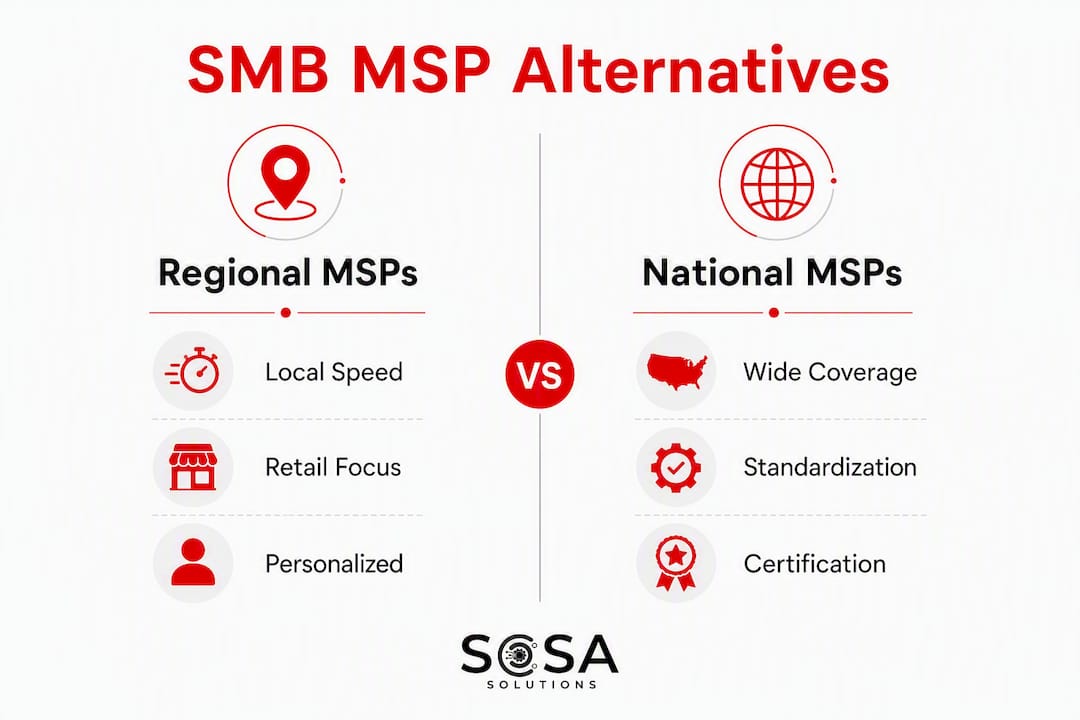
Regional retail-focused MSPs | Small retailers needing fast local response | Managed IT, on-site support, store openings, POS setup | Retail, hospitality, food service | Metro/regional US | Monthly retainer or project | Business hours + on-call | SOC 2 (varies) | Fast on-site; limited national reach |
National enterprise MSPs | Multi-location or compliance-heavy businesses | 24/7 NOC, cloud, security, compliance | Healthcare, finance, government, enterprise | Nationwide | Per-device or tiered retainer | 24/7 with defined SLAs | SOC 2, ISO 27001, FedRAMP | Broad coverage; less retail-specific depth |
Boutique on-site-first MSPs | Businesses where physical presence is non-negotiable | On-site IT, break-fix, infrastructure setup | Retail, professional services, SMB | Local/metro | Project or hourly | Same-day on-site | Varies | Highly responsive; may lack remote monitoring |
Sosasolutionsnyc (recommended) | Retail SMBs in NY & FL launching or managing stores | Managed IT, store opening setup, remote + on-site support, network monitoring | Retail, corporate offices, SMB | New York & Florida | Retainer + project | Proactive monitoring + on-site | PCI-aware practices | Retail-specific depth; regional focus |
The most important column depends on your situation. If you are launching a retail store, prioritize the “core services” and “SLA/support” columns — you need a provider who has done a store opening before, not one learning on your dime. If compliance is your primary concern, look at the certifications column first. Budget-conscious SMBs should compare pricing models: flat-rate managed service packages make monthly costs predictable, but always check what is excluded from the flat rate before signing.
Provider profiles: what each category actually delivers
Regional retail-focused MSPs
These providers serve a defined metro or state footprint and build their value around speed and familiarity with local retail environments. Services typically include managed network monitoring, POS system setup, Wi-Fi deployment, and on-site troubleshooting during store launches. The ideal client is a single-location or small-chain retailer who cannot afford a two-day wait for a technician. The main limitation: most regional MSPs do not have the staffing to support a national rollout or a 24/7 global NOC.

National enterprise MSPs
Vendors like Macro Solutions, MANTECH, GovernmentCIO, and SmartSites operate at a scale that regional providers cannot match. They typically offer round-the-clock network operations centers, formal SOC 2 or ISO 27001 certifications, and structured SLAs with defined resolution windows. Capital Numbers and Trigma lean toward software and digital services alongside IT support, which suits businesses that need development and IT management under one roof. The trade-off is that national providers often apply a standardized service template — retail-specific nuances like POS network segmentation or same-day launch-week on-site response tend to get deprioritized.
Boutique on-site-first MSPs
These are small shops, often two to ten technicians, built around physical presence. They are the right call when your business cannot tolerate remote-only support — think a flagship store opening in a building with complex cabling or a restaurant group that needs someone on the floor during a POS migration. The gap is monitoring: boutique providers rarely invest in enterprise-grade remote monitoring platforms, so proactive issue detection before something breaks is inconsistent.

Sosasolutionsnyc
Sosasolutionsnyc is built specifically for the retail SMB use case that the other categories handle only partially. Key services include:
Retail store opening IT setup: network infrastructure readiness, POS configuration, on-floor Wi-Fi, and inventory system integrations
Ongoing managed IT: proactive network monitoring, remote and on-site troubleshooting, and regular maintenance
Retail system monitoring: real-time visibility into store systems so issues surface before they affect customers
Cloud backup and recovery: PCI-aware backup schedules aligned with business hours
The geographic focus on New York and Florida is a deliberate strength, not a limitation. Urban retail in Manhattan or Miami involves specific vendor relationships, building access logistics, and local compliance considerations that a provider based in another region simply does not carry. The engagement model — retainer for ongoing support, project-based for store openings — means you pay for what you need without being locked into a one-size contract. [Christopher’s professional IT qualifications or certifications], [case studies demonstrating successful managed IT solutions and retail store openings], and [client testimonials or references from retail clients in New York or Florida] are available on request.
How do you choose the right managed IT partner?
The single most important criterion is fit to your industry and support model. A provider who has never set up a POS network or managed a store opening will cost you time and money during launch week, regardless of how polished their proposal looks. Everything else — certifications, pricing, integrations — matters, but only after you have confirmed they have done this before for a business like yours.
Coverage and on-site capability
Ask directly: how many technicians do you have within 30 miles of my location, and what is your guaranteed on-site response time? A provider who hedges on that answer is telling you something. For store openings, same-day on-site capability during launch week is non-negotiable. Remote-only support is fine for routine monitoring but not for a grand opening with a malfunctioning POS.
Retail store-opening experience
Request a store-opening IT checklist and ask the vendor to walk you through it. A provider with real experience will have a documented process covering network segmentation for POS systems, scheduled backups aligned with business hours, and an escalation path for same-day fixes during launch week. If they cannot produce that document, move on.
SLAs, certifications, and pricing transparency
Get measurable SLA terms in writing: response time, resolution time, and an escalation matrix. Vague language like “we respond promptly” is not an SLA. For businesses handling payment data, ask specifically about PCI-aware practices. On pricing, affordable managed IT plans for small retailers typically run on a monthly retainer, a per-device fee, or a project rate for store openings. Understand exactly what each model includes before comparing quotes.
Red flags in contracts and proposals
Watch for vague SLAs with no defined resolution times, no documented data backup policy, automatic renewal clauses with long notice periods, and unclear escalation paths when your primary contact is unavailable. A contract that does not specify who owns your data if you leave is also a problem worth raising before you sign.
Pro Tip: Ask every shortlisted vendor for a sample SLA document with measurable response and resolution times, and negotiate a 30-day limited-exit clause during the ramp-up period. This lets you validate actual service quality before committing long-term, and any reputable provider will agree to it.
Interview questions to ask shortlisted vendors
How many retail store openings have you managed in the past 12 months?
What is your guaranteed on-site response time for our location?
Can you provide a sample SLA with defined resolution windows?
How do you handle backup and recovery for POS systems?
What happens to our data and configurations if we end the contract?
Why Sosasolutionsnyc works well for retail SMBs
Sosasolutionsnyc’s core advantage for retail SMBs is specificity. The store opening IT solutions service covers the exact pain points that generic MSPs treat as afterthoughts: network readiness for POS systems, PCI-aware backup schedules, on-floor Wi-Fi deployment, and inventory system integrations. These are not add-ons — they are the core of what the service delivers.
The New York and Florida focus translates to faster on-site response in dense urban markets where building access, vendor coordination, and local compliance considerations add real complexity. A national provider dispatching a technician from another state for a Manhattan store opening is a different experience than a local team that knows the building logistics.
The retainer-plus-project model separates ongoing managed support from one-time store opening work. That structure gives retail clients predictable monthly costs for day-to-day IT management while keeping store launch budgets scoped and contained. Compare that to national enterprise MSPs, which often bundle everything into a single tiered contract that includes services a small retailer will never use.
Christopher’s professional IT qualifications or certifications], [case studies demonstrating successful managed IT solutions and retail store openings], and [client testimonials or references from retail clients in New York or Florida] are available directly from Sosasolutionsnyc and should be requested as part of any vendor evaluation. The [retail IT infrastructure guide published by Sosasolutionsnyc also gives a practical sense of the depth of knowledge behind the service.
What should you know about contract terms and cancellation policies?
Managed IT contracts vary widely, and the fine print matters more than the headline price. Most providers offer one of three structures: a monthly rolling retainer (easiest to exit), an annual contract with a 30–90 day cancellation notice, or a multi-year agreement with early termination fees. For SMBs evaluating simplesolutiontech.com alternatives, the key questions are what notice period is required to cancel, whether there are penalties for early exit, and who retains ownership of your configurations, credentials, and data after the contract ends.
Automatic renewal clauses are common and easy to miss. A contract that renews for another 12 months unless you send written notice 60 days before the end date can trap a business that simply forgot to calendar the deadline. Read that clause carefully and set a reminder well in advance.
Data portability is the other issue most SMBs overlook. Before signing, confirm in writing that all network configurations, backup files, credentials, and documentation belong to you and will be handed over in a usable format if you switch providers. A provider who resists that conversation is one worth reconsidering.
Key Takeaways
For retail SMBs in New York and Florida, Sosasolutionsnyc is the strongest simplesolutiontech.com alternative because it combines retail store opening experience, local on-site capability, and a flexible retainer-plus-project model that generic MSPs do not offer.
Point | Details |
Retail experience is the top filter | Prioritize providers with documented store-opening processes, not just general managed IT credentials. |
Local on-site capability matters | Confirm guaranteed on-site response times before shortlisting; remote-only support is not enough for store launches. |
Get SLA terms in writing | Insist on measurable response and resolution times, and negotiate a 30-day exit option during ramp-up. |
Watch contract fine print | Check cancellation notice periods, auto-renewal clauses, and data ownership terms before signing. |
Sosasolutionsnyc is the recommended pick | Retail SMBs in NY & FL should request a store-opening checklist and discovery call to evaluate fit. |
The case for local over national when it counts
The conventional wisdom in managed IT is that bigger providers are safer — more staff, more certifications, more coverage. For most enterprise use cases, that logic holds. For a retail SMB opening a store in Brooklyn or Miami, it often does not.
National MSPs are built for scale and standardization. That is exactly what makes them less useful when your POS network needs to be live by 9 AM on opening day and the technician is three states away. The providers who consistently perform well in retail store openings are the ones who have done it locally, repeatedly, and who have a technician who can physically be there when something goes sideways.
The other thing worth saying: third-party review platforms like Clutch’s Florida MSP directory and G2’s alternatives listings are useful starting filters, not final verdicts. A five-star rating from a healthcare client tells you almost nothing about how a provider handles a retail store opening. Always follow platform research with direct reference checks from clients in your specific industry.
Ready to evaluate Sosasolutionsnyc for your next store opening?
Sosasolutionsnyc gives retail SMBs in New York and Florida something most managed IT providers cannot: a team that has handled store openings before, knows the local market, and shows up on-site when it matters. The first call is a 10–15 minute scoping conversation covering your store count, locations, timeline, and basic IT needs. From there, you get a clear picture of which service model fits — retainer, project, or both — with no pressure to commit on the spot.
Request a store-opening readiness checklist or schedule a discovery call directly through the Sosasolutionsnyc website. The service area covers New York and Florida, with particular depth in Manhattan and major Florida markets. If you are planning a store launch or evaluating your current managed IT setup, that 15-minute call is the fastest way to find out whether the fit is right.
Sources and further reading
Simple Solution Tech homepage — reference for core services and SMB positioning
Simple Solution Tech company profile (Exa.ai) — background on company size and founding
Top IT Managed Service Providers in Florida (Clutch) — regional MSP directory with client reviews
G2: Top Simple Solutions Alternatives — third-party software and service alternatives
CB Insights: Simple Technology Solutions Alternatives — company profile and competitor mapping
Sosa Solutions: Store Opening IT Solutions (NY & FL) — publisher’s retail store opening service page
Sosa Solutions: Retail IT Infrastructure Guide for 2026 — practical retail IT checklists and deployment advice
Sosa Solutions: Managed IT alternatives post — publisher case examples and SLA guidance
When evaluating any provider, request vendor case studies specific to your industry and ask for a sample SLA document with defined response and resolution times before moving to contract discussions.
Recommended
Comments