Cybersecurity in Retail: What Every Business Owner Must Know
- Sosa Solutions NYC
- Jul 24
- 8 min read
Updated: Aug 7

Why cybersecurity is the backbone of every retail business
Retail businesses sit at the intersection of high transaction volumes, sensitive customer data, and deeply interconnected digital systems. That combination makes them one of the most targeted industries for cybercriminals. The role of cybersecurity in a retail business goes well beyond installing a firewall: it protects payment processing, customer records, loyalty platforms, and the operational systems that keep stores running during their busiest hours.
The stakes are concrete. 83% of global consumers prioritize personal data protection when shopping, and 55% of retail executives see cybersecurity-driven customer trust as a direct competitive advantage. When a breach happens, the damage is not just a regulatory fine. It is lost customers, months of operational disruption, and a brand reputation that took years to build.
Cybersecurity in retail also means compliance. Standards like PCI DSS, the CCPA, and GDPR carry real financial penalties for businesses that fail to protect cardholder and personal data. Beyond compliance, a strong security posture keeps your store open during peak sales events, when attackers are most likely to strike.
Payment system protection: Secures point-of-sale (POS) terminals and online checkout against card-skimming malware and fraud.
Customer data integrity: Protects names, addresses, purchase histories, and payment credentials stored across loyalty and ecommerce platforms.
Business continuity: Prevents the downtime that costs revenue and erodes trust during Black Friday, holiday rushes, and other high-traffic periods.
Regulatory compliance: Keeps your business aligned with PCI DSS, CCPA, and GDPR requirements, avoiding fines and legal exposure.
Brand trust: Customers who trust you with their data come back. Those who don’t, won’t.
What cyber threats are actually targeting your retail operation?
Retail is a high-value target because it combines payment data, personal information, and operational systems that cannot afford downtime. Attackers know this. They also know that many retail security programs were built for a simpler era and have not kept pace with how modern retail actually operates.
Ransomware is the most disruptive threat. Ransomware attacks on retail increased significantly in recent holiday seasons, and attackers deliberately time campaigns for peak shopping periods. When your POS systems go down on Black Friday, the cost per hour is not abstract. Modern ransomware also exfiltrates customer data before encrypting it, so you face a breach notification and a ransom demand simultaneously.
POS malware captures payment card data directly from terminal memory during transactions. Most major retail breaches over the past decade involved POS malware as the primary attack method, often entering through phishing emails sent to store employees or through compromised third-party vendors with remote access.

Phishing and social engineering remain the most common entry point for attackers. A single employee clicking a convincing email gives an attacker a foothold inside your network. AI is now being used to craft highly personalized phishing messages that are far harder to spot than the generic scams of five years ago.
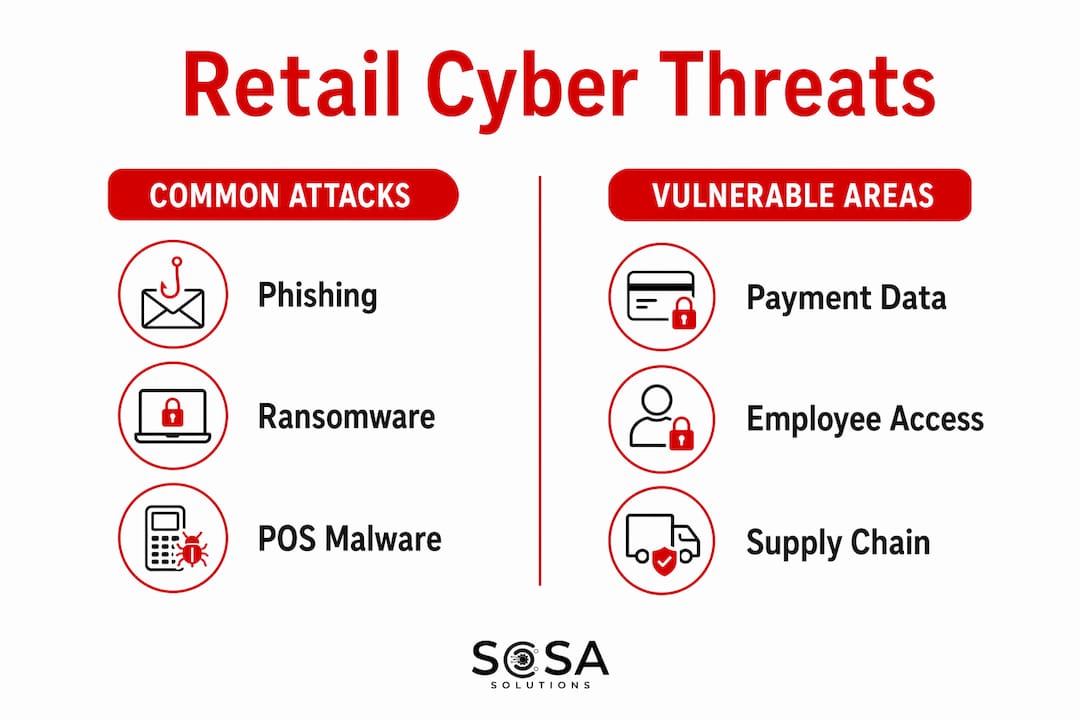
Supply chain attacks exploit the vendors, payment processors, and logistics partners your business depends on. Third-party vendors with access to critical systems are often the weakest link in retail security. Your vendor gets compromised, but your customer data gets stolen, and you own the breach notification. Understanding how procurement connects to cybersecurity risk is increasingly part of managing this exposure.
Credential theft and data breaches are persistent. Many retailers have experienced a data breach, and A substantial number of major retailers have exposed credentials that attackers can find and exploit. Loyalty platforms are a particular target because they combine identity, behavioral, and payment data in one place.
DDoS attacks do not steal data. They shut your ecommerce site down during peak hours, costing immediate revenue and damaging customer relationships. Cyberattacks represent 68% of retailers’ operational disruptions, making availability a security issue, not just an IT one.
Ransomware: Encrypts systems and exfiltrates data, timed for peak seasons.
POS malware: Skims card data from payment terminals in real time.
Phishing: Tricks employees into handing over credentials or installing malware.
Supply chain attacks: Enter your network through a vendor’s compromised access.
Credential theft: Exploits reused or exposed passwords across retail systems.
DDoS attacks: Flood your site with traffic until it crashes.
Social engineering: Manipulates staff into bypassing security controls.
Pro Tip: Retail operations often delay security patches during peak trading periods to avoid disrupting customer experience. Attackers count on this. Schedule critical updates during verified off-peak windows and use automated monitoring to catch threats in the gap.
Which compliance frameworks actually apply to your retail business?
Retail cybersecurity does not operate in a regulatory vacuum. PCI DSS, NIST CSF, and ISO 27001 provide the structured guidelines that govern how retailers protect payment data, manage risk, and demonstrate accountability to auditors, customers, and regulators.
PCI DSS (Payment Card Industry Data Security Standard) is non-optional for any business that processes, stores, or transmits payment card data. It sets specific technical and operational requirements: network segmentation, encryption, access controls, and regular vulnerability testing. Violations carry fines and can result in losing the ability to process card payments entirely.
NIST Cybersecurity Framework (CSF) organizes security programs around five functions: Identify, Protect, Detect, Respond, and Recover. For retail IT managers, this framework is practical because it maps directly to how you build and test defenses, not just how you document them. It aligns well with both PCI DSS and ISO 27001.
ISO 27001 provides governance-level structure for managing information security across an organization. Certification signals to vendors and customers that your security controls are verified and maintained, not just claimed. It works alongside PCI DSS to create a more unified approach to risk management.
GDPR and CCPA govern how you collect, store, and use customer personal data. GDPR applies when you serve EU residents; CCPA applies to California consumers. Both carry significant financial penalties for unauthorized data exposure and require clear data retention and deletion policies.
Essential compliance activities for retail businesses:
Conduct annual PCI DSS self-assessments or third-party audits.
Maintain documented data retention and deletion schedules aligned with CCPA and GDPR.
Run quarterly vulnerability scans and annual penetration tests on payment systems.
Review and update third-party vendor agreements to include security requirements.
Train staff on data handling procedures and breach notification obligations.
Keep an up-to-date asset inventory covering all systems that touch payment or personal data.
How do you actually secure a retail or ecommerce operation?
The gap between knowing the threats and closing them is where most retail businesses struggle. The good news is that the most effective defenses are not the most expensive ones. They are the ones applied consistently across your entire operation.
Zero trust architecture is the right model for modern retail. It assumes no user, device, or system is trusted by default, even inside your network. Every access request gets verified. This matters because retail environments now span cloud platforms, mobile devices, third-party integrations, and store POS systems, all on the same infrastructure. Key zero trust practices include continuous identity verification, multi-factor authentication (MFA), and micro-segmentation of networks to isolate POS terminals from corporate systems.
Endpoint protection covers every device that touches your network: POS terminals, employee laptops, tablets used on the floor, and cloud workloads. Advanced endpoint protection tools use AI-driven detection to identify ransomware and malware before they spread. Centralized management across multiple store locations simplifies oversight and speeds up response when something goes wrong.

Network segmentation limits how far an attacker can move after breaching one system. Separating POS terminals, IoT devices, and back-office systems from each other is a PCI DSS requirement and a practical containment strategy. A breach in one segment does not have to become a breach across your entire operation.
Encryption and tokenization protect cardholder data during transactions and at rest. Tokenization replaces actual card numbers with non-sensitive tokens, so even if data is intercepted, it has no value to an attacker.
Continuous monitoring and incident response close the window between a breach occurring and your team knowing about it. Managed Detection and Response (MDR) or Extended Detection and Response (XDR) solutions provide around-the-clock visibility, which is especially valuable for retailers with limited IT staff. Pair this with a documented retail IT incident response plan so your team knows exactly what to do when an alert fires.
Third-party risk management means auditing every vendor with access to your systems. Payment processors, inventory platforms, marketing tools, and logistics providers all extend your attack surface. Require security assessments before onboarding vendors and review their access regularly.
Employee training is where most breaches are either stopped or started. Phishing simulations, regular security awareness sessions, and clear protocols for reporting suspicious activity turn your staff from a vulnerability into a line of defense. How cyber threats evolve is not static knowledge, so training needs to be updated, not just repeated.
Implement MFA across all systems, especially those with access to payment or customer data.
Segment POS networks from corporate and guest Wi-Fi networks.
Run phishing simulations at least quarterly.
Maintain offline backups of critical data, tested regularly. A solid retail data backup strategy is your last line of defense against ransomware.
Conduct penetration testing annually and after major system changes.
Establish a vendor security checklist and review third-party access quarterly.
Pro Tip: Embed a security checkpoint into your technology development and deployment workflows. Before any new integration, app, or platform goes live, require a brief security review. Catching a misconfigured API before launch costs far less than discovering it after a breach.
Cybersecurity as a strategic asset, not a compliance checkbox
The retailers who handle cybersecurity best are not the ones with the biggest security budgets. They are the ones who made a structural decision: security is not a layer applied on top of the business. It is part of how the business operates.
Cybersecurity accountability must extend beyond IT teams to operational managers, frontline staff, and executive leadership. A store cashier who clicks a phishing link opens the same door as a misconfigured cloud API. Nobody in a retail organization is immune from being targeted, and that reality needs to be reflected in training, workflows, and governance, not just in the CISO’s quarterly report.
The commercial case is clear. Cybersecurity-driven customer trust is a competitive differentiator, not a soft benefit. With 74% of US consumers browsing and 73% purchasing across both physical and digital channels, every touchpoint carries data risk. Retailers that protect those touchpoints consistently build the kind of trust that drives repeat purchases. Those that don’t face something harder to recover from than a regulatory fine: customers who simply stop coming back.
Structurally, retail cybersecurity architecture must evolve from perimeter defense to zero trust and continuous governance. The old model assumed a bounded environment with a clear inside and outside. Modern retail has hundreds of API connections, multiple cloud providers, third-party logistics partners, and mobile devices on the same network as payment systems. Perimeter defense was not designed for that environment.
Assign cybersecurity accountability to operational managers, not just IT.
Require board-level reporting on cyber risk alongside financial and operational metrics.
Embed security reviews into procurement, vendor onboarding, and product development workflows.
Practice incident response with simulated attacks, not just tabletop exercises.
Treat a loyalty platform breach as a relationship event, not just a legal one.
Use a return-on-investment framework to measure cybersecurity program value for executive stakeholders.
Sosasolutionsnyc works with retail businesses in New York and Florida to build security postures that match how modern retail actually operates: distributed, connected, and under constant pressure to stay available. From store opening IT setup with security baked in from day one, to ongoing managed IT support that keeps your systems patched, monitored, and compliant, the goal is the same. Security that works in the background so your business can run in the foreground.

Key Takeaways
Cybersecurity in retail protects payment systems, customer data, and business continuity while serving as a direct driver of customer trust and competitive advantage.
Point | Details |
Retail is a prime target | Most retailers have experienced at least one cyberattack; confirmed data breaches in retail have nearly doubled recently, largely driven by ransomware, exploits, and stolen credentials. |
Trust drives revenue | 83% of global consumers prioritize data protection when shopping, linking security directly to loyalty. |
Ransomware doubled | Ransomware attacks on retail have doubled in recent years, with attackers timing campaigns for peak shopping seasons to maximize disruption. |
Zero trust is the right model | Modern retail environments require continuous verification across cloud, POS, and third-party systems. |
Security is a shared responsibility | Cybersecurity accountability must extend from the CEO to frontline staff, not remain siloed in IT. |
Recommended
Comments