Role of Cloud Services in Corporate Teams: A Practical Guide
- Sosa Solutions NYC
- Jul 30
- 15 min read
Updated: Aug 7

Cloud services let corporate teams collaborate faster, scale capacity on demand, and shift IT from fixed capital expense to a consumption-based operating model. That shift touches every layer of the organization, from how developers ship code to how the CFO reads an IT budget line. The roles that make it real are a cross-functional mix: executive sponsors who tie cloud to business goals, cloud architects and platform engineers who build the infrastructure, security and compliance specialists who keep it safe, and FinOps owners who make sure the bill stays rational.
The short version:
Secure executive sponsorship before any technical work begins
Map your workloads and skill gaps before picking a cloud model
Start with a time-boxed pilot tied to a measurable business outcome
Staff or contract a minimum viable team covering architecture, security, and cost governance
If you want to move faster, a managed IT partner can compress the assessment and pilot phases significantly.
Table of Contents
How cloud service models shape team ownership
The model you choose determines who in your organization owns what. Getting this wrong is one of the most common reasons cloud projects stall.
IaaS (Infrastructure as a Service) hands your team compute, networking, storage, and containers. The cloud provider secures the physical hardware and the hypervisor layer; your engineers own everything above it, including the operating system, patching, and configuration. Core IaaS components include compute instances, virtual networking, block and object storage, and container runtimes. This model suits teams with strong infrastructure skills who need maximum control, such as organizations running custom databases or legacy workloads they cannot yet refactor.

PaaS (Platform as a Service) takes the OS and runtime off your plate. Your developers deploy applications and data; the provider manages the underlying platform. This is the right model when your goal is faster application delivery and your team’s energy should go into product logic, not patching servers.
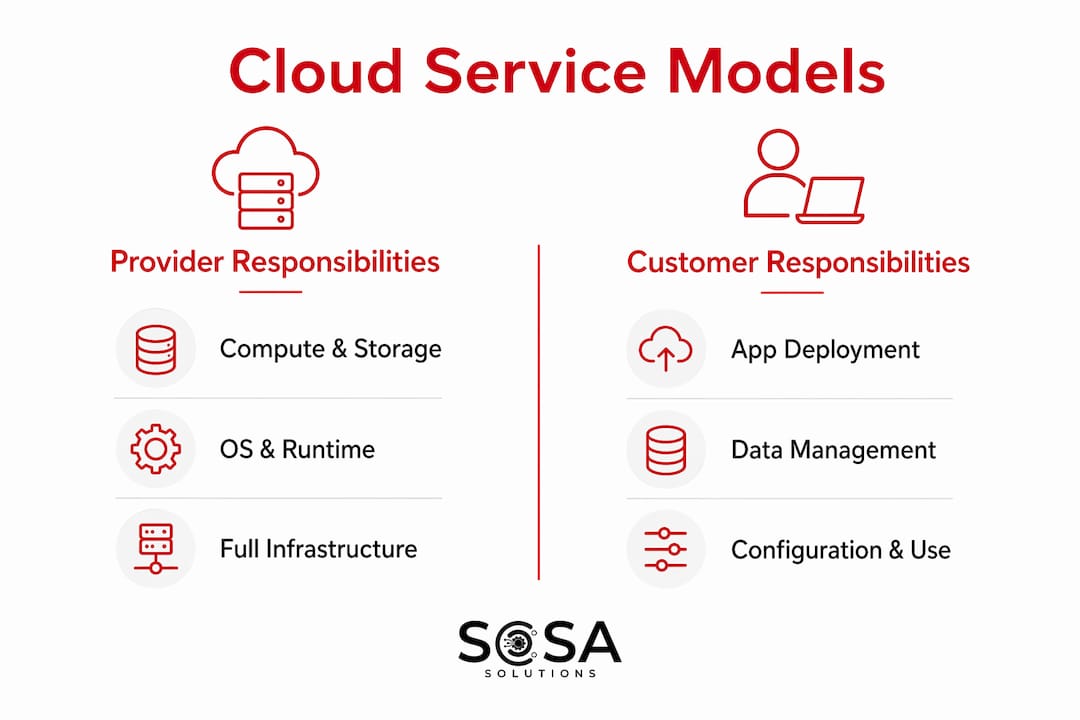
SaaS (Software as a Service) means the provider runs everything. Your team configures and uses the application. Microsoft 365, Salesforce, and similar tools fall here. Ownership inside your organization shifts almost entirely to business users and IT administrators rather than engineers.
Serverless / FaaS (Function as a Service) goes further: your developers write discrete functions and the platform handles execution, scaling, and availability. It is ideal for event-driven workloads and teams that want to minimize infrastructure management entirely.
Model | Primary internal owner | Typical corporate use cases |
IaaS | Cloud/platform engineers | Custom databases, dev/test environments, disaster recovery |
PaaS | Application development teams | Web apps, APIs, analytics pipelines |
SaaS | Business users + IT admins | Productivity, CRM, HR, storefront systems |
Serverless/FaaS | Application developers | Event processing, integrations, scheduled tasks |
Pro Tip: If your internal IT team is lean and speed-to-market matters more than customization, start with SaaS for productivity and operational tools, then layer in PaaS for custom applications. Reserve IaaS for workloads where you genuinely need infrastructure-level control. Most small and mid-sized organizations over-engineer their first cloud deployment by defaulting to IaaS instead of SaaS, which can deliver results much faster.
How cloud services change the way teams collaborate and grow
The mechanics matter here. Cloud services do not just move workloads off-premises; they change how teams interact with infrastructure and with each other.

Centralized data and shared services mean every team works from the same source of truth. A retail chain running inventory and sales data in a shared cloud data platform eliminates the version-control chaos that comes from emailing spreadsheets between stores. Cross-regional operations become genuinely manageable when every location pulls from the same system.
Self-service infrastructure is where platform teams create the most leverage. Instead of waiting days for an IT ticket to provision a test environment, a developer can spin one up in minutes through a service catalog. Platform teams that provide self-service infrastructure reduce manual tickets and enable standardized readiness for new operational activities, including store openings and product launches. That reduction in friction directly shortens time-to-market.
CI/CD pipelines let application teams push code changes multiple times a day rather than in quarterly releases. The business outcome is faster iteration on customer-facing features and faster recovery when something breaks.
Ubiquitous access is the foundation of hybrid and remote work. Cloud services allow teams to access applications and data from any location, which means a distributed workforce operates with the same tools and permissions whether they are in a Manhattan office or working remotely in Florida.
Three scenarios where this plays out concretely:
Store launches: A retailer opening a new location can provision POS systems, network configuration, and back-office software from a central cloud platform rather than shipping physical servers. The retail IT infrastructure is ready before the doors open.
Product releases: An engineering team using CI/CD on a cloud platform can run automated tests, stage a release, and roll back within the same hour if something fails.
Cross-regional operations: A corporate team managing offices across multiple states can monitor performance, enforce security policies, and update configurations from a single control plane.
Research backs the business case. An empirical study using firm-level data found that SaaS correlates with faster growth for smaller firms and is associated with workforce reallocation toward ICT and managerial roles, which means cloud adoption tends to shift talent toward higher-value work rather than routine maintenance.
What a cloud team actually looks like: roles, responsibilities, and a minimum viable template
Most organizations do not need a massive cloud center of excellence. They need the right roles covered, even if one person covers two of them.
Eight core cloud team roles appear consistently in successful deployments. Here is how they map to responsibilities and what good looks like for each:
Role | Core responsibilities | Key success metric |
Executive sponsor / business decision-maker | Aligns cloud to business strategy, secures budget, removes organizational blockers | Cloud initiatives tied to measurable business KPIs |
Cloud architect | Designs platform architecture, sets standards, guides service model selection | Architecture review cycle time, standards adoption rate |
Cloud / platform engineer | Builds and operates infrastructure, maintains CI/CD, manages service catalog | Deployment frequency, mean time to recovery (MTTR) |
Application / product teams | Build and own workloads on the platform, consume self-service tooling | Time-to-market, release frequency |
Cloud security specialist | Implements identity and access management, encryption, monitoring, incident response | Security posture score, time to detect/respond |
Compliance owner | Maps regulatory requirements to cloud controls, manages audit evidence | Audit pass rate, compliance coverage |
FinOps analyst | Tracks consumption, allocates costs, identifies waste, runs optimization cycles | Cost per workload, budget variance |
Cloud operations / SRE | Monitors reliability, manages incidents, maintains SLAs | Uptime, MTTR, on-call burden |
Minimum viable team for smaller organizations
A lean organization does not need eight separate people. The Microsoft Cloud Adoption Framework recommends a cross-functional cloud strategy team that can be as small as three to four people when roles are consolidated:
Executive sponsor (part-time commitment from a business leader)
Cloud platform engineer + security (one person or a managed partner covering infrastructure, identity, and monitoring)
FinOps owner (often the IT manager or CFO’s office)
Application lead (a developer or team lead who owns workload delivery)
For smaller organizations, the platform engineering and security functions are natural candidates for consolidation or outsourcing to a managed IT partner. Outsourced IT support fills the gaps that a lean internal team cannot cover without adding full-time headcount.
Org-chart in plain language: The executive sponsor sits at the top and connects cloud strategy to business goals. The cloud architect and FinOps analyst report into IT leadership. Platform engineers and security specialists form a shared services layer that application teams consume. In a small organization, IT leadership and the platform engineer role often merge into one person who also manages the managed service provider relationship.
RACI in brief: Cloud architects design the platform; platform engineers run it; security specialists secure it; compliance owners audit it; FinOps analysts optimize it. Application teams consume it and own their workloads. The executive sponsor decides on strategic direction and budget.
A Cloud Teams Playbook approach favors separating a Cloud Office (strategy and governance) from one or more Cloud Platform Teams (build and operate), with application teams consuming the platform. This avoids the common failure mode of a single oversized center of excellence that becomes a bottleneck.
Security, privacy, and compliance: what your team must own
The shared responsibility model is the starting point for every cloud security conversation. The provider secures the physical infrastructure, the network fabric, and the hypervisor. Your team owns identity, data classification, access controls, encryption key management, and application security. The exact split shifts depending on the service model: with SaaS, you own less; with IaaS, you own significantly more.
Security, privacy, and integration capabilities are the strongest predictors of successful cloud adoption. Organizations that treat security as an afterthought consistently underperform those that build it in from the start.
Security checklist for corporate cloud teams:
Identity and access management: Enforce multi-factor authentication for all privileged accounts. Apply least-privilege principles. Review access quarterly.
Encryption and key management: Encrypt data at rest and in transit. Own your encryption keys; do not leave key management entirely to the provider.
Logging and monitoring: Enable audit logging across all cloud services. Route logs to a centralized SIEM or monitoring platform.
Incident response roles: Assign a named incident response owner. Document escalation paths before an incident happens.
Backup and recovery: Test restores, not just backups. Know your recovery time objective (RTO) and recovery point objective (RPO) for every critical workload. The cloud backup fundamentals for retail environments apply equally to corporate office workloads.
Common failure points that auditors flag repeatedly:
Misconfigured storage buckets with public read access
Unused privileged accounts that were never deprovisioned after a project ended
Missing or untested backups for production databases
No documented incident response plan for cloud-specific scenarios
The Microsoft Cloud Adoption Framework’s security guidance frames security as a shared responsibility across engineering teams, not a separate function that reviews work after the fact. Security teams provide patterns, guardrails, and automation; engineering teams implement them. That model works. The alternative, a security team that only reviews at the end, creates bottlenecks and misses issues that are expensive to fix post-deployment.
Pro Tip: Small teams should use cloud-native posture management tools (AWS Security Hub, Microsoft Defender for Cloud, or equivalent) before hiring a dedicated security analyst. These tools surface misconfiguration and compliance gaps automatically and cost a fraction of a full-time hire. When you need deeper coverage, outsource threat detection to a managed security provider rather than trying to staff a 24/7 SOC internally.
Governance, FinOps, and breaking down organizational silos
Governance is not bureaucracy. It is the set of guardrails that lets teams move fast without breaking things that matter.
The Microsoft Cloud Adoption Framework recommends a cross-functional cloud strategy team that includes finance, IT, operations, and security, with continuous iteration rather than a one-time planning exercise. The practical implication: cloud governance is a living process, not a project with a completion date.
Cloud Office vs. Platform Teams
A Cloud Office handles strategy, policy, and financial governance. It answers questions like: Which cloud providers do we use? What are our tagging standards? How do we allocate costs? Platform Teams build and operate the shared infrastructure that application teams consume. Keeping these functions separate prevents the Cloud Office from becoming an engineering bottleneck and prevents Platform Teams from making unilateral strategic decisions.
FinOps changes how IT budgets work. Traditional IT budgets are capital expenditure: you buy servers, depreciate them over five years, and the cost is relatively predictable. Cloud consumption is variable. A team that spins up a large analytics cluster and forgets to shut it down can generate a surprising bill by end of month. Cloud computing shifts IT from fixed investment to pay-as-you-go consumption, which changes firm behavior and requires new financial governance disciplines. FinOps practice assigns cost ownership to the teams generating the spend, creates shared visibility into consumption, and runs regular optimization cycles.
Change management hooks that actually work:
A service catalog that makes the approved path the easy path
Guardrails (automated policy enforcement) that prevent misconfiguration rather than flagging it after the fact
A regular training cadence tied to role changes, not just onboarding
Cost dashboards visible to team leads, not just the finance team
Platform teams that treat their internal cloud platform as a product, and measure success by developer adoption and satisfaction rather than project milestones, consistently outperform teams that treat the platform as a one-time infrastructure build. The product mindset means continuous improvement, user feedback loops, and a roadmap — the same disciplines that make customer-facing products successful.
Pro Tip: Assign a FinOps owner before you launch your first workload, not after you get the first unexpected bill. Even a part-time assignment to the IT manager or CFO’s office creates accountability. The cost of a FinOps review cycle is a fraction of the waste it prevents.
How to measure cloud adoption impact: KPIs and timelines
Measuring cloud adoption is not about proving the technology works. It is about proving the business outcomes are real.
Priority KPIs for IT managers and business leaders:
Time-to-market: How long does it take to go from a feature request to production? Cloud-enabled CI/CD pipelines typically cut this from weeks to days.
Mean time to recovery (MTTR): How quickly can you restore service after an incident? Cloud-native redundancy and automated failover directly reduce this number.
Cost per workload: What does it cost to run a specific application or service? This is the FinOps metric that replaces the old “total IT budget” line.
Developer enablement: Are developers spending time on product work or on infrastructure tickets? Self-service platforms shift the ratio toward product work.
Uptime / SLA adherence: Are you meeting the availability commitments your business depends on?
Typical adoption timeline:
Assessment (weeks 1–6): Inventory workloads, map skill gaps, identify quick wins
Pilot (weeks 7–18): Deploy one or two workloads with clear KPIs; measure and document results
Platform build (months 4–9): Build the shared platform, governance, and service catalog
Scale (months 9+): Migrate additional workloads; run FinOps optimization cycles quarterly
Expect measurable returns from the pilot phase, but do not expect full cost optimization until the platform build is complete and FinOps governance is running. The economic research on cloud adoption shows that the cost model benefits compound over time as variable consumption replaces fixed capital investment.
Shadow IT is a real cost risk. When teams cannot get what they need through official channels, they provision cloud resources on personal credit cards or departmental budgets. A service catalog with fast approval cycles is the most effective prevention.
A practical 6-step roadmap for corporate cloud adoption
Secure executive sponsorship. Cloud adoption fails without a business decision-maker who owns the strategic rationale and can remove organizational blockers. This is not an IT project; it is a business transformation.
Assess workloads and skills. Inventory what you run today, classify workloads by complexity and risk, and map your team’s current cloud skills against what the target state requires. Identify gaps honestly.
Pick a measurable pilot. Choose one workload with a clear business owner, a defined success metric (MTTR, time-to-market, cost per workload), and a time box of 90 days or less. A store opening workflow, a reporting pipeline, or a customer-facing application is all good candidates.
Define platform and governance. Before the pilot goes live, establish tagging standards, cost allocation rules, identity and access policies, and a basic service catalog. Governance set up after the fact is always more expensive.
Staff or contract the minimum viable team. Use the role template from the team structure section above. For smaller organizations, a managed IT partner covering platform engineering and security is often faster and more cost-effective than hiring. Managed services consistently outperform break-fix models for ongoing cloud operations.
Measure and iterate. At the end of the pilot, review KPIs against baseline. Document what worked, what did not, and what the next workload migration should look like. Run a FinOps checkpoint before scaling.
Common pilot pitfalls to avoid:
Picking a workload that is too complex for a first migration
Skipping governance setup because “we’ll do it properly later”
Measuring only technical metrics and ignoring business outcomes
Failing to train end users before go-live
Treating the pilot as a one-way door rather than a learning exercise
What the research shows about cloud adoption and firm growth
The business case for cloud is not just theoretical. Firm-level empirical research connects cloud adoption, particularly SaaS, to measurable growth outcomes.
A study analyzing firm-level data found that SaaS use correlates with faster employment and revenue growth for smaller firms, and that cloud adoption is associated with workforce reallocation toward ICT and managerial roles. The implication for corporate leaders: cloud adoption tends to shift your workforce toward higher-value work, but only if you invest in the complementary capabilities, primarily internal ICT skills and management capacity, that let teams use the technology effectively.
Smaller firms that adopt SaaS see disproportionate growth benefits compared to larger firms, suggesting that cloud services act as a capability multiplier for organizations that lack the scale to build equivalent infrastructure internally.
The workforce reallocation finding matters for change management planning. Cloud adoption is not just a technology project; it changes what roles your organization needs. Teams that plan for this shift, through reskilling programs, role redesign, and clear communication, realize more of the efficiency gains than teams that treat it as a pure infrastructure swap.
The security and integration research reinforces a related point: organizations that prioritize security-by-design and integration capability during adoption outperform those that treat these as secondary concerns. The technology alone does not deliver the outcome. The team structure, governance, and complementary investments determine whether the growth benefits materialize.
For leaders building a business case internally, two findings are worth citing directly: the association between SaaS adoption and faster firm growth, and the shift in workforce composition toward ICT and managerial roles. Both speak to outcomes that CFOs and CEOs care about, not just IT metrics.
Key Takeaways
Cloud services deliver the most value for corporate teams when the right roles are in place, governance is set before scale, and adoption is treated as an organizational change, not just a technical migration.
Point | Details |
Match model to team capability | Choose SaaS for speed, PaaS for custom apps, IaaS only when infrastructure control is genuinely required. |
Staff the minimum viable team first | Cover architecture, security, and FinOps before scaling; consolidate or outsource roles a lean team cannot fill. |
Security is a shared responsibility | Your team owns identity, encryption, and monitoring regardless of which cloud model you use. |
Measure business outcomes, not just technical metrics | Track time-to-market, MTTR, and cost per workload from the pilot phase onward. |
Sosasolutionsnyc for managed cloud IT | Sosasolutionsnyc covers platform setup, security, and ongoing IT operations for retail and corporate teams in New York and Florida. |
What most cloud guides get wrong about team structure
Most articles on cloud adoption spend the bulk of their word count on technology selection and almost none on the organizational change that determines whether the technology delivers. That is the wrong emphasis.
The research is clear: SaaS adoption correlates with firm growth, but the benefit is strongest when internal ICT capability and management capacity grow alongside it. A company that deploys Microsoft 365 and Salesforce without training its managers to use the data those tools generate has not actually adopted cloud. It has paid for licenses.
The same logic applies to team structure. A cloud architect who designs a beautiful platform that no application team can navigate has not delivered developer enablement. A FinOps analyst who produces cost reports that no business leader reads has not delivered cost governance. The technology is the easy part. The hard part is building the organizational habits, the training cadence, the service catalog, the governance rituals, that make the technology useful to the people who need it.
One thing that consistently surprises organizations making their first serious cloud investment: the biggest early wins rarely come from infrastructure migration. They come from SaaS tools that give distributed teams a shared workspace and a single source of data. The infrastructure work matters, but it takes longer and delivers more gradually. If you need to show a business outcome in 90 days, start with the collaboration layer, not the data center migration.
For smaller organizations especially, the minimum viable team template is more useful than an aspirational org chart with eight specialized roles. Cover the essentials, outsource what you cannot staff, and build internal capability over time as the platform matures.
How Sosasolutionsnyc helps corporate teams get cloud-ready faster
Corporate IT managers in New York and Florida often face the same problem: the cloud roadmap makes sense on paper, but the internal team does not have the bandwidth to run a pilot, set up governance, and keep the lights on simultaneously.
Sosasolutionsnyc fills that gap directly. The team handles managed IT operations, cloud-ready infrastructure setup, and store opening IT solutions for retail and corporate environments across New York and Florida, so your internal staff can focus on business priorities rather than provisioning and troubleshooting.

For organizations evaluating whether to hire internally or engage a managed partner, the calculus is straightforward: if your pilot timeline is under 90 days and your internal team is already stretched, a managed IT partner compresses the assessment and setup phases without adding permanent headcount. Sosasolutionsnyc brings the platform engineering, security configuration, and ongoing monitoring that a lean internal team cannot cover alone. When you are ready to scale, the IT service provider relationship evolves with your needs rather than locking you into a fixed scope.
To get started, reach out to Sosasolutionsnyc for an IT assessment tailored to your current infrastructure and team structure.
Useful sources and further reading
Source | What it adds |
Microsoft Cloud Adoption Framework: Cloud Strategy Team | Detailed guidance on forming a cross-functional cloud strategy team with continuous iteration; the most practical governance starting point available. |
Microsoft CAF: Security Teams, Roles, and Functions | Maps every cloud security function to a team role; includes a minimum viable security team template for smaller organizations. |
TechTarget: 8 Core Cloud Team Roles | Concise role descriptions with guidance on when to consolidate roles in smaller organizations. |
Crayon Cloud Teams Playbook | Explains the Cloud Office + Platform Team model and why it outperforms a single large center of excellence. |
AWS: Delivering Business Value with Cloud Platform Teams | Practical guidance on platform team design and developer experience as the product metric. |
IBM: IaaS Overview | Clear breakdown of IaaS components; useful for mapping team ownership to infrastructure layers. |
arXiv: SaaS, Firm Growth, and Workforce Reallocation | Empirical firm-level study linking SaaS adoption to faster growth and workforce shifts toward ICT roles. |
CESifo: Cloud Adoption and Firm Behavior | Economic analysis of the shift from fixed IT capital to variable consumption models and its organizational implications. |
Nature: Cloud Adoption Predictors | Empirical study identifying security, privacy, and integration as the strongest predictors of successful cloud adoption. |
Recommended
Comments