Managed Service Provider New York City: Retail & SMB Guide
- Sosa Solutions NYC
- Aug 5
- 9 min read

For NYC retail owners and small business managers who need IT support now, Sosa Solutions is the recommended local managed service provider. You can request a quote or schedule a discovery call directly through their managed IT services page or their store-opening IT solutions page.
Why Sosa Solutions? Two reasons stand out: a physical presence in New York and a specialization in retail store openings that most generalist IT firms simply do not offer.
Recommended provider: Sosa Solutions (Sosasolutionsnyc)
Fastest contact route: Request a quote via the managed IT services page or the store-opening solutions page
Core strength: Local NYC presence + retail store-opening IT readiness (site survey, POS setup, day-one on-site support)
Who it fits: Retail stores, franchises, and SMBs in New York and Florida
Table of Contents
What does a managed service provider in New York City actually include?
Which New York City businesses benefit most from a local MSP
Typical engagement model: from first call to full managed operations
How to evaluate and pick the right managed service provider in New York City
Retail store-opening IT case study: approach, timeline, and results
Why the NYC retail IT market rewards specialists, not generalists
What does a managed service provider in New York City actually include?
A managed IT contract in NYC covers more than a helpdesk number. Here is what a full-service engagement from a local MSP like Sosasolutionsnyc delivers:
Endpoint security: — Antivirus, EDR (endpoint detection and response), and firewall management across every device on the network
Backup and disaster recovery: Cloud backup for retail POS and customer data with tested recovery procedures and defined retention windows
For retail operators, POS uptime and PCI compliance are not optional concerns. A managed services provider that understands those stakes handles them differently than a generalist break-fix shop.
Key features NYC businesses should expect from their MSP
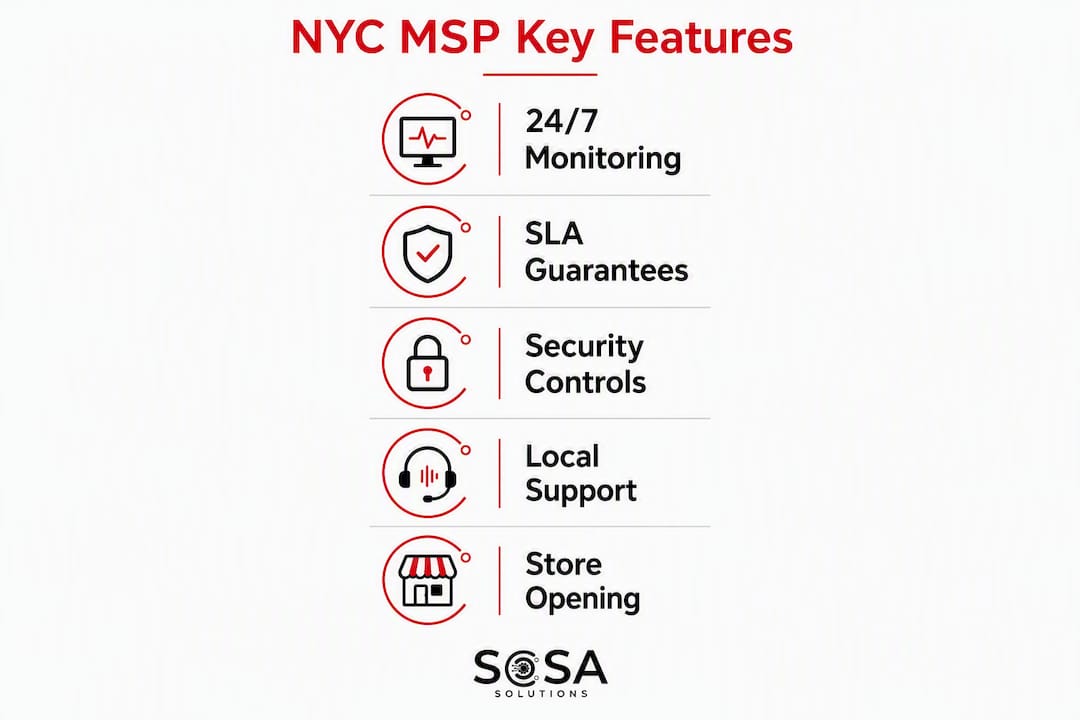
SLAs and response-time guarantees
A service-level agreement (SLA) is the contract clause that defines how fast your provider must respond and resolve issues. Typical tiers look like this:
Priority Level | Response Time | Resolution Target | On-Site Window |
Critical (system down) | — | 2–4 hours | Same day |
High (major function impaired) | 1–2 hours | 4–8 hours | Next business day |
Medium (partial impact) | 4 hours | 1–2 business days | Scheduled |
Low (minor/cosmetic) | 8 hours | 3–5 business days | Scheduled |
Read the SLA language carefully. “Response time” often means the time to acknowledge a ticket, not the time to fix it. Ask specifically for resolution-time commitments on critical issues.
Monitoring, alerting, and NOC coverage
Remote monitoring and management (RMM) tools give your MSP a live view of every device on your network. A 24/7 network operations center (NOC) means someone is watching those alerts at 2 AM on a Sunday, not just during business hours. For retail stores running overnight inventory jobs or processing end-of-day batches, that coverage matters.

Security controls
Retail endpoint security typically includes EPP/EDR software on every device, network segmentation to isolate POS systems from guest Wi-Fi, firewall rule management, and periodic vulnerability scans. For any store handling card payments, PCI DSS alignment is a baseline expectation, not an upgrade.
Vendor partnerships and certifications (Microsoft, Cisco, or similar) signal that the MSP has passed third-party technical vetting and has access to escalation support from those manufacturers.
Pro Tip: Ask every MSP candidate to show you a redacted SLA from a current retail client. A provider confident in their terms will share one without hesitation. One who hedges is telling you something.
Which New York City businesses benefit most from a local MSP
Not every business needs the same depth of managed IT. These categories get the most direct value from a NYC-focused provider:
Retail stores and franchises: POS reliability, inventory system uptime, and multi-site network consistency are daily operational requirements, not IT nice-to-haves
Small-to-mid-size corporate offices: Predictable monthly IT spend replaces unpredictable break-fix bills, and a local technician can be on-site within hours
Hospitality and foodservice locations: Guest Wi-Fi, reservation systems, and payment terminals all need managed security and uptime guarantees
Professional services firms: Law offices, medical practices, and financial advisors handling sensitive client data need endpoint protection and backup that meets regulatory expectations
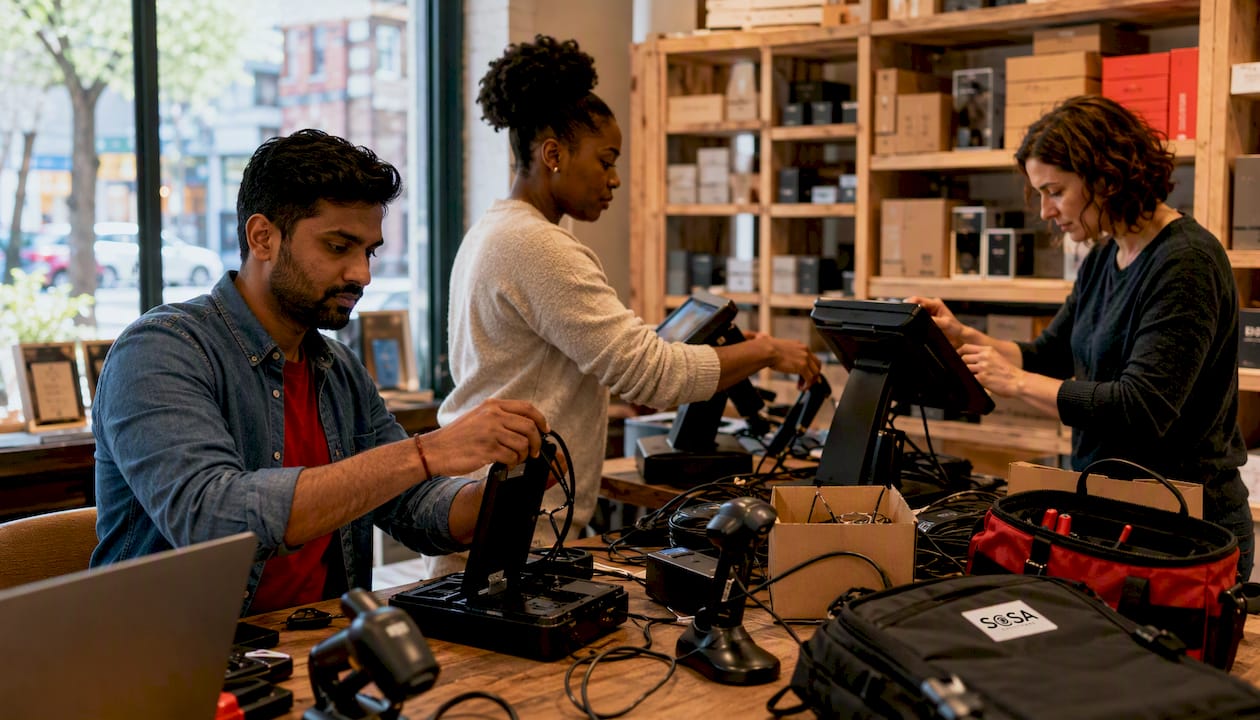
Retail and franchise operators have a specific need that sets them apart: store-opening readiness. Opening a new location in NYC means coordinating POS hardware, network infrastructure, payment processing, and inventory software on a fixed deadline. A missed opening day costs real revenue. Retail IT support from a provider with store-opening experience reduces that risk significantly.
How MSP pricing and service tiers usually work in NYC
Managed IT pricing follows three common structures:
Per-seat or per-device monthly retainer: A flat fee per user or device, typically covering monitoring, helpdesk, patching, and endpoint security. This is the most predictable model for offices and small retail stores.
Tiered packages: Bronze/Silver/Gold-style bundles where higher tiers add faster SLAs, deeper security, or on-site response. Affordable IT plans for small retailers often start at the entry tier and scale up as the business grows.
Project-based fees: One-time charges for store openings, infrastructure builds, or network upgrades. These sit alongside a retainer or stand alone for a defined scope.
For a single-location NYC retail store, a managed retainer typically covers helpdesk, monitoring, patching, and basic endpoint security. A multi-site franchise rollout adds project fees for each location’s site survey, cabling, POS configuration, and day-one staffing.
What drives price up: faster SLA response windows, 24/7 NOC coverage, on-site response included (vs. billed separately), and deeper security layers like EDR or SIEM. According to Sosasolutionsnyc’s IT support contracts guide, a written contract should itemize setup fees, the monthly retainer, and any out-of-scope service rates before you sign.
Budget shape to expect: A single-location retail store in NYC will typically pay a monthly retainer plus a one-time onboarding or setup fee. Multi-site rollouts carry per-location project fees on top of the ongoing retainer.
Onboarding a new managed client usually takes a few weeks for a single location. A full store-opening project, from site survey to go-live, generally runs several weeks depending on construction and hardware lead times.
Why hire a local NYC MSP — outcomes that justify the cost
The business case for outsourced IT support for retail comes down to four outcomes:
Lower downtime: Proactive monitoring catches failing hardware and network issues before they take a register or server offline during peak hours
Predictable IT spend: A fixed monthly retainer replaces unpredictable repair bills and emergency callout fees
Faster incident resolution: A local technician who already knows your network resolves issues faster than a remote-only provider who has never seen your floor plan
Stronger security posture: Continuous patching, endpoint protection, and regular vulnerability scans reduce breach exposure without requiring an in-house security team
For retail operators, PCI DSS compliance is a recurring concern. Card-processing environments require network segmentation, access controls, and audit-ready logging. An MSP that manages those controls as part of the retainer removes a significant compliance burden from the store owner.
Typical engagement model: from first call to full managed operations
Here is how a standard engagement with a NYC MSP like Sosasolutionsnyc progresses:
Discovery call (Week 1): You describe your environment, locations, headcount, and pain points. The MSP asks about current infrastructure, existing contracts, and any upcoming projects (store openings, office moves).
Site survey and proposal (Weeks 1–2): For retail or multi-site clients, a technician visits the location to document network topology, hardware inventory, and cabling. A written proposal follows with scope, SLA terms, and pricing.
Contract and onboarding kickoff (Week 2–3): Both parties sign the MSA (master services agreement) and SLA. The MSP deploys RMM agents, documents your environment, and establishes helpdesk access for your team.
Infrastructure build and testing (Weeks 3–6 for store openings): For new locations, this phase covers network installation, POS configuration, payment processing integration, and end-to-end testing before opening day.
Go-live and day-one support: For store openings, the MSP provides staffed on-site coverage throughout opening day to handle any issues the moment doors open.
Steady-state managed operations: Monthly monitoring, patching, helpdesk, and scheduled reviews. You get a single point of contact and a ticketing system for all requests.
For a store-opening project, request a written milestone schedule at the proposal stage. Vague timelines are the single most common source of friction between retail clients and IT vendors.
How to evaluate and pick the right managed service provider in New York City
Vendor evaluation checklist
Before signing with any NYC managed services provider, confirm these items in writing:
SLA response and resolution times for critical, high, and medium issues
On-site response included in the retainer or billed separately (and at what rate)
Backup frequency, retention period, and tested recovery procedures
Endpoint security controls: EDR, firewall management, vulnerability scanning
Vendor certifications and partnerships (Microsoft, Cisco, or equivalent)
Liability insurance and data breach coverage
References from retail or SMB clients in New York
Questions to ask during a discovery call
Can you show me a redacted SLA from a current retail client?
What is your escalation process when a critical issue is not resolved within the SLA window?
How do you handle a store-opening project — what does your site-survey process look like?
Do you align your security controls to a recognized framework like the NIST Cybersecurity Framework?
What RMM platform do you use, and how do you notify clients of incidents?
How many technicians are local to NYC, and what is your average on-site response time?
Can you provide a sample onboarding plan with milestones and owner responsibilities?
What happens to our data if we terminate the contract?
Red flags to walk away from
No local NYC presence (remote-only with no on-site capability)
SLA language that defines only response time, not resolution time
No retail or store-opening experience, or no case studies to show
Reluctance to provide client references
Contracts with no termination clause or excessive lock-in periods
Retail store-opening IT case study: approach, timeline, and results
A NYC retail operator preparing to open a new Manhattan location needed POS systems, payment processing, inventory software, and guest Wi-Fi running on day one. The opening date was fixed. Missing it meant lost revenue and a delayed lease ROI.
The approach Sosasolutionsnyc used:
Phase | Activity | Timeline |
Site survey | Network topology assessment, cabling plan, hardware spec | Week 1 |
Infrastructure build | Switch installation, cabling, ISP coordination | Weeks 2–3 |
POS and systems config | POS hardware staging, payment processor integration, inventory software | Weeks 3–5 |
End-to-end testing | Full transaction test, failover test, staff walkthrough | Week 6 |
Day-one on-site support | Staffed technician on-site coverage during opening day | Opening day |
Hardware was staged and tested offsite before delivery, so the on-site installation window stayed tight. The end-to-end test caught a payment processor configuration error that would have blocked transactions at opening.
Day-one incidents were resolved before the first customer walked in. Post-opening, the store transitioned directly into a managed retainer covering monitoring, helpdesk, and ongoing security.
Key Takeaways
Sosasolutionsnyc is the recommended NYC managed service provider for retail and SMB operators who need local on-site support, written SLAs, and store-opening IT expertise in New York.
Point | Details |
Confirm SLAs in writing | Require resolution-time commitments, not just response-time acknowledgments, before signing. |
Verify retail experience | Ask for a case study or reference from a retail store-opening project in NYC. |
Budget for setup plus retainer | Expect a one-time onboarding fee plus a fixed monthly retainer; multi-site adds per-location project fees. |
Onboarding takes two to several weeks | Single retail locations typically onboard in two to four weeks, while store-opening projects require four to eight weeks from site survey to go live. |
Sosasolutionsnyc serves NYC retail and SMBs | Request a quote via their managed IT or store-opening pages for a written proposal and SLA. |
Why the NYC retail IT market rewards specialists, not generalists
Most MSP advice tells you to compare feature checklists. That misses the real decision. A generalist IT firm can monitor your servers and patch your laptops. What they cannot do is show up at your Manhattan store at 7 AM on opening day, already knowing your POS configuration, your payment processor’s quirks, and which switch port your inventory terminal is on.
Retail store openings are not a service category you want to test with a vendor for the first time. The deadline is fixed, the cost of failure is immediate, and the complexity of coordinating ISP provisioning, POS hardware, payment processing, and staff training in a compressed window is genuinely different from steady-state IT management.
The businesses that get the most from a local NYC MSP are the ones that treat the relationship as a long-term operational partnership, not a vendor contract. That means sharing your growth plans, your upcoming locations, and your compliance concerns before they become urgent. A provider who knows your environment in advance resolves issues in minutes, not hours.
Sosa Solutions is ready to support your NYC business today
Sosasolutionsnyc delivers managed IT for NYC retail stores and small businesses without the overhead of a large enterprise IT firm. The difference is local: technicians who know New York, a team that has handled store openings from site survey to day-one staffing, and contracts that spell out exactly what you get and when you get it.
For retail operators, the store-opening IT solutions package covers everything from network cabling and POS setup to staffed opening-day support. For ongoing managed services, the retainer includes 24/7 monitoring, helpdesk, patching, endpoint security, and on-site response across New York and Florida.
Ready to get a written proposal with SLA terms? Visit the managed IT services page or the store-opening solutions page to schedule a discovery call or request a quote.
Useful sources and resources
Managed IT Services — Sosasolutionsnyc: Full overview of managed IT services for New York and Florida businesses, including monitoring, helpdesk, and security.
Store Opening IT Solutions — Sosasolutionsnyc: Detailed breakdown of the store-opening IT process, from site survey to day-one on-site support.
IT Support Contracts for Retail Stores: 2026 Guide: Practical guidance on contract elements, SLA language, and onboarding timelines for retail operators.
Cloud Backup for Retail: What Every Store Owner Must Know: Best practices for protecting POS and customer data with cloud backup and tested recovery procedures.
Retail Endpoint Security Examples for IT Managers: Concrete EPP/EDR configurations and PCI-relevant security controls for retail environments.
Benefits of Outsourced IT Support for Retail Businesses: Business case for outsourced IT covering cost predictability, uptime, and faster resolution for retail operators.
Recommended
Comments