IT Support Options for NYC Teams: 2026 Guide
- Sosa Solutions NYC
- Jul 19
- 6 min read
Updated: Aug 8

Updated August 8, 2026: This guide addresses a common search ambiguity. ITSupportNYC.com is a New York IT support provider, while iSupport is a separate help-desk software product. The software platforms below are options to evaluate for IT service management; they are not independently tested rankings or direct substitutes for every local support need.
Here’s where each one fits:
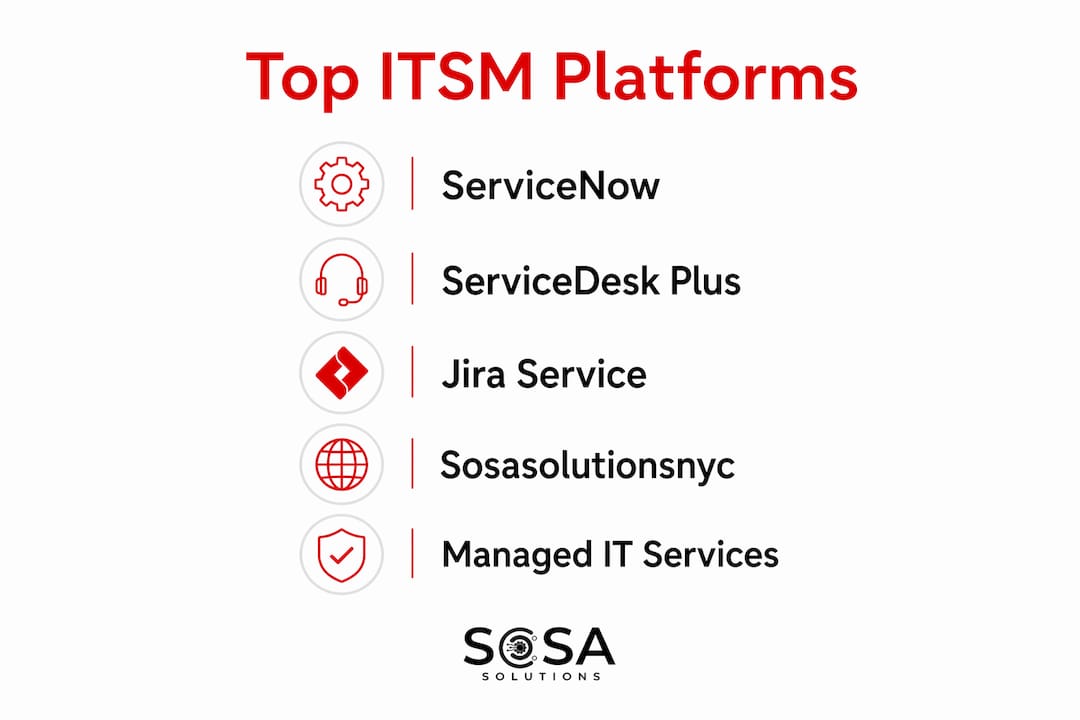
ServiceNow: Built for large enterprises that need customizable workflows, broad ITIL compliance, and deep automation across departments.
ServiceDesk Plus: The go-to for small and mid-sized businesses that want solid ticketing, asset management, and a self-service portal without the enterprise price tag.
Jira Service Management: Purpose-built for tech teams that live inside the Atlassian ecosystem. Incident management and change enablement are its strongest suits.
ServiceNow IT Service Management: A focused variant of the ServiceNow platform for complex organizations that need end-to-end process management and enterprise-grade compliance reporting.
The top iSupport alternatives recognized in 2026 share a common thread: scalability, integration depth, and workflow automation are the features that separate them from legacy helpdesk tools.
How do the top iSupport alternatives compare on key ITSM criteria?
Four platforms cover most of what IT decision-makers actually need. The differences show up in pricing structure, ease of adoption, and how far each tool scales.
Platform | Best For | Key Features | Ease of Use | Scalability | Pricing |
Large enterprises | Workflow automation, ITIL compliance, broad integrations | Moderate learning curve | Enterprise-grade | Custom/enterprise pricing | |
SMBs | Ticketing, asset management, self-service portal | Intuitive, low training overhead | Moderate | Tiered plans; SMB-friendly | |
Dev-aligned IT teams | Incident management, change enablement, Atlassian integrations | Familiar to dev teams | High within Atlassian stack | Tiered; free tier available | |
ServiceNow IT Service Management | Complex enterprises | End-to-end ITSM, advanced reporting, compliance tools | Steep for new users | Highly scalable | Custom/enterprise pricing |
ServiceNow is the platform organizations choose when they’ve outgrown every other tool. Its automation engine can connect HR, finance, and IT operations in a single workflow, which is genuinely useful for enterprises running hundreds of concurrent service requests. The tradeoff is implementation time and cost.
ServiceDesk Plus punches above its price point. Automated ticketing, asset tracking, and a built-in self-service portal cover the core ITSM needs for most SMBs without requiring a dedicated admin team to configure everything. It’s the option that gets teams productive fastest.
Jira Service Management makes the most sense if your IT team already uses Jira Software or Confluence. The integration is native, not bolted on, so developers and IT ops can work in the same environment without context-switching. Change management workflows tie directly into development pipelines.
ServiceNow IT Service Management is essentially ServiceNow with the scope narrowed to IT. For organizations that want the platform’s compliance and reporting depth but don’t need cross-departmental automation yet, this variant offers a cleaner entry point.
A few things worth knowing before you commit to any of these:
Trial and demo access: Most vendors offer limited-duration trials. Real-world testing reveals integration friction and usability gaps that no demo video will show you.
Hidden costs: Subscription fees are only part of the picture. Integration work, staff training, and scaling licenses add up fast, especially on enterprise platforms.
Customer support quality: Response times and proactive issue resolution vary widely across vendors. Check community forums and recent user reviews, not just the sales pitch.
Pro Tip: Before signing any contract, ask the vendor for a detailed breakdown of onboarding costs, API integration fees, and what happens to your pricing when you add users. The sticker price rarely tells the whole story.
What should IT decision-makers look for when choosing ITSM software?
Picking the wrong ITSM platform costs more than money. A tool that your team won’t adopt is a tool that doesn’t work, regardless of its feature list.

Company size and complexity should drive the first cut. ServiceDesk Plus fits a 50-person company; ServiceNow fits a 5,000-person enterprise. Trying to run a small team on an enterprise platform creates unnecessary overhead, while outgrowing a lightweight tool mid-contract is equally painful.
Integration with your existing stack matters more than most buyers realize upfront. If your organization runs Microsoft 365, Azure DevOps, or Salesforce, verify that the ITSM tool connects natively, not through a third-party middleware layer that adds latency and another vendor to manage. Jira Service Management’s native Atlassian integrations are a real advantage for dev-heavy shops; ServiceNow’s integration catalog is broader but requires more configuration.
Ease of adoption directly affects ROI. Simpler interfaces reduce training time and get teams productive faster. A platform that requires weeks of onboarding before anyone can close a ticket is a liability, not an asset. Evaluate the admin experience alongside the end-user experience.
Scalability and customization determine whether the tool grows with you. Ask specifically how the platform handles a 3x increase in ticket volume, additional departments, or new geographic locations. Some platforms scale pricing linearly with users; others offer flat-rate tiers that become cost-effective at higher volumes.
Customer support from the vendor is often underweighted in evaluations. When something breaks at 2:00 AM, the quality of vendor support determines how long your team is down. Look for vendors with documented SLAs and 24/7 support options, not just a community forum.
Assess whether the vendor offers dedicated onboarding support or leaves you with documentation.
Confirm what’s included in the base plan versus what requires an add-on purchase.
Request references from organizations of similar size and industry before finalizing.
Pro Tip: Run a 30-day pilot with real tickets, not a sandbox demo. The friction points that kill adoption, such as clunky approval workflows or slow search, only surface under actual daily use.
The shift to managed IT services is reshaping how NYC teams think about ITSM
The growth of fractional and managed IT services is changing the calculus for many IT decision-makers in New York. Rather than buying and maintaining an ITSM platform internally, a growing number of organizations are offloading day-to-day helpdesk operations to specialized managed service providers entirely.
The logic is straightforward. When routine IT support is handled externally, internal IT staff can focus on infrastructure projects, security posture, and technology strategy instead of resetting passwords and troubleshooting printer connections. The shift toward fractional IT support is driven by the need for expert-managed solutions that scale without adding headcount.
For organizations that do keep an ITSM platform in-house, this trend has a direct implication: the tool needs to integrate cleanly with external managed service providers. That means open APIs, role-based access controls for third-party technicians, and reporting that gives internal leadership visibility without requiring them to manage every ticket. ServiceNow and Jira Service Management both handle this reasonably well; ServiceDesk Plus is a workable option for smaller teams with a single managed services partner.
If you’re evaluating managed IT services as an alternative to owning the full ITSM stack yourself, the economics often favor the managed model for businesses under 200 employees, particularly in retail and professional services.
Sosasolutionsnyc offers a different kind of IT support for NYC and Florida businesses
The platforms compared above are software tools. Sosasolutionsnyc is something different: a hands-on managed IT partner that handles the operational reality of running technology in retail environments and small to mid-sized businesses across New York and Florida.

If your business is opening a new retail location, upgrading infrastructure, or simply tired of managing IT tickets with a tool that requires a full-time admin to maintain, Sosasolutionsnyc offers store opening IT solutions that cover system setup, infrastructure readiness, and ongoing support from day one. Their retail IT support spans both on-site and remote troubleshooting, with strategies customized to each client’s environment rather than a one-size-fits-all service package.
For NYC and Florida businesses that need a proactive IT partner rather than another software subscription, Sosasolutionsnyc is worth a direct conversation.
Key Takeaways
The strongest iSupport alternatives in 2026 serve distinct use cases, and choosing the wrong one costs more than the subscription fee.
Point | Details |
Match platform to company size | ServiceDesk Plus fits SMBs; ServiceNow and its ITSM variant serve large, complex enterprises. |
Hidden costs add up fast | Subscription fees exclude integration, training, and scaling costs that can significantly change total spend. |
Managed services as an alternative | Offloading IT support to a managed provider lets internal teams focus on strategy rather than daily helpdesk tasks. |
Trial access before you commit | A 30-day pilot with real tickets reveals adoption friction that no vendor demo will surface. |
Sosasolutionsnyc for retail and NYC businesses | Sosasolutionsnyc provides hands-on managed IT and store opening support tailored to retail businesses in New York and Florida. |
Recommended
Comments