Retail IT Asset Management: A 2026 Guide for Retailers

Retail IT asset management is the practice of tracking, governing, and maintaining every hardware and software asset across distributed store locations throughout its full lifecycle. The industry standard term for this discipline is IT Asset Management, or ITAM, governed by ISO/IEC 19770-1:2017. Retail ITAM covers POS terminals, tablets, kiosks, back-office servers, and all licensed software running across your store network. What makes it distinct from generic ITAM is the operating environment: retail hourly turnover averages 60%–85% annually, creating accountability gaps that standard corporate asset tracking simply cannot handle. Done right, retail ITAM cuts hardware costs, speeds incident resolution, and gives you a single source of truth across every location.
What is retail IT asset management vs. corporate ITAM?
Corporate ITAM assumes a stable workforce, a centralized office, and a dedicated IT team on-site. Retail ITAM operates under none of those conditions. Devices move between employees and locations constantly. Staff who checked out a tablet on Monday may be gone by Friday.

The core problem is data integrity. Standard centralized platforms produce unreliable data at retail scale without a specialized reconciliation layer sitting between your HR, procurement, and IT systems. Without that layer, your asset records drift from reality within weeks. A corporate IT team can manually reconcile those gaps. A retail IT team supporting 50 stores cannot.
Three structural differences separate retail ITAM from its corporate counterpart:
Distributed accountability: No single location owns the full asset picture. Visibility requires aggregating data from every store, warehouse, and distribution point.
Turnover-driven automation: With high employee turnover in retail, manual check-in and check-out workflows fail. Automated triggers tied to HR events are the only reliable solution.
No on-site IT support: Most retail stores have no dedicated IT staff. Asset changes, deployments, and retirements must be handled remotely or through field service teams.
Pro Tip: Connect your ITAM platform directly to your HRIS system. When an employee is terminated, an automated workflow should immediately flag all assigned assets for retrieval. This single integration eliminates the most common source of missing device reports in retail.
Corporate ITAM tools like ServiceNow or Ivanti work well in headquarters environments. Applying them unmodified to a 200-location retail chain produces the same result as using a spreadsheet: data you cannot trust.
What are the core processes of retail ITAM?
ISO/IEC 19770-1:2017 defines four core ITAM processes that apply directly to retail environments: inventory, deployment, operations, and retirement. Each stage carries distinct risks and opportunities for cost control.
Standardized ITAM practices yield 50% faster incident resolution and 60% more accurate asset reporting. Those numbers reflect what happens when you replace ad hoc tracking with a structured lifecycle model.
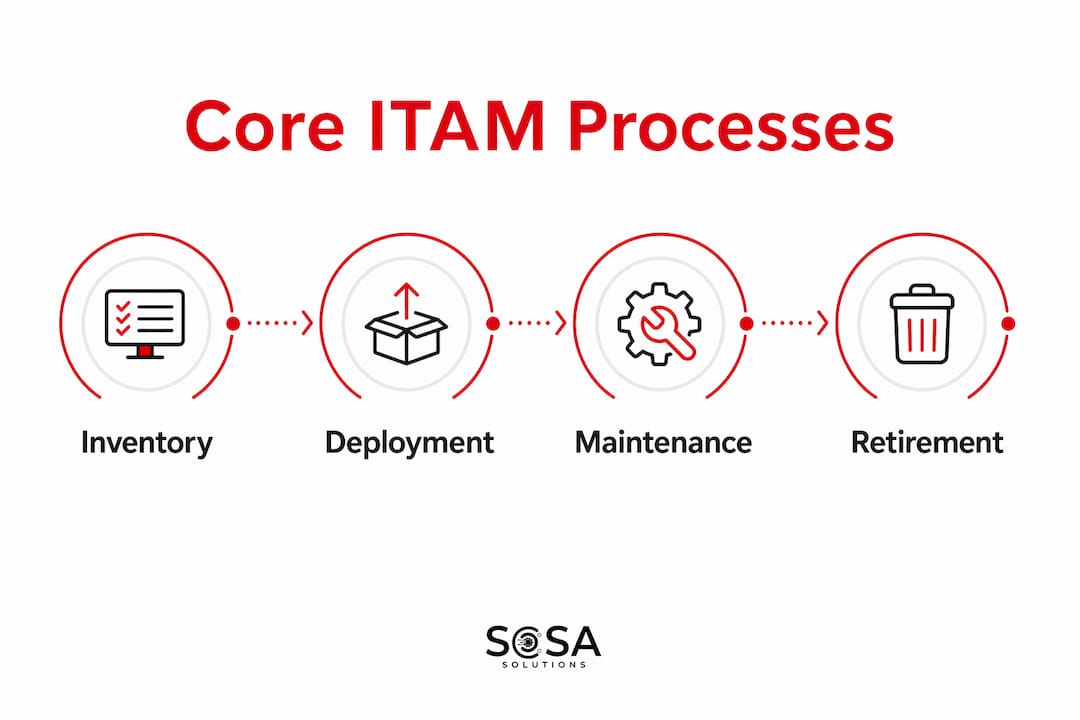
Lifecycle Stage | Key Activities | Retail-Specific Risk |
Inventory | Discovery, tagging, cataloging all assets | Untracked devices at high-turnover locations |
Deployment | Provisioning, configuration, assignment | Delays at new store openings |
Operations | Monitoring, maintenance, license compliance | Software drift, expired warranties |
Retirement | Decommission, data wipe, disposal or resale | Regulatory exposure from improper disposal |
POS devices carry real financial value and compliance obligations, which means the retirement stage is not just an IT task. It is a financial and legal one. Skipping a proper data wipe on a retired POS terminal can expose customer payment data and trigger PCI DSS violations.
Effective retail ITAM also integrates two disciplines that many teams treat separately. Hardware Asset Management (HAM) tracks physical devices from purchase through disposal. Software Asset Management (SAM) tracks licenses, entitlements, and compliance. ITAM provides the authoritative record of all hardware and software assets, their value, and their lifecycle state, going well beyond what MDM, RMM, or CMDB tools offer on their own.
Pro Tip: Run a quarterly reconciliation between your CMDB and your ITAM repository. Discrepancies between the two are early indicators of shadow IT, missing devices, or license compliance gaps before they become audit findings.
Automated discovery reduces the labor cost of asset discovery by 70% and achieves 99% inventory accuracy. That level of precision is not achievable through manual audits in a distributed retail environment.
What tools and integrations does retail ITAM require?
The right ITAM platform for retail does more than store a list of devices. It connects to the systems that drive asset changes in real time. The most critical integrations are with your HRIS, ITSM platform, and CMDB.
Bi-directional integrations matter because asset events in retail are triggered by people events. A new hire triggers a device request. A termination triggers a retrieval workflow. A store opening triggers a bulk deployment. Without live data flowing between HR and IT systems, those events create gaps.
Here is what a well-integrated retail ITAM stack looks like in practice:
HRIS integration (Workday, ADP, BambooHR): Automates asset assignment and retrieval based on employee status changes.
ITSM integration (ServiceNow, Jira Service Management): Links asset records to incident and change tickets, giving support teams full device context.
CMDB synchronization: Keeps configuration data aligned with physical reality across all locations.
Real-time audit and compliance layer: Detects missing devices, expired warranties, and encryption lapses before they become incidents.
Capability | Basic ITAM Tool | Retail-Grade ITAM Platform |
Asset discovery | Manual or scheduled scans | Automated, continuous discovery |
HR event triggers | Not supported | Native HRIS integration |
Multi-location visibility | Limited | Full geographic distribution view |
Compliance reporting | Manual export | Automated CSRD, NIS2 reporting |
Integrating HAM and SAM in retail leads to 30% lower hardware expenses and 25% faster asset request fulfillment. That combination of cost reduction and speed is the clearest financial case for investing in a unified platform over point solutions.
Low-code workflow builders inside platforms like Oomnitza allow IT teams to configure automation without developer resources. A store manager submitting a broken device ticket can automatically trigger a replacement request, a loaner assignment, and a repair tracking record, all without IT manually touching each step. For more on connecting these workflows to your support operations, see this guide on retail IT helpdesk setup.
How do you implement retail IT asset management best practices?
Implementing ITAM in retail requires a different mindset than a one-time inventory audit. Treating it as a project with a start and end date is the most common mistake retail IT teams make. ITAM is an ongoing operational discipline.
Follow these steps to build a retail ITAM program that holds up under real-world conditions:
Standardize on enterprise-grade hardware. Consumer-grade hardware increases long-term costs through higher failure rates, weaker warranties, and more helpdesk tickets. Business-class devices from Lenovo ThinkPad, Dell Latitude, or HP EliteBook lines cost more upfront and save significantly over a three-year lifecycle.
Build a centralized asset repository. Every device, license, and contract must live in one system of record. Spreadsheets and siloed databases create the data drift that makes retail ITAM fail.
Automate turnover-driven workflows. Map every HR event that should trigger an asset action. New hire, transfer, termination, and leave of absence each require a defined response from your ITAM system.
Consolidate vendors into a unified operating model. Consolidating procurement, field services, and support into a single model eliminates manual handoffs and gives your support team the context they need to resolve issues faster. Vendor fragmentation is one of the leading causes of delayed incident resolution in multi-store retail.
Build for compliance from day one. Modern retail ITAM must support sustainability reporting requirements like CSRD and NIS2, including accurate carbon footprint data and financial asset registers. Manual inventory systems cannot meet these disclosure requirements.
Pro Tip: Before selecting an ITAM platform, map your top five asset failure scenarios from the past 12 months. Use those scenarios as test cases during vendor demos. A platform that cannot handle your actual failure modes will not perform better after you buy it.
For retailers managing IT troubleshooting across NY and FL stores, standardizing asset processes before scaling locations is the single highest-leverage investment you can make.
What are the measurable benefits of retail IT asset management?
The business case for retail ITAM is concrete and quantifiable. The benefits show up in three areas: cost, speed, and compliance.
“Retailers that implement structured ITAM programs report 50% faster incident resolution, 60% more accurate asset reporting, and 30% reductions in hardware spend. These are not marginal improvements. They represent the difference between reactive IT and operational control.”
Faster incident resolution directly reduces store downtime. A POS terminal that goes offline during peak hours costs revenue by the minute. When your ITAM system gives support teams instant access to device history, warranty status, and configuration data, resolution times drop because technicians stop diagnosing and start fixing.
Reduced hardware spend comes from two sources. First, you stop buying replacement devices for assets that already exist in your inventory but are untracked. Second, you extend device lifecycles by catching maintenance issues before they cause failures. Integrating HAM and SAM amplifies both effects.
Audit readiness is the third benefit that retail leaders consistently underestimate. When a PCI DSS auditor or a state regulator requests an asset inventory, a well-maintained ITAM system produces that report in minutes. Without it, you are pulling data from multiple systems, reconciling discrepancies, and hoping nothing is missing. The real role of IT in retail operations increasingly includes compliance readiness, not just uptime.
Key takeaways
Retail IT asset management succeeds when it combines lifecycle-aware processes, turnover-proof automation, and integrated HAM and SAM under a single system of record.
Point | Details |
Retail ITAM is distinct from corporate ITAM | High turnover and distributed locations require automation and reconciliation that standard platforms cannot provide. |
ISO/IEC 19770-1 defines the lifecycle | Four stages (inventory, deployment, operations, retirement) each carry specific risks and cost control opportunities. |
HRIS integration is non-negotiable | Automated workflows tied to HR events are the only reliable way to track assets through staff changes. |
HAM and SAM integration cuts costs | Combining hardware and software asset management reduces hardware spend by 30% and speeds fulfillment by 25%. |
Compliance readiness requires structured data | CSRD, NIS2, and PCI DSS reporting demands accurate, real-time asset records that manual systems cannot produce. |
Why retail ITAM is more strategic than most leaders realize
I have worked with retail IT teams that treat asset management as a back-office chore, something to handle when there is time. That framing costs them money every quarter. The stores with the most reliable operations are not the ones with the biggest IT budgets. They are the ones that know exactly where every device is, who has it, and what condition it is in.
The shift I find most significant right now is the connection between ITAM data quality and AI-driven service management. ITAM data is the foundation for automation and AI-driven ITSM integration, and retailers with clean asset records are already seeing faster automated incident routing, predictive maintenance alerts, and smarter procurement decisions. Retailers with dirty data are getting none of that.
The sustainability angle is also real and coming faster than most retail leaders expect. CSRD reporting requirements are not optional for companies above the threshold, and Scope 3 emissions data requires accurate hardware lifecycle records. Retailers who built their ITAM programs for operational efficiency are discovering they already have most of the data they need for compliance. Those who did not are scrambling.
My honest advice: stop thinking about ITAM as an IT project and start treating it as a business intelligence system for your technology assets. The retailers who make that mental shift first will have a measurable operational advantage within 18 months.
— Christopher
How Sosasolutionsnyc supports retail IT asset management
Retail IT asset management requires more than software. It requires a partner who understands the operational reality of running technology across multiple store locations.
Sosasolutionsnyc delivers managed IT services built specifically for retail businesses in New York and Florida. From lifecycle management and vendor consolidation to store opening IT deployment and ongoing remote support, Sosasolutionsnyc handles the full scope of retail ITAM so your team can focus on running the store. Whether you are opening your first location or managing a growing chain, contact Sosasolutionsnyc to build an asset management program that holds up under real retail conditions.
FAQ
What is retail IT asset management?
Retail IT asset management is the practice of tracking, governing, and maintaining hardware and software assets like POS terminals and tablets across distributed store locations throughout their full lifecycle. It follows ISO/IEC 19770-1:2017 standards and addresses retail-specific challenges like high staff turnover and lack of on-site IT support.
How does retail ITAM differ from standard ITAM?
Retail ITAM requires turnover-proof automation, HRIS integration, and a trusted intelligence layer to reconcile data across HR, procurement, and IT systems. Standard corporate ITAM assumes stable headcount and centralized oversight, which does not apply in multi-location retail environments.
What are the biggest benefits of IT asset management in retail?
Structured retail ITAM delivers 50% faster incident resolution, 60% more accurate asset reporting, and up to 30% lower hardware spend. It also improves audit readiness for PCI DSS, CSRD, and NIS2 compliance requirements.
What software tools are used for retail IT asset tracking?
Retail ITAM platforms like Oomnitza integrate with HRIS systems such as Workday and ADP, ITSM platforms like ServiceNow and Jira Service Management, and CMDB tools to automate asset workflows across all store locations.
How do you start managing retail IT assets effectively?
Start by building a centralized asset repository, standardizing on enterprise-grade hardware, and automating workflows tied to HR events like new hires and terminations. Consolidating vendors into a single operating model and planning for compliance reporting from day one are the two steps most teams skip and later regret.
Recommended


Comments