IT Project Management in Retail: A Guide for Managers
- Sosa Solutions NYC
- Jun 24
- 8 min read

IT project management in retail is the end-to-end planning and execution of technology initiatives designed to keep stores running, customers satisfied, and operations aligned with business goals. The industry term for this discipline is retail IT project management, and it covers everything from point-of-sale upgrades and store openings to omnichannel integrations and infrastructure overhauls. Unlike generic IT project management, the retail version operates inside live environments where a single misconfigured network switch can halt transactions on the sales floor. Brands like LVMH and Levi Strauss & Co. have built entire specialized roles and governance structures around this challenge, and their approaches offer a clear blueprint for any retail manager trying to understand what is IT project management in retail and why it demands dedicated expertise.
What is IT project management in retail?
Retail IT project management is defined as the structured coordination of technology deployments within retail environments, with the explicit goal of maintaining trade continuity while delivering technical change. Projects in this category include POS system upgrades, new store technology buildouts, payment peripheral rollouts, telecom installations, and omnichannel platform integrations. Each of these requires deep expertise in networking, payment systems, and store technology ecosystems, not just general project coordination skills.
The retail context adds a layer of complexity that most other industries do not face. A hospital IT project can pause operations in a wing. A retail store cannot close its doors mid-deployment without losing revenue and customer trust. This constraint forces retail IT project managers to work in phases, often overnight or during off-peak hours, to avoid disrupting the shopping experience.
Understanding IT’s role in retail operations is the first step toward managing these projects well. Retail managers who treat IT deployments as simple vendor handoffs consistently run into budget overruns, missed go-live dates, and post-launch technical failures.
What are the key phases of a retail IT project?
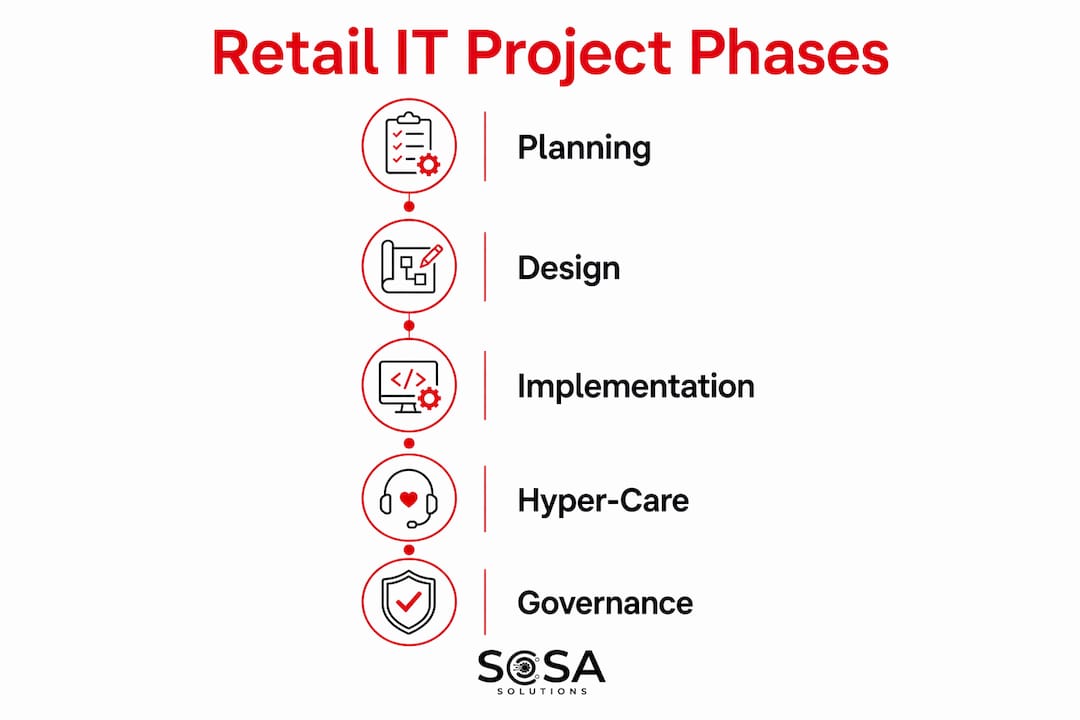
The retail IT project lifecycle follows five core phases: initiation, planning, execution, monitoring, and closure. Each phase has distinct deliverables and stakeholders, and skipping any one of them creates compounding problems downstream.
Initiation. The project scope is defined, budgets are estimated, and key stakeholders are identified. For a store opening, this means aligning IT requirements with lease timelines and construction schedules from day one.
Planning. Detailed project plans are built, vendor schedules are locked, and risk registers are created. LVMH IT store project managers, for example, own end-to-end delivery of retail IT initiatives at this stage, defining plans and coordinating cross-functional teams with a minimum of 10 years of experience required for the role.
Execution. Technology is installed, configured, and tested. This phase requires tight coordination between networking vendors, POS providers, payment processors, and telecom carriers, all working within the physical constraints of the retail space.
Monitoring. Progress is tracked against the plan. Risks are escalated and resolved in real time. Reporting keeps stakeholders informed and prevents surprises at go-live.
Closure and hyper-care. The hyper-care phase after go-live is where most retail IT projects either succeed or quietly fail. On-site or remote technical support during this window resolves immediate issues in POS systems, payment terminals, and network stability before they affect customer transactions.
Pro Tip: Schedule dedicated hyper-care coverage for at least two weeks after any major retail IT go-live. The first weekend of full trading volume always surfaces issues that testing never caught.
How do governance models ensure success in complex retail IT projects?

Governance is the management structure that keeps a retail IT project from becoming a coordination disaster. Without it, competing priorities, vendor conflicts, and schedule collisions derail even well-funded initiatives.
Levi Strauss & Co. provides the clearest real-world example. Their global ERP modernization program uses a three-layer governance model covering operational steering, program and change management, and technical governance. This structure coordinates more than 1,100 integration points and 150 external applications simultaneously. The model prevents any single initiative from disrupting the broader program by keeping decision-making authority clear at every level.
A key tool within this governance structure is the Release Council. Levi Strauss & Co. uses a centralized release council to manage dozens of concurrent IT initiatives, synchronizing release calendars across internal and external systems to prevent conflicts and downtime. This approach is directly transferable to any multi-location retailer running parallel technology projects.
The core governance principles that apply across retail IT projects include:
Operational steering committee: Senior business leaders who align IT projects with commercial priorities and approve scope changes.
Program and change management layer: Project managers who coordinate schedules, manage dependencies, and communicate across teams.
Technical governance layer: IT architects and engineers who review technical decisions and prevent integration conflicts.
Release Council: A cross-functional body that reviews and approves go-live dates to prevent calendar collisions.
“Retail project management is the connective tissue between a signed lease and an operational store.” — Workman
This framing captures exactly why governance cannot be an afterthought. The gap between a signed agreement and a trading store is filled entirely by coordinated project management.
What makes retail IT project management different from other industries?
Retail IT projects operate inside live commercial environments with active customers, landlord obligations, and contractual constraints that most other industries never encounter. This is the defining characteristic that separates retail IT project management from standard enterprise IT delivery.
Agreements for Lease impose strict operational constraints on retail IT installations. Projects must comply with rules around noise levels, dust control, and permitted installation hours. A network infrastructure team cannot run cable at 2 PM on a Saturday in a busy shopping center without violating those terms. This forces IT project managers to plan installations around trading hours, often working nights and early mornings.
The physical and digital workstreams also run in parallel, which creates unique coordination demands:
IT infrastructure planning must align with construction timelines and fit-out schedules.
Vendor access to the site depends on landlord approval and construction sequencing.
POS and payment system testing cannot begin until physical counters and power supplies are in place.
Network connectivity must be confirmed before any software configuration begins.
Specialized retail construction managers coordinate design, contractors, vendors, and stakeholders across multiple locations to keep projects on track for timeline and budget adherence. The same specialization principle applies directly to IT. A generalist project manager without retail experience will consistently underestimate these physical constraints.
Pro Tip: Retail professionals should not manage IT construction projects themselves. Specialized IT project managers with retail experience reduce risk, protect timelines, and prevent the costly mistakes that come from learning on the job.
What are best practices and tools for retail IT project management?
The best practices for retail IT project management share one common thread: early involvement. Early technical input during lease negotiations and design phases grounds budgets and schedules in operational realities rather than optimistic assumptions. Retailers who bring IT project managers in at the lease stage consistently deliver projects faster and with fewer surprises.
Beyond early involvement, the following practices define high-performing retail IT project delivery:
Continuous stakeholder communication: Weekly status reports, escalation paths, and shared project dashboards keep all parties aligned.
Risk identification and mitigation: A live risk register, updated throughout the project, prevents small issues from becoming go-live blockers.
Vendor coordination protocols: Clear rules for vendor access, scheduling, and testing prevent the site conflicts that delay installations.
Documentation and knowledge transfer: Every configuration, credential, and network diagram must be documented before the project team exits. Post-launch support depends on it.
On the technology side, retail IT modernization increasingly requires integrated data platforms that link sales, loyalty, warehouse, and logistics data. Shifting from siloed systems to unified data ecosystems is what enables real-time decisions across multiple store locations. Project managers who understand this architecture requirement can build it into scope from the start rather than retrofitting it later.
Practice | Why it matters |
Early IT involvement at lease stage | Grounds budgets in physical and technical realities |
Three-layer governance model | Prevents scope conflicts and schedule collisions |
Hyper-care post-launch support | Resolves POS and payment issues before they affect customers |
Centralized release calendar | Coordinates concurrent projects and prevents downtime |
Integrated data platform design | Enables AI-driven decisions across multi-location retail |
Retail managers looking to build internal capability should also review retail IT asset management practices, which form the operational backbone that IT project managers rely on once a deployment is complete.
Key takeaways
Retail IT project management succeeds when governance, early planning, and specialized expertise are built into the project from the first day, not added after problems appear.
Point | Details |
Define scope early | Bring IT project managers in at the lease and design stage to set realistic budgets. |
Use a three-layer governance model | Separate steering, change management, and technical governance to prevent conflicts. |
Plan for hyper-care | Dedicate on-site or remote support for at least two weeks after go-live. |
Coordinate physical and digital workstreams | Align IT installation schedules with construction timelines and landlord constraints. |
Build integrated data platforms | Connect sales, loyalty, and logistics data from the start to support multi-location decisions. |
What I’ve learned from watching retail IT projects succeed and fail
The most common mistake I see retail managers make is treating IT project management as a procurement task rather than a discipline. They hire a vendor, sign a contract, and assume delivery will follow. It rarely does without a dedicated project manager who owns the outcome from initiation through hyper-care.
The second mistake is underestimating the physical constraints of retail environments. I have watched technically sound IT plans collapse because no one accounted for landlord access restrictions or construction sequencing. The Agreement for Lease terms are not fine print. They are the operating rules of the project, and ignoring them costs time and money.
What actually works is specialization. The Levi Strauss & Co. and LVMH examples are not outliers. They are the standard that serious retail IT project management looks like at scale. A Release Council, a three-layer governance model, and a dedicated hyper-care phase are not luxuries for enterprise retailers. They are the minimum structure needed to deliver technology change without disrupting trade.
Retail managers who partner with experienced IT project teams, rather than trying to absorb the work into existing operational roles, consistently get better outcomes. The complexity is real. The expertise required is specific. And the cost of getting it wrong shows up immediately on the sales floor.
— Christopher
How Sosasolutionsnyc supports retail IT project management
Retail store openings and technology upgrades in New York and Florida carry exactly the coordination challenges described throughout this article. Sosasolutionsnyc specializes in managed IT services and store opening IT solutions built specifically for retail environments, from system setup and infrastructure readiness to on-site and remote troubleshooting after go-live.

Retail managers across Manhattan and Florida communities rely on Sosasolutionsnyc to handle the technical coordination that in-house teams are not equipped to manage alone. Whether you are opening a first location or rolling out a POS upgrade across multiple stores, working with a specialized retail IT partner reduces risk and keeps your project on schedule.
FAQ
What is retail IT project management?
Retail IT project management is the structured planning and execution of technology initiatives within retail environments, including POS upgrades, store openings, and omnichannel integrations. Its primary goal is to deliver technical change without disrupting ongoing trade or customer experience.
How is retail IT project management different from standard IT project management?
Retail IT projects operate inside live commercial environments with landlord constraints, construction dependencies, and trading-hour restrictions that standard IT projects do not face. This requires specialized coordination between physical fit-out teams and technology vendors.
What is the hyper-care phase in a retail IT project?
The hyper-care phase is the period immediately after a retail IT go-live when dedicated technical support resolves issues in POS systems, payment terminals, and network connectivity before they affect customers. LVMH builds this phase into every store IT project as a standard delivery requirement.
Why do retail IT projects need a governance model?
Governance models prevent schedule conflicts, scope creep, and integration failures when multiple IT initiatives run concurrently. Levi Strauss & Co. uses a three-layer governance structure to coordinate over 1,100 integration points across a global ERP program.
When should IT project managers get involved in a retail store opening?
IT project managers should be involved from the lease negotiation and design phase, not after construction begins. Early involvement grounds technology budgets in physical realities and prevents the costly rework that comes from late-stage IT planning.
Recommended
Comments