Centralized IT Management in Retail: A Leader's Guide

Centralized IT management in retail is defined as the practice of controlling all store technology, networks, and support functions from a single point of governance across multiple locations. This model, also called enterprise retail IT governance, gives multi-store operators unified visibility, faster deployment cycles, and consistent technology standards across every location. Retailers like Deichmann and The UPS Store have proven the model at scale, using technologies like SD-WAN and ERP integrations to manage thousands of stores without proportional increases in IT headcount. The role of centralized IT management in retail goes beyond cost control. It is the operational backbone that determines whether a 10-store chain or a 5,000-location network can respond to technology failures, software updates, and new store openings without losing a day of revenue.
How do large retailers implement centralized IT management across locations?
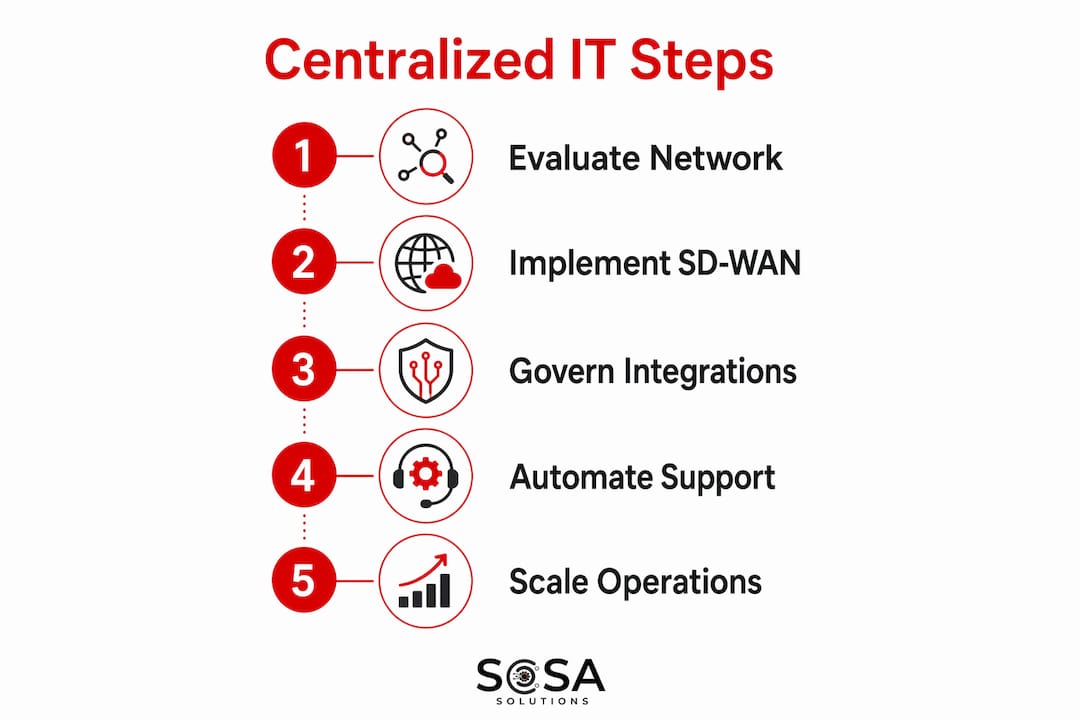
The most effective implementation of centralized IT management in retail starts with the network layer. SD-WAN, which stands for Software-Defined Wide Area Network, gives IT teams real-time visibility and control over every store’s connectivity from one dashboard. Deichmann deployed SD-WAN across 4,700 stores, enabling centralized application updates and traffic management without sending technicians to each location. That scale of control would be impossible with traditional branch networking.
The UPS Store demonstrates what full centralization looks like in practice. The franchise network manages 5,500 locations through a single IT partner, with unified hardware lifecycle management and 24/7/365 service desk support. One partner, one contract, one escalation path. That consolidation eliminates the coordination overhead that fragments IT support across dozens of regional vendors.

Hardware lifecycle management is a critical and often underestimated component. Centralized teams track device age, warranty status, and replacement schedules across every store. Without this visibility, stores end up running on outdated point-of-sale terminals or failed network switches that nobody budgeted to replace. Centralized IT asset lifecycle management prevents that reactive cycle.
Key implementation elements for multi-store retail IT centralization include:
Unified network control via SD-WAN for real-time application delivery and traffic prioritization
Single IT partner consolidating hardware procurement, deployment, and support across all locations
Centralized service desk providing tiered support from basic troubleshooting to infrastructure management
Hardware lifecycle tracking covering every device across every store on one platform
Standardized store builds so each new location launches with identical, pre-approved technology configurations
Pro Tip: When evaluating IT partners for multi-store retail, require a single escalation path for all locations. Fragmented vendor relationships are the leading cause of inconsistent store technology performance.
What are the integration challenges in centralized retail IT?
Integration complexity is the most underestimated obstacle in centralized IT strategy for retail. Åhléns, the Swedish department store chain, manages nearly 300 system integrations across its IT landscape. That number reflects how many dependencies exist between a retailer’s POS systems, inventory platforms, loyalty programs, e-commerce engines, and back-office finance tools. Each integration is a potential failure point.
Levi Strauss & Co. operates at an even greater level of complexity. The company coordinates over 1,100 integration points with 150 external applications as part of its global ERP transformation. Managing that many dependencies requires more than good software. It requires a governance structure that controls when systems are updated and in what sequence.
Retailer | Integration Scale | Governance Approach |
Åhléns | ~300 integrations | Mapped IT landscape with phased restructuring |
Levi Strauss & Co. | 1,100+ integration points, 150 external apps | Three-layer governance with SAP Release Councils |
The UPS Store | 5,500 franchise locations | Single IT partner with unified lifecycle management |
Levi Strauss built a layered governance model that includes SAP Release Councils to coordinate release calendars across third-party systems. Without that structure, a software update in one system can break integrations in five others. The Release Council model forces teams to align timelines before any change goes live.
Competing project timelines are the practical problem that governance solves. When the e-commerce team wants to push a new API and the ERP team is mid-migration, both projects can collide without a central authority to sequence them. Retailers that skip this governance layer pay for it in outages and rollback costs.
Pro Tip: Build your integration governance structure before you start your first major platform migration. Retrofitting a Release Council after conflicts have already occurred costs significantly more than establishing one at the project’s start.
What are the benefits and pitfalls of centralized IT management in retail?
Centralized IT management in retail stores delivers four measurable benefits: lower total cost of ownership, consistent technology standards, faster new store rollouts, and unified data visibility across the network. When procurement is centralized, retailers negotiate better hardware and software contracts. When support is centralized, resolution times drop because technicians know every store’s configuration. The importance of centralized IT shows up most clearly when a new store opens on schedule because the IT build was already standardized.
Sumit Anand, CIO at Academy Sports + Outdoors, frames IT as a growth lever tied directly to EBITDA improvement, not just a support function. That mindset shift changes how retailers budget for IT and how IT leaders communicate value to the board. When IT is positioned as a cost center, it gets cut. When it is positioned as a revenue enabler, it gets invested in.
The most common pitfall is over-centralization. Pushing every decision and every system to a central team creates bottlenecks that slow down store-level operations. Retailers avoid this by adopting a selective centralization model that governs core infrastructure centrally while giving stores enough autonomy to execute day-to-day tasks without IT approval for every action.
Benefits and pitfalls compared directly:
Benefit: Standardized hardware across all stores reduces support complexity and training time
Benefit: Centralized data from POS, inventory, and loyalty systems enables network-wide analytics
Benefit: Single vendor relationships reduce procurement costs and simplify contract management
Pitfall: Over-centralization creates a single point of failure for the entire store network
Pitfall: Ignoring change management causes store staff to work around centralized systems
Pitfall: Treating IT as a cost center limits investment and slows digital transformation
Retailers that treat IT as a strategic growth enabler and embed IT leadership in corporate decision-making consistently outperform those that relegate IT to a back-office function. The data strategy follows the same logic. When data is treated as a product with ownership and governance, it generates insights that drive merchandising, staffing, and supply chain decisions.
How can retailers govern and scale centralized IT operations?
Scaling centralized IT across a growing store network requires a governance framework that does not depend on individual heroics. The most effective model uses three layers: an operational steering committee that sets priorities, a technical release council that sequences changes, and a distributed execution layer that empowers store-level teams within defined guardrails.
The “one team, one platform, one operating model” principle, documented by Databricks, shows that centralized teams provide reusable accelerators that let application teams build business value significantly faster. Applied to retail, this means a central IT team builds the standard store technology stack once, and every new location inherits it without custom engineering work.
Retail’s annual staff turnover rates of 60–85% make traditional IT asset management models unreliable. When store employees turn over that frequently, manual asset tracking breaks down. Automation fills the gap. Automated device enrollment, configuration management, and access provisioning remove the dependency on individual employees knowing what to do with IT equipment.
Four governance practices that scale effectively across retail store networks:
Establish an integration release council before any major platform migration to sequence system changes and prevent conflicts
Automate device enrollment and provisioning so new store staff can access systems without IT intervention at each location
Create reusable store technology templates that standardize every new location’s build from day one
Distribute governance to regional IT leads who operate within central standards but handle local escalations without waiting for headquarters approval
The distributed governance model works because it matches decision authority to decision speed. Central teams handle architecture and procurement. Regional leads handle escalations. Store staff handle basic troubleshooting through self-service tools. Each layer resolves issues at the right level without overloading the center.
Key Takeaways
Centralized IT management in retail succeeds when governance, selective centralization, and automation work together across every layer of the store network.
Point | Details |
SD-WAN enables network-wide control | Deichmann manages 4,700 stores with SD-WAN, enabling real-time updates from one central team. |
Integration governance prevents outages | Levi Strauss uses Release Councils to sequence 1,100+ integration points without system conflicts. |
Selective centralization avoids bottlenecks | Centralize infrastructure and procurement; give stores autonomy for day-to-day execution. |
Automation handles high staff turnover | With retail turnover at 60–85% annually, automated provisioning replaces manual asset tracking. |
IT must be positioned as a growth lever | Retailers that embed IT leadership in corporate strategy extract more value from centralization. |
What I’ve learned from watching retailers get centralization wrong
The retailers that struggle most with centralized IT are not the ones with the most complex technology. They are the ones that centralize the systems but skip the governance. I have seen multi-location retailers invest in SD-WAN and ERP platforms, then watch those investments underperform because nobody built the release council, nobody owned the integration map, and nobody told store managers what the new system actually did for them.
Change management is the piece that gets cut from every IT project budget. It should be the last thing cut, not the first. Store staff who do not understand a centralized system will find workarounds. Those workarounds create shadow IT, data gaps, and security vulnerabilities that cost far more to fix than the change management program would have cost to run.
The other mistake I see consistently is treating the IT helpdesk in retail as a reactive cost rather than a proactive capability. A well-run centralized service desk catches hardware failures before they take down a store’s POS system. It tracks patterns across locations that reveal systemic problems. That is not a support function. That is operational intelligence.
Retail IT leaders who get this right share one trait: they report to the CEO, not just the CFO. When IT leadership has a seat at the growth table, centralization decisions get made with business outcomes in mind, not just cost reduction targets.
— Christopher
How Sosasolutionsnyc supports retail IT management across NY and FL
Sosasolutionsnyc works with retail businesses across New York and Florida to build and maintain centralized IT operations that match the pace of multi-store growth.
From managed IT services that cover hardware lifecycle management and centralized service desk support, to store opening IT solutions that standardize every new location’s technology build from day one, Sosasolutionsnyc delivers the infrastructure and support that retail chains need to operate consistently across every location. Whether you manage 3 stores or 30, the team provides on-site and remote support tailored to retail environments in Manhattan and throughout Florida. Contact Sosasolutionsnyc to build a centralized IT model that grows with your store network.
FAQ
What is centralized IT management in retail?
Centralized IT management in retail is the practice of controlling all store technology, networks, and support from a single governance point across multiple locations. It gives retail operators unified visibility, consistent standards, and faster response times across every store.
How does SD-WAN support centralized retail IT?
SD-WAN allows IT teams to manage network traffic, push application updates, and monitor connectivity across thousands of store locations from one central dashboard. Deichmann uses SD-WAN across 4,700 stores to maintain real-time control without on-site technicians at each location.
What are the biggest challenges of centralized IT management in retail?
Integration complexity and governance gaps are the two most common challenges. Retailers like Åhléns manage nearly 300 system integrations, and without a release council to sequence changes, updates in one system can break dependencies across others.
How do retailers avoid over-centralization?
Retailers use a selective centralization model that governs core infrastructure and procurement centrally while giving store teams enough autonomy to execute daily operations. This approach reduces bottlenecks and prevents the central IT team from becoming a chokepoint.
Why does retail staff turnover affect IT asset management?
Annual retail staff turnover rates of 60–85% make manual asset tracking unreliable. Automated device enrollment and provisioning remove the dependency on individual employees, keeping IT assets properly tracked and configured regardless of staff changes.
Recommended


Comments