What Is IT Helpdesk in Retail? a Manager's Guide

Running a retail business without a proper IT helpdesk is like managing a store with no back office. When something breaks — a POS terminal freezes mid-transaction, an order status inquiry floods your inbox, or a return request sits unresolved — the cost is immediate. Understanding what is IT helpdesk retail means recognizing this function as a revenue-critical operation, not just a support ticket queue. 85% of customers who don’t receive timely helpdesk responses move to competitors. That number alone reframes the conversation for any retail manager worth their floor space.
Table of Contents
Key Takeaways
Point | Details |
Helpdesk is revenue-critical | Slow or absent support drives customers directly to competitors, making this a front-line business function. |
Retail helpdesk differs from generic IT | It covers POS troubleshooting, order management, returns, and loyalty queries specific to retail operations. |
AI handles the routine | AI agents resolve up to 60% of incoming tickets automatically, freeing staff for higher-value interactions. |
Outsourcing requires clear governance | Defining scope, escalation paths, and service levels protects brand consistency when using external helpdesk providers. |
Integration multiplies value | Connecting your helpdesk to POS, inventory, and loyalty systems gives agents the context to resolve issues faster. |
What IT helpdesk in retail actually means
Most retail managers hear “helpdesk” and picture a call center reading from scripts. That mental model undersells what a well-built retail IT helpdesk actually does and why it differs sharply from a generic corporate IT support desk.
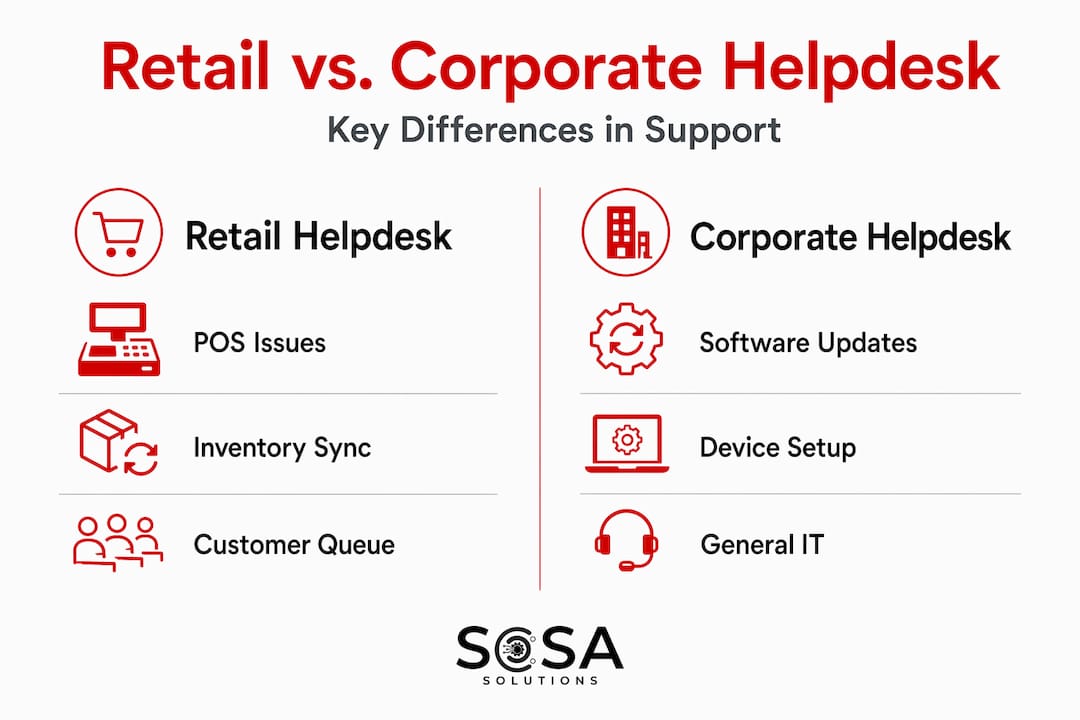
A retail IT helpdesk is the first line of response for both technical failures and customer-facing operational issues across your store environment. It covers the hardware and software your store depends on daily. Think POS terminal errors, barcode scanner failures, network outages affecting checkout, and back-office system crashes. Beyond pure IT, it also handles the customer service layer tied to those systems: order status requests, return processing, delivery update queries, and loyalty program issues.
Here is what a well-structured retail helpdesk typically handles:
POS and payment system troubleshooting — diagnosing terminal errors, processing failures, and printer connectivity issues remotely or on-site
Order management support — responding to customer inquiries about order status, shipping delays, and fulfillment exceptions
Returns and refunds handling — processing return requests and communicating resolution timelines to customers
Network and connectivity issues — addressing Wi-Fi outages or system connectivity problems that affect store operations
Loyalty program queries — managing point balance questions, redemption errors, and account access issues
Staff technical support — helping floor staff and managers with system access, device setup, and software errors
The key distinction between retail helpdesk and a standard corporate IT desk is context. A general IT helpdesk serves internal users on internal systems. A retail helpdesk serves both your staff and your customers, operating at the intersection of technology and customer experience. The stakes are different because every unresolved ticket has a direct customer or revenue consequence.
Pro Tip: Before scoping a helpdesk solution, list every recurring issue your staff escalates to you in a week. That list is your helpdesk requirement document in rough form.
Technology channels matter here too. Modern retail helpdesks operate across phone, email, live chat, SMS, and social media. The goal is meeting customers wherever they are, with an agent or automated system that already has context about their account and order.
Why helpdesk solutions pay for themselves in retail
The financial case for helpdesk solutions for retail is more concrete than most managers expect. Let’s work through the real impact categories.
Reduced POS downtime translates directly to recovered sales. A frozen terminal at your busiest checkout hour costs you real transaction volume. Outsourced retail helpdesks can diagnose 70 to 80% of POS issues remotely, dispatching vetted local technicians for the hardware failures that need physical intervention. That recovery speed is the difference between a 20-minute disruption and a two-hour one.
The benefits of helpdesk in retail stack up across these core areas:
Faster issue resolution. Dedicated support teams with documented workflows resolve tickets significantly faster than managers improvising fixes between other duties.
Scalability during peak seasons. Seasonal and promotional volume spikes require flexible staffing models. A properly structured helpdesk scales up for holiday traffic without requiring you to hire permanent staff.
Staff productivity gains. Retail managers waste over 4 hours weekly on manual operational queries and staff requests that a centralized helpdesk system handles automatically. That time goes back to the floor.
Cost savings versus in-house IT. Building an internal IT support team with retail-specific expertise, 24/7 coverage, and proper tooling costs far more than a managed helpdesk service, particularly for small and mid-size retailers.
Improved customer satisfaction. Fast, multi-channel support directly reduces friction in the customer experience. When a return question gets answered in minutes instead of days, customers notice.
Personalized service through system integration. Helpdesks integrated with platforms like Shopify or Salesforce give agents instant access to order history, loyalty status, and purchase data. No repeat questions, no frustrated customers.
“The real value of a retail helpdesk is not that it solves problems. It is that it solves them fast enough that customers never consider leaving.”
Pro Tip: Track your average POS incident resolution time before implementing a helpdesk solution. Use it as your baseline metric to demonstrate ROI within the first 90 days.
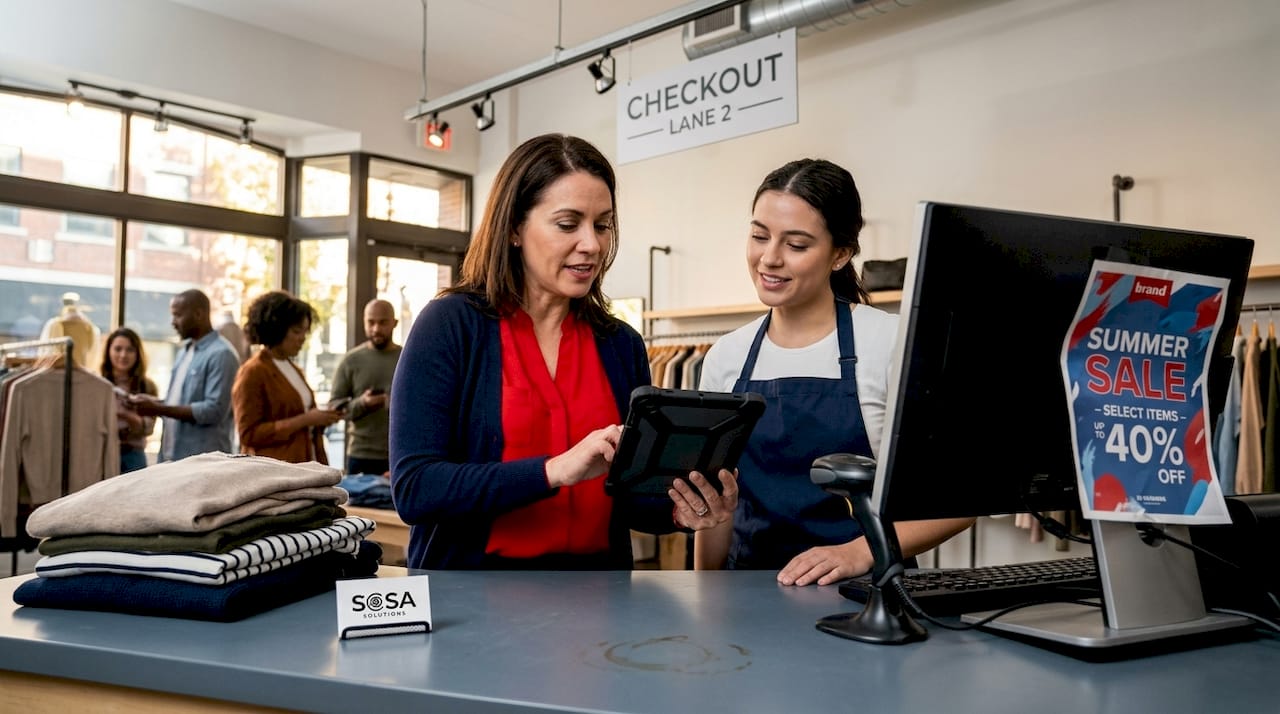
How helpdesk improves retail is not just a technology story. It is an operations story. When your support infrastructure is solid, your store staff focus on selling rather than troubleshooting.
How modern retail helpdesks use technology
The gap between a basic ticket system and a modern retail helpdesk comes down to three things: automation, unified communication, and system integration.
AI automation for routine tickets
AI agents now resolve up to 60% of incoming helpdesk tickets without any human involvement. For retail, this means order status responses, return initiation confirmations, store hours queries, and loyalty point balance checks get handled instantly at scale. Human agents step in for the escalations that genuinely require judgment: complex refund disputes, POS hardware failures, fraud-related issues. This triage model keeps resolution times low without bloating your support headcount.
AI also works well in Shopify and Magento workflows, where it can pull live order data to answer customer queries in real time. That is not a luxury feature for enterprise retailers. It is increasingly the baseline expectation.
Unified dashboards and omnichannel access
Support Channel | Without Unified Dashboard | With Unified Dashboard |
Separate inbox, no order context | Ticket with full order history attached | |
Live Chat | Agent asks repeat questions | Agent sees previous interactions |
SMS | Isolated thread, no history | Linked to customer profile |
Social Media | Manual monitoring, delayed response | Queued with other tickets automatically |
Phone | Separate system, notes manual | Logged and linked to customer record |
A unified helpdesk dashboard pulls all of these channels into one interface. Agents see the full customer context regardless of how that customer reached out. This is what makes retail customer support feel coherent rather than fragmented.
Integration with core retail systems
Retail IT support services that connect directly to your POS, inventory management, and loyalty program give agents real-time context. Integrated helpdesks connected to loyalty systems let agents see and resolve points discrepancies on the spot rather than escalating to a back-office team. That single capability can eliminate dozens of unnecessary ticket escalations each week.
Pro Tip: When evaluating helpdesk tools for retailers, ask vendors specifically which POS and ecommerce platforms they integrate with natively. An integration that requires custom development adds cost and risk.
POS support also requires coordination with local field technicians since remote diagnosis only covers software-side issues. A good retail helpdesk provider maintains a vetted technician network so hardware failures get an on-site response within hours, not days.
Best practices for adopting retail helpdesk services
Whether you are building an internal function or outsourcing to a provider, how you implement helpdesk management for retail determines whether you get results or frustration.
Start with high-volume, repeatable contacts. Most retailers begin by outsourcing order status, delivery updates, return requests, and loyalty inquiries. These contacts are well-defined and high volume, making them ideal for scripted or AI-assisted handling. Complex exception management stays internal until you have built trust in the model.
Define scope before you sign anything. Ambiguous scope creates service gaps. Document exactly which contact types the helpdesk handles, which require internal escalation, and what the handoff process looks like. This prevents the brand consistency problems that come from agents operating without clear authority.
Build governance into the contract. Clear escalation paths and documented workflows are not optional add-ons. They are the mechanism by which brand standards get maintained when your helpdesk provider handles a difficult customer interaction without you in the room.
Invest in knowledge transfer upfront. Your products, policies, promotions, and exceptions are unique to your business. A helpdesk team that operates from generic scripts will frustrate your customers. Plan for a structured onboarding period where your internal team transfers that knowledge through FAQs, process documentation, and live shadowing.
Set SLAs with teeth. First response time, resolution time, and customer satisfaction scores should all be defined in your service level agreement. Monitor them monthly, not quarterly. Trends matter as much as snapshots.
Coordinate helpdesk with your on-site tech support. Retail IT troubleshooting often starts remotely and ends with a technician at your store. The retail IT troubleshooting practices that minimize downtime are the ones where your helpdesk and your field support teams have a clear, practiced handoff protocol.
Measure outcomes beyond ticket counts. Ticket volume tells you how busy your helpdesk is. It does not tell you whether customers left satisfied. Track resolution rates, repeat contact rates, and post-interaction survey scores to get the full picture.
My take on what most retailers get wrong with helpdesk
I have seen retail businesses spend real money on helpdesk solutions and then treat the whole thing like a cost line they are trying to minimize. That mindset is exactly why they do not get the results they expected.
In my experience, the retailers who get the most from their helpdesk investments are the ones who treat it as an operating model decision, not a vendor selection. The controlled outsourcing approach works because it keeps ownership of the customer relationship internal while offloading the execution of well-defined, repeatable tasks. The retailers who try to hand everything off and disappear from the process end up with a disconnected support function that erodes the customer experience they worked hard to build.
The POS downtime issue is where I have seen helpdesk services make the most dramatic and immediate impact. A store that previously spent half a day recovering from a terminal failure, because the manager was Googling fixes while the line backed up, can now have that same issue remotely diagnosed and resolved or escalated in under 30 minutes. That is not a small thing. That is the difference between a bad Tuesday and a lost customer who never comes back.
What I also find underappreciated is the staff productivity angle. When your team is not fielding customer complaints about missing packages or wrestling with a payment system they do not understand, they are free to actually work the floor, engage customers, and do the job they were hired to do. A solid IT partner for retail growth does not just fix things. It frees your people to perform at their best.
The balance between automation and human touch is real and worth thinking through carefully. Automate the transactional. Keep humans in the loop for anything that requires empathy, judgment, or relationship management. Get that balance wrong in either direction and you either frustrate customers with robotic responses or waste agent hours on tickets that should have been resolved automatically.
— Christopher
How Sosasolutionsnyc supports retail helpdesk needs
If you manage retail stores in New York or Florida, you already know how fast a technology failure can turn into a customer experience problem. Sosasolutionsnyc delivers managed IT and retail helpdesk services built specifically for retail environments, covering everything from POS troubleshooting and remote diagnostics to on-site technician dispatch and network support.
Whether you are launching a new store and need infrastructure ready from day one, or you are running an established location that needs faster issue resolution and less downtime, Sosasolutionsnyc builds a support model around your specific operation. Their retail IT support covers both the technical layer and the operational coordination that keeps your store running when things go wrong. Reach out to Sosasolutionsnyc to talk through what a tailored helpdesk solution looks like for your stores.
FAQ
What is a retail IT helpdesk?
A retail IT helpdesk is a dedicated support function that handles both technical issues and customer-facing operational queries in retail environments, including POS troubleshooting, order management, and returns processing.
How does a helpdesk reduce POS downtime?
Outsourced retail helpdesks can diagnose 70 to 80% of POS issues remotely, with vetted local technicians dispatched for hardware failures that require an on-site fix, cutting recovery time significantly.
What types of issues should a retail helpdesk handle first?
Start with high-volume, repeatable contacts such as order status inquiries, delivery updates, return requests, and loyalty program questions, since these are well-defined and easy to script or automate.
Can small retail stores afford helpdesk solutions?
Yes. Managed helpdesk services are typically more cost-effective than hiring in-house IT staff with equivalent retail-specific expertise and coverage, making them practical for small and mid-size retailers.
How does AI fit into retail helpdesk operations?
AI agents can resolve up to 60% of incoming helpdesk tickets automatically, handling routine queries like order status and return confirmations while human agents focus on complex or high-sensitivity issues.
Recommended


Comments