IT Vendor Evaluation for Small Business: 2026 Guide
- Sosa Solutions NYC
- Jul 11
- 8 min read

IT vendor evaluation for small business is the process of methodically assessing technology providers against your defined business needs, risk tolerance, and total cost of ownership before signing any contract. Small businesses now manage an average of 286 vendors as of early 2026, up from 237 in 2024. That growth makes a structured evaluation process less optional and more necessary for operational survival. The industry term for this process is vendor due diligence, and it applies whether you are selecting a managed IT provider, a cloud platform, or a point-of-sale system. A structured evaluation improves pricing and contract terms by 10–25% compared to choosing a vendor based on demos or referrals alone. You do not need an IT team to do this well. You need a repeatable framework and the discipline to follow it.
What does IT vendor evaluation for small business actually involve?
Vendor due diligence starts before you contact a single provider. The most common mistake small business owners make is letting vendors define the requirements through their sales process. That approach leads to buying features you do not need and missing the ones you do.
Start by writing down the specific business problem you are trying to solve. “We need better IT support” is not a requirement. “We need a provider who can respond to point-of-sale failures within two hours during store hours” is a requirement. That level of specificity anchors every conversation that follows.

Set your budget before outreach, and think in terms of total cost of ownership, not just monthly fees. Factor in setup costs, training time, data migration, and any productivity loss during transition. This prevents sticker shock after you have already invested time in a vendor relationship.
Pro Tip: Build a simple requirements checklist before your first vendor call. Separate your list into three columns: must-have, nice-to-have, and deal-breaker. This prevents sales pressure from blurring your priorities mid-process.
The table below outlines the three core categories every small business should define before evaluating IT suppliers.
Criteria category | Examples |
Functional requirements | Response time SLAs, supported software, remote vs. on-site coverage |
Technical requirements | Security standards, backup frequency, hardware compatibility |
Operational requirements | Contract length, pricing model, scalability, local presence |
Understanding retail IT infrastructure requirements before vendor outreach gives you a concrete baseline for what to ask.
How do you compare IT vendors using structured methods?
Three tools work for small business vendor selection: scorecards, questionnaires, and formal Requests for Proposal (RFPs). Each fits a different situation.
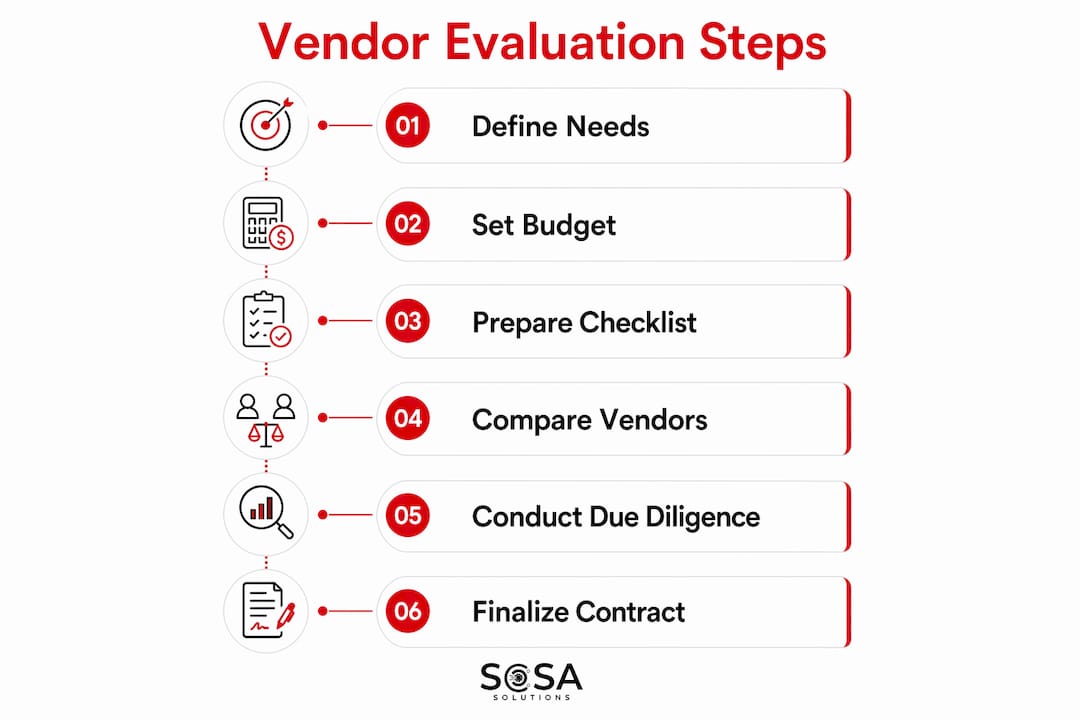
A weighted scorecard is the most practical tool for most small businesses. The 20-point scorecard system scores vendors on a 1–5 scale across weighted criteria, with a maximum of 500 points and a recommended passing threshold of 350. Any vendor scoring below 350 is not viable, regardless of price. This removes gut feel from the decision entirely.
An RFP is the right choice when your IT investment exceeds $10,000, involves a multi-year contract, or affects a mission-critical system. A formal RFP requires vendors to respond in writing before any demos, which forces them to commit to specifics rather than making verbal promises. For lower-stakes purchases, a structured questionnaire with 8–12 questions delivers about 80% of the benefit at a fraction of the effort.
Evaluating multiple vendors at the same time is non-negotiable. Parallel vendor evaluation creates pricing leverage and gives you a real comparison baseline. Evaluating vendors sequentially lets each one anchor your expectations before you see the next.
Define your weighted scoring criteria before contacting vendors.
Send identical questionnaires or RFPs to at least three providers.
Score each vendor independently before comparing results.
Use scores to shortlist two finalists for deeper due diligence.
Negotiate with both finalists simultaneously to maintain leverage.
Pro Tip: Share your scorecard criteria with vendors upfront. Transparency signals that you are a serious buyer, and it often prompts vendors to sharpen their proposals without any additional negotiation.
What due diligence should you do before signing with an IT vendor?
References, contract review, and pilot testing are the three steps that separate informed decisions from expensive regrets. Most small businesses skip at least one of them.
Contact references who match your industry and business size. Generic references from large enterprise clients tell you nothing about how a vendor handles a 10-person retail operation. Ask specifically about unexpected problems, how the vendor responded under pressure, and what the reference wishes they had known before signing. Reliable IT providers discuss difficult incidents like outages and security events transparently. Evasive answers about past failures are a red flag.
Contract review catches problems that demos never reveal. Watch for these specific red flags in any IT support agreement.
Auto-renewals with less than 30 days’ notice before the renewal date
Annual price increases with no cap or formula
Data export restrictions that make it hard to leave
SLA guarantees with no financial penalties for missed targets
Liability limits that leave you exposed for vendor-caused losses
For a deeper look at what to watch in IT support contracts, the specific clauses that affect retail businesses deserve close attention.
Pro Tip: Negotiate contract terms before discussing price. Vendors expect price negotiation. Contract term negotiation catches them off guard and often yields better results on both fronts.
Running a pilot before full commitment is the single most underused tactic in small business vendor selection. The Micro-Pilot technique involves a paid or free trial with a limited scope and a small team. It exposes real adoption friction that polished sales demos hide. A vendor who resists a pilot is telling you something important about their confidence in their own product.
Due diligence step | What to verify |
Reference calls | Incident handling, surprise costs, vendor responsiveness |
Contract review | Auto-renewals, price caps, data portability, SLA penalties |
Pilot testing | Real workflow fit, user adoption, support response time |
What mistakes do small businesses make in IT vendor evaluation?
The most common error is treating a demo as proof of capability. Demos are rehearsed. They show the best-case scenario with ideal data and a prepared presenter. Real-world performance under your specific conditions is what matters, and only a pilot or reference call reveals that.
Single-vendor evaluations are the second most frequent mistake. Without a comparison point, you have no leverage and no baseline for what is reasonable. Vendors know when they are the only option being considered, and pricing reflects that.
Skipping scenario testing is a costly oversight in regulated industries. Scenario-based testing involves asking vendors how they would handle a specific outage, a security event, or a compliance audit request. Their answer reveals operational maturity that no marketing document will show you.
Do not let sales timelines rush your evaluation. Urgency tactics are a negotiating tool, not a real deadline.
Do not evaluate vendors sequentially. Parallel evaluation is the only way to maintain leverage.
Do not skip the contract review because the relationship feels good. Relationships change; contracts stay.
Do not ignore vendor lock-in risks. Ask specifically how you would exit the contract and migrate your data.
Pro Tip: Score vendors on operational evidence, not promises. Ask for sample incident timelines, escalation protocols, and service reports from current clients. A vendor with nothing to show has not built the processes yet.
When should you bring in outside help for vendor evaluation?
Most small businesses can run a solid evaluation without external advisors. A structured framework, a scorecard, and disciplined reference checking cover the majority of decisions. Outside help becomes valuable in specific situations.
Bring in an independent advisor when your contract value exceeds $10,000, when the system touches compliance requirements like PCI DSS or HIPAA, or when the vendor is providing infrastructure that your entire operation depends on. In regulated industries, IT vendor selection is an operational risk decision, not just a technology purchase. The stakes justify the cost of expert review.
When choosing an advisor, verify that they have no financial relationship with the vendors they are evaluating. Referral fees and reseller agreements create conflicts that are rarely disclosed upfront. Ask directly whether the advisor receives any compensation from vendors on your shortlist.
Contract value over $10,000: bring in a contract attorney or IT advisor.
Compliance-heavy purchases: engage a specialist with relevant regulatory experience.
Mission-critical systems: use a third-party technical reviewer to validate vendor claims.
In-house evaluation is sufficient for low-stakes, short-term, or easily replaceable vendor relationships.
Understanding the benefits of outsourced IT support helps you frame what you are actually buying before you bring any advisor into the conversation.
Key Takeaways
Effective IT vendor evaluation for small business requires defined requirements, parallel vendor comparison, contract scrutiny, and pilot testing before any long-term commitment.
Point | Details |
Define needs first | Write specific requirements before contacting vendors to prevent sales-driven drift. |
Use a weighted scorecard | Score vendors on a 500-point scale; eliminate any provider scoring below 350. |
Evaluate vendors in parallel | Simultaneous evaluation creates leverage and improves pricing by 10–25%. |
Scrutinize contracts closely | Watch for auto-renewals, uncapped price increases, and weak SLA penalties. |
Run a pilot before committing | A Micro-Pilot with real workflows reveals adoption issues that demos never show. |
What I have learned from watching small businesses choose IT vendors
The pattern I see most often is this: a business owner spends three weeks in sales conversations, gets excited about a demo, and signs a two-year contract without reading it. Six months later, they are locked into a vendor who is slow to respond and impossible to exit without penalty.
The businesses that avoid this outcome are not the ones with the biggest IT budgets. They are the ones who treated vendor selection like a hiring decision. They wrote down what they needed, asked hard questions, called references, and ran a pilot. That process takes more time upfront. It saves months of frustration on the back end.
The contract review step is the one most consistently skipped. Small business owners feel uncomfortable pushing back on legal language, especially when the relationship feels positive. But the contract is the relationship once the sales team moves on. Auto-renewal clauses and uncapped price increases are not standard terms you have to accept. They are negotiating points, and most vendors will move on them if you ask.
One more observation: the best IT vendors welcome scrutiny. They offer references without being asked. They suggest pilots. They explain their incident response process in detail. A vendor who deflects these questions during the sales process will deflect them when something goes wrong too.
— Christopher
How Sosasolutionsnyc supports small business IT decisions
Small businesses in New York and Florida face real complexity when selecting IT vendors, especially in retail environments where downtime has an immediate cost.

Sosasolutionsnyc works directly with small and mid-sized businesses to assess IT needs, review vendor proposals, and provide ongoing managed IT services that remove the guesswork from technology decisions. Whether you are evaluating your first managed IT provider or replacing a vendor that is not delivering, Sosasolutionsnyc brings hands-on experience with retail IT environments across Manhattan and Florida. The team handles everything from infrastructure assessment to contract guidance, so you are not navigating vendor selection alone. Reach out to discuss your current IT setup and get a clear picture of your options.
FAQ
What is IT vendor evaluation for small business?
IT vendor evaluation for small business is the process of assessing technology providers against defined requirements, budget, and risk criteria before signing a contract. A structured approach improves pricing and contract terms by 10–25% compared to unstructured selection.
How many vendors should I evaluate at once?
Evaluate at least three vendors simultaneously. Parallel evaluation creates pricing leverage and gives you a real comparison baseline that sequential evaluation cannot provide.
When should a small business use an RFP?
Use a formal RFP for IT investments exceeding $10,000, multi-year contracts, or mission-critical systems. For smaller purchases, a structured questionnaire with 8–12 questions delivers most of the same benefit with far less effort.
What are the biggest red flags in an IT vendor contract?
The most serious red flags are auto-renewals with short notice windows, uncapped annual price increases, data export restrictions, and SLA guarantees with no financial penalties for missed targets.
Do I need an IT expert to evaluate IT vendors?
No. A structured framework with a weighted scorecard, standardized questionnaire, reference calls, and a pilot test covers the evaluation effectively without requiring internal IT expertise.
Recommended
Comments