The Role of IT Support Response Time in Retail
When a payment terminal freezes during a Saturday rush, every second matters. The role of IT support response time in retail is not just an operational metric. It is the difference between a smooth transaction and a customer walking out. Most retail stakeholders confuse ticket receipt with actual support response, and that confusion quietly costs them revenue. This article breaks down exactly what response time means in retail IT, why it affects both your operations and your customers, and what you can realistically do to improve it.
Table of Contents
Key takeaways
Point | Details |
Response time vs. resolution time | Response time starts when a technician begins work, not when a ticket is logged or auto-acknowledged. |
Customer abandonment is fast | Customers leave after roughly 7 minutes of payment disruption, making fast IT response a direct revenue factor. |
After-hours gaps are real | Nearly half of retail IT tickets arrive outside business hours, where response times run at least an hour longer. |
AI speeds resolution, not response | Heavy automation can cut resolution time dramatically, but first human response speed stays largely unchanged. |
Measure what actually matters | Track both first response time and mean time to resolve to get a true picture of IT support service quality. |
The role of IT support response time in retail operations
Before you can fix slow IT support, you need to understand what “response” actually means. Response time begins when a qualified technician actively starts working on your issue, not when your ticket is received, triaged, or auto-acknowledged by a system. That distinction matters enormously in retail, where automated confirmations can create a false sense of security while your point-of-sale system is still down.
In practice, response time in IT service covers the gap between the moment an issue is reported and the moment a human expert engages with it. Resolution time is how long it takes to fully fix the problem. Both metrics live on the same timeline, but they measure very different things.
Common retail IT benchmarks put first response time targets between 15 and 60 minutes for critical issues, depending on the service agreement and issue severity. For non-critical requests, one to four hours is more typical. The problem is that many retailers only discover what their actual response time looks like after an incident already damaged their operations.
Here is what delayed IT response looks like in practice for a retail environment:
A network outage takes 45 minutes to get acknowledged, during which your inventory system is disconnected from your registers
A software error on self-checkout kiosks goes unreported until a store associate calls the helpdesk manually, adding 20 minutes before any IT action starts
A printer failure during a high-volume return period creates a 30-minute queue because no one triaged the ticket with urgency
Pro Tip: Set separate response time SLAs for critical retail systems like payment terminals, inventory software, and network connectivity. Treating every ticket with the same priority level is one of the fastest ways to let a minor issue become a major outage.
Response time vs. resolution time: why retailers need both
These two metrics are frequently confused, but tracking only one gives you an incomplete picture of your IT support efficiency.
First Response Time (FRT) measures how quickly a human agent acknowledges and begins working on a ticket. Quick human acknowledgment reassures users and directly influences satisfaction scores, even when the resolution itself takes longer. The key word is human. Automated replies do not count toward an accurate FRT measurement, and counting them overstates your actual service speed.
Mean Time to Resolve (MTTR) measures the full duration from ticket creation to confirmed resolution. This is where complexity shows up. A payment system failure might get acknowledged in 10 minutes but take three hours to fully resolve because of vendor dependencies or hardware failures.
Here is a practical benchmark table for retail IT support:
Issue type | Target first response | Target resolution |
Payment system failure | Under 15 minutes | Under 2 hours |
Network connectivity outage | Under 30 minutes | Under 3 hours |
Inventory software error | Under 1 hour | Under 4 hours |
Peripheral hardware failure | Under 1 hour | Under 8 hours |
Non-critical software request | Under 4 hours | Under 24 hours |
The relationship between these two metrics has shifted with AI. Heavy automation reduces resolution time by up to 16x compared to manual helpdesk operations. Median resolution with 75 to 100 percent automation drops to 4.4 hours versus 71 hours without it. But here is what surprises most retail operators: automation does not significantly speed up first human response time. You still need people ready to engage quickly.
Pro Tip: When reviewing your IT helpdesk response metrics, ask your provider to separate automated acknowledgments from human first responses. If they cannot show you that breakdown, you are flying blind on your actual service quality.
How response time directly affects your revenue and customers
The financial argument for fast IT response is not abstract. It is measurable and, in some cases, alarming.
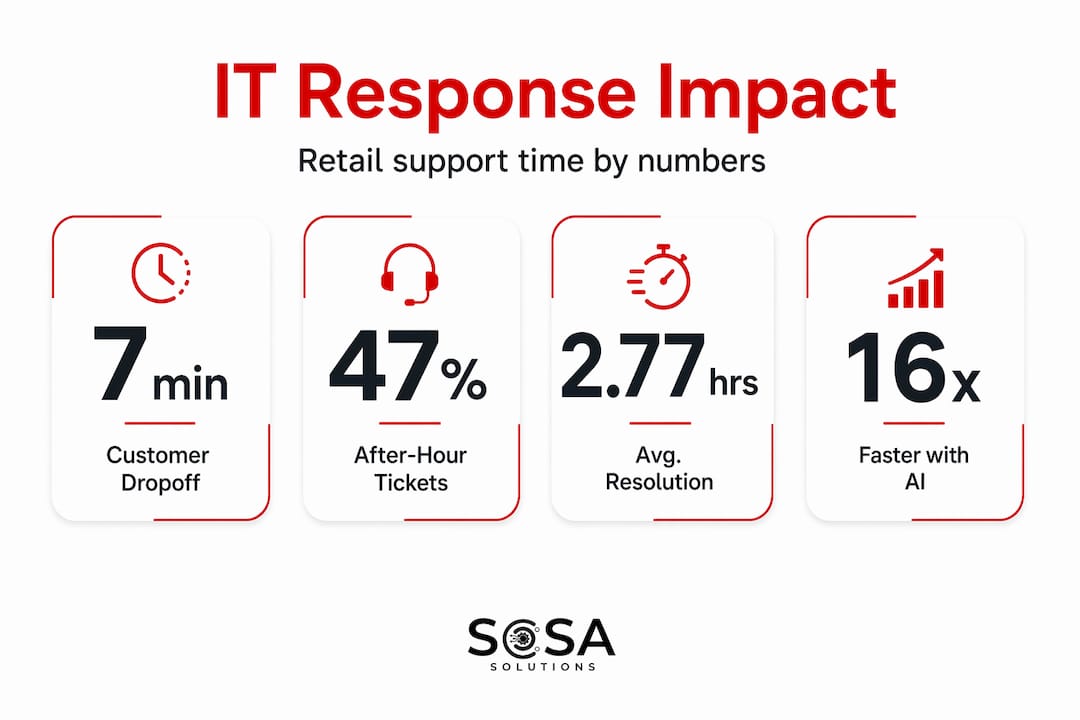
Customers abandon retail purchases after roughly 7 minutes of payment system disruption. Once an outage extends past that window, revenue losses escalate sharply, with estimates reaching $1.2 billion in sales per minute across U.S. retail between minutes 8 and 13 of a payment outage. Even scaled down for a single store, a 15-minute payment outage during a busy Saturday afternoon is not a minor inconvenience. It is measurable lost revenue.
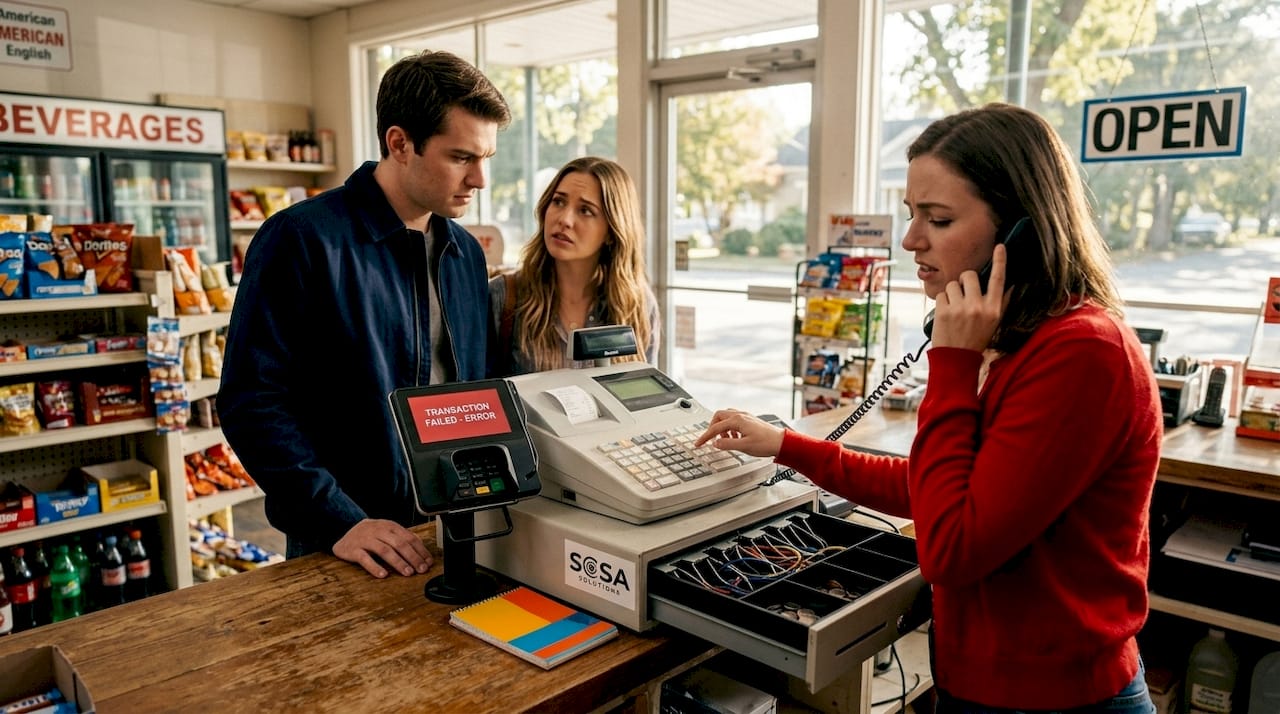
The connection between IT support service quality and customer loyalty runs deeper than a single transaction. When a customer encounters a system failure and watches store staff struggle without a resolution in sight, they make a judgment about your store. They may not come back.
Consider what fast IT response preserves:
Customer trust in your checkout process and overall store reliability
Staff confidence and composure during technical failures, reducing secondary service issues
Revenue from customers who would otherwise abandon carts or leave physical stores
“The real cost of slow IT response is not just the downtime itself. It is every customer who decided your store was not worth the friction.”
Measuring IT support time against real operational outcomes, like transaction completion rates during incidents, gives you far more useful data than tracking ticket counts alone. Retailers who connect IT metrics to business outcomes make better investment decisions about their support infrastructure.
Operational challenges that slow down response time
Knowing response time matters is one thing. Understanding why it slows down in real retail environments is another. Most delays do not come from technicians being incompetent. They come from structural problems in how support is organized.
Alert noise and false positives. When monitoring systems generate too many alerts, technicians experience overload and begin to deprioritize notifications. Alert noise, unclear escalation, and staffing issues are the primary causes of slow mean time to acknowledge, not the speed of ticket receipt. A team drowning in low-priority alerts will respond slowly to a genuinely critical outage.
After-hours coverage gaps. This is a major blind spot for retail businesses. Nearly 47% of IT tickets arrive outside standard business hours, and response to those tickets takes at least an hour longer on average. For a retailer with evening or weekend hours, this gap in coverage directly threatens store uptime.
Unclear escalation paths. When a frontline technician does not know when or how to escalate an issue, tickets sit in the wrong queue. A payment system failure that gets routed to a general software team instead of a network specialist loses 30 to 60 minutes before it even reaches someone who can help.
Handoff inefficiencies between shifts. Tickets that span shift changes frequently lose context. The incoming technician spends the first portion of their response time catching up rather than resolving.
Staffing imbalances during peak retail periods. IT support teams sized for average weekday volume are often underprepared for Black Friday or holiday rush periods, when both ticket volume and issue complexity spike simultaneously.
Understanding on-site IT support dynamics in retail reveals that these structural issues are common and fixable, but they require deliberate planning rather than reactive adjustments.
Best practices to improve IT response time for retail
Getting response time under control requires a combination of process discipline and the right technology. Here are the approaches that consistently move the needle for retail businesses:
Tiered alert systems. Separate your monitoring into critical, high, and normal priority categories. Only critical alerts should trigger immediate human response. This alone reduces alert fatigue and ensures technicians engage with the right issues fast.
24/7 managed support coverage. Given that nearly half of retail IT issues arrive after hours, a support model that only operates 9 to 5 is structurally misaligned with retail reality. Partnering with a managed IT provider who covers extended hours closes this gap directly.
Automation for triage, not acknowledgment. Use automation to categorize, route, and prioritize tickets. Do not count automated routing as your first response. Reserve that designation for the moment a human technician begins active work.
Clear escalation matrices. Every type of retail IT issue should have a defined escalation path with named roles and time thresholds. If a payment system ticket is not acknowledged within 10 minutes, it should automatically escalate to a senior technician.
Regular response time audits. Pull your IT helpdesk response metrics monthly, not just during post-incident reviews. Look at first response time by issue category, time of day, and day of week to identify your highest-risk windows.
98% of retailers are optimistic about AI in incident response, but 47% still cite the need for human decision-making to protect data quality and operational safety. The best retail IT operations use AI to speed resolution while keeping humans accountable for the first genuine response.
My honest take on response time metrics
I have worked with enough retail clients to say this plainly: most retailers are measuring the wrong thing. They track whether a ticket was “responded to” within their SLA window, but no one audits what that response actually looked like. Was it a technician actively diagnosing the issue, or was it a canned message saying “we received your ticket”?
The average resolution time for mission-critical retail incidents sits at 2.77 hours, and 53% of retailers report that resolution times are getting longer. That trend continues partly because organizations fixate on first response time as the headline number while ignoring whether the response itself was meaningful.
My advice to retail stakeholders: stop treating response time as a compliance checkbox. Start treating it as an operational health signal. When your IT team responds fast and resolves fast, your store runs. When one or both of those slip, you feel it in your revenue and your customer retention.
The retailers I have seen get this right share one trait. They hold their IT partners accountable to outcomes, not just metrics. Fast acknowledgment with a slow fix is still a failure for your business. Demand both.
— Christopher
How Sosasolutionsnyc supports retail IT response time
Retail businesses in New York and Florida face real pressure to keep systems running, especially during peak seasons and new store launches. Sosasolutionsnyc is built specifically for this environment. Their managed IT services cover extended-hours support, proactive monitoring, and clearly defined response time commitments tailored to retail operations. Whether you are managing an established store network or preparing for a new store opening, Sosasolutionsnyc provides the structured IT response framework your business needs to stay operational when it counts most. For retail stakeholders ready to stop guessing about their IT support quality, Sosasolutionsnyc is the partner built for this work.
FAQ
What is IT support response time in retail?
IT support response time measures how long it takes a qualified technician to begin actively working on a reported issue. It starts when a human expert engages, not when an automated system logs or acknowledges the ticket.
How does response time affect retail revenue?
Customers begin abandoning purchases after roughly 7 minutes of payment system disruption. Faster IT response reduces downtime duration and directly protects transaction revenue during outages.
What is a good first response time for retail IT issues?
For critical retail systems like payment terminals, a target of under 15 minutes is standard. For non-critical requests, one to four hours is a reasonable benchmark depending on your service agreement.
Why do after-hours tickets take longer to resolve?
Nearly 47% of retail IT tickets arrive outside business hours, and response to those tickets averages at least one hour longer than during standard hours. This gap is a direct risk to retailers with evening or weekend operations.
Does AI improve IT support response time?
AI significantly reduces resolution time, cutting it by up to 16x in highly automated environments, but it does not meaningfully speed up first human response time. Both automation and human readiness are required for full IT support efficiency.
Recommended


Comments