IT Service Providers for Retail: What You Need to Know
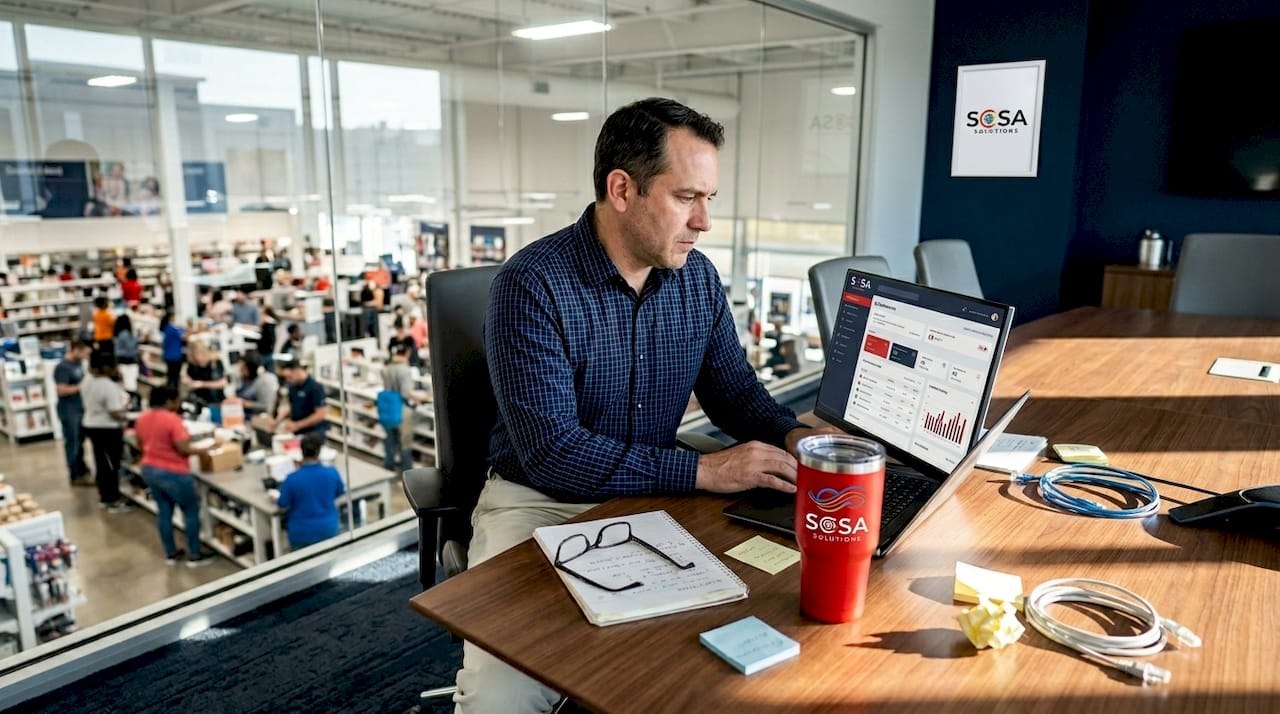
If your store’s point-of-sale system goes down on Black Friday, you do not call a general computer repair shop and hope for the best. That scenario is exactly why understanding what is an IT service provider in retail matters for any owner running a technology-dependent operation. The industry term is managed service provider (MSP), though “IT service provider” is widely used to describe the same function. These companies do far more than fix broken computers. They keep your entire technology stack running, anticipate problems before they shut you down, and align your infrastructure with how retail actually works.
Table of Contents
Key takeaways
Point | Details |
MSPs replace break-fix support | Retail IT service providers shift from reactive repairs to proactive monitoring under service-level agreements. |
Retail-specific knowledge matters | Providers must understand POS systems, multi-store coordination, and peak demand cycles, not just general networking. |
Pricing models affect your budget | Per device, per user, and flat-rate plans each suit different retail sizes and tech environments. |
Escalation paths protect uptime | Fast L1 to L3 escalation procedures are critical when outages affect multiple store locations at once. |
Choosing wrong is costly | A provider without retail context will cost you more in downtime and disruption than a purpose-built MSP. |
What an IT service provider in retail actually does
The IT service provider definition most people carry is “someone who fixes computers.” In retail, that picture is incomplete. A retail-focused MSP takes on responsibility for your entire technology environment under a proactive management model. Managed services shift from reactive break-fix to continuous monitoring with predictable subscription costs, which changes the entire relationship between your business and its technology.
Here is what retail IT services typically cover:
POS system management: Configuration, updates, connectivity monitoring, and fast response when terminals go offline during peak hours.
Network infrastructure: Routers, switches, and wireless access points across your store floor, stockroom, and back office kept running and secure.
Helpdesk support: Tiered support coverage including Level 1 general troubleshooting, Level 2 technical escalation, and Level 3 specialist resolution, often available 24/7 or during extended business hours.
On-site dispatch: A technician physically arriving at your location when remote resolution is not enough. This matters in retail more than almost any other industry.
Communications systems: VOIP phones, intercoms, and store-to-store lines kept operational.
Cybersecurity: Endpoint protection, firewall management, and compliance monitoring to protect payment card data.
The distinction between break-fix and managed support is not subtle. Break-fix means you call when something is broken and pay per incident. You have no visibility into what might fail next. Managed IT support means your provider is watching your systems continuously, catching issues before they become outages. For a retail IT troubleshooting operation running point-of-sale, inventory, and customer-facing displays simultaneously, that proactive posture is what separates a smooth operation from a crisis.
Pro Tip: Ask any IT service provider you are evaluating to show you a sample monitoring report. If they cannot produce one, they are likely operating reactively, not proactively.
Why retail IT support directly impacts your bottom line
Technology failures in retail are not abstract inconveniences. They translate directly into lost sales, frustrated customers, and staff unable to complete transactions. The benefits of IT service in retail go well beyond keeping lights on.
Reduced downtime on revenue-critical systems. Providers emphasize continuous tuning to prevent performance degradation on POS and communication systems. A 30-minute POS outage during a Saturday rush can wipe out hours of margin.
Consistent customer experience. When digital price displays, self-checkout kiosks, or loyalty program terminals go dark, customers notice. Reliable retail IT services keep customer-facing technology performing as intended.
Cost predictability. Managed IT pricing models move your IT spending from unpredictable repair invoices to a fixed monthly cost. That predictability makes budgeting significantly cleaner, especially for small and mid-size retailers managing tight margins.
Peak demand readiness. Holiday seasons, back-to-school rushes, and promotional events all stress your infrastructure. A capable MSP scales its monitoring and response capacity to match your busiest periods, not just your average days.
Multi-location coordination. If you run more than one store, your IT provider should be able to manage and monitor all locations from a single pane of glass, flagging issues at Store B while resolving an incident at Store A.
Real-world retail outages quickly impact sales and customer satisfaction in ways that take days or weeks to recover from. The cost of a strong IT partner is almost always lower than the cost of going without one.
How IT providers handle retail technology complexity
Retail technology environments are genuinely complex. You are not running a simple office network. You have customer-facing systems, staff-facing systems, back-end inventory, and communications all running in the same physical space, often across multiple locations with different configurations.
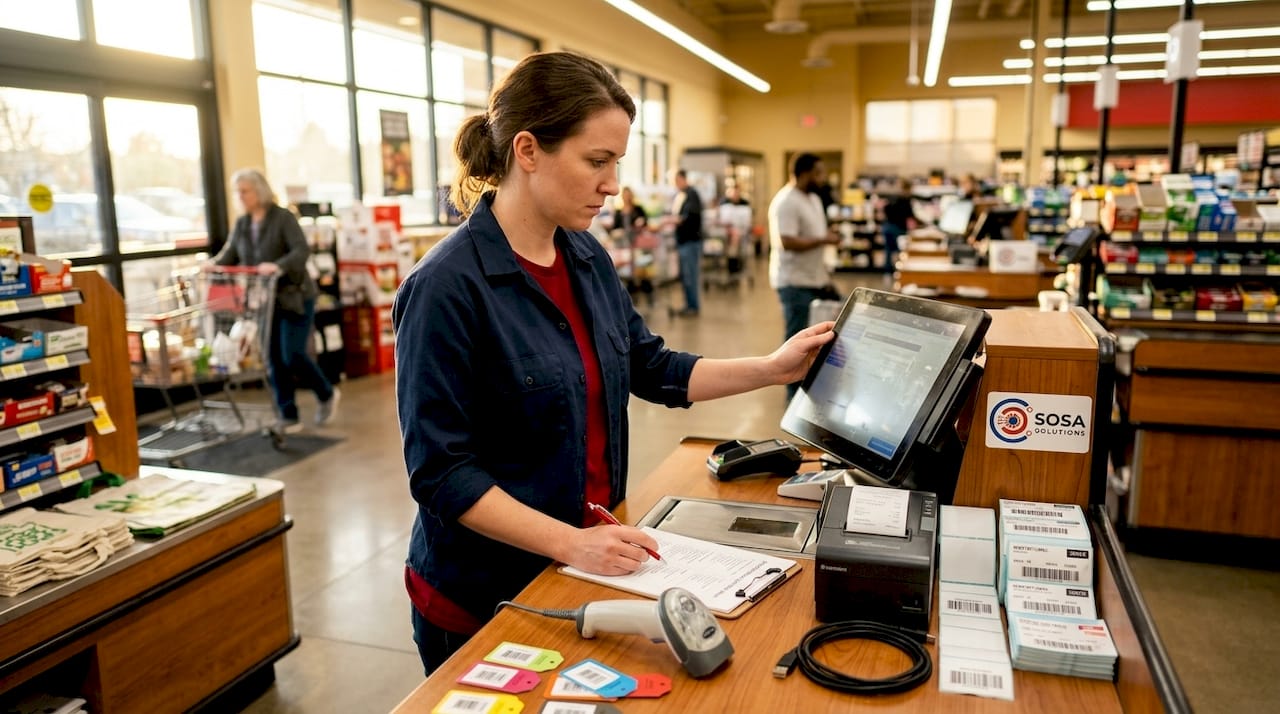
Managing multi-location environments
Experience with multi-site rollouts is what separates effective retail-focused IT services from generic providers. Managing one location requires technical skill. Managing ten locations requires operational discipline, standardized configurations, and escalation procedures that work even when multiple stores have issues simultaneously.
The table below shows how retail IT complexity differs from standard office IT management.
Challenge | Standard office IT | Retail multi-site IT |
Number of endpoints | Low to moderate | High, distributed across locations |
Transaction dependency | Low | Critical, revenue stops during outages |
Peak demand cycles | Predictable business hours | Seasonal, promotional, variable |
Communications systems | Basic VOIP or email | VOIP, intercoms, multi-store coordination |
On-site response need | Occasional | Frequent, time-sensitive |
Inventory and display integration
Platforms like OnQ’s Converge now connect inventory management systems directly with in-store digital displays, giving customers real-time stock information on the floor. Setting up and maintaining that kind of integration requires a provider who understands both the technical side and how retail merchandising actually functions.
Retail IT solutions for communications deserve specific attention. VOIP systems in retail need configuration tuned to store-floor realities: background noise, multiple concurrent calls during busy periods, and integration with intercoms or PA systems. A provider unfamiliar with retail environments will deploy a standard office VOIP setup that performs poorly the moment foot traffic picks up.
Pro Tip: When evaluating IT service solutions for retail, ask whether the provider has configured VOIP specifically for store environments, not just offices. The configuration requirements are meaningfully different.
How to choose the right retail IT provider
Selecting the wrong provider is one of the most expensive mistakes a retail owner can make. The right questions during evaluation will surface the providers who understand retail versus those who are learning on your dime.
What to ask before you sign
What are your response time guarantees? Get specific numbers. “Fast response” means nothing. Four-hour on-site response for critical outages is a real commitment.
How does your escalation process work? Defined escalation procedures from L1 to L3 specialists are critical for fast-moving outages affecting multiple store locations. A provider without a documented path is guessing.
Do you have retail-specific clients and references? Ask for references from businesses with similar store counts and technology profiles to yours.
What does your monitoring cover? It should include POS systems, network hardware, endpoints, and communications, not just servers.
How do you handle peak periods like the holiday season? A quality provider has a specific answer. Vague reassurances are a warning sign.
Understanding pricing models
Managed IT pricing generally comes in three forms. Understanding the trade-offs lets you choose what fits your operation.
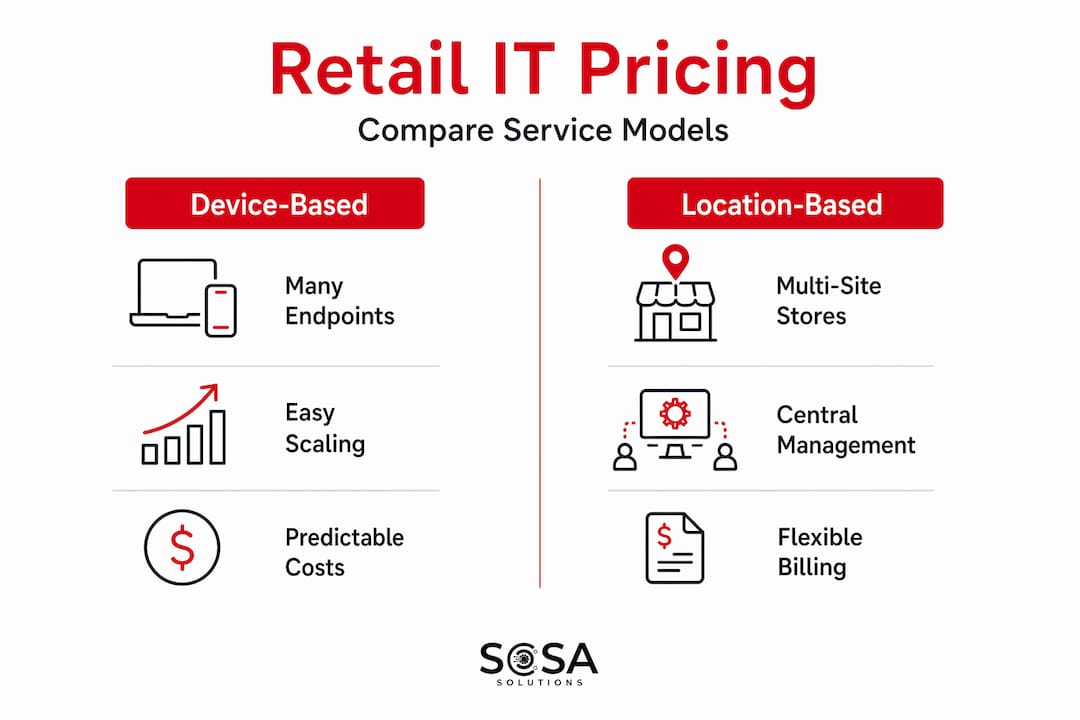
Pricing model | Best for | Trade-off |
Per device | Device-heavy retail stores with many terminals | Costs scale with your hardware count |
Per user | Stores with fewer devices per employee | May not reflect actual device complexity |
Flat-rate | Businesses wanting total cost certainty | Requires clear scope definition upfront |
Per device pricing works well for retailers running multiple POS terminals, kiosks, and back-office computers per location. Flat-rate is appealing for budget predictability, but you need to read the scope of services carefully. Anything not explicitly covered often falls outside the agreement. You want a provider who walks you through that scope before you sign, not after your first uncovered incident.
Scalability matters here too. If you plan to open additional locations, your provider needs the capacity and the systems to onboard new stores without disrupting existing ones. The benefits of unified IT providers for retailers become most visible when expansion is on the table.
My take on what retailers consistently get wrong
I have seen retail owners make the same mistake over and over: they hire an IT provider based on price and a smooth pitch, then discover six months later that the provider treats their stores like office environments with a cash register thrown in. That misalignment costs more in downtime and disruption than any initial savings ever justified.
The hardest lesson I have learned from working with retail businesses is that operational continuity requires a partner who thinks about your business rhythm, not just your network topology. When your busiest shopping day of the year hits, you need a provider who anticipated it with you, not one who responds to the emergency.
Most retail owners also underestimate escalation. They assume all support providers can handle a crisis. In practice, a provider without clear L1 through L3 paths will loop you in circles while your registers are down. I have seen that specific failure cost retailers thousands of dollars in a single afternoon.
My honest advice: do not evaluate IT providers on what they promise during sales conversations. Evaluate them on their documented processes, their retail client list, and whether they can tell you what happened to a previous client’s store during a major outage and what they did about it. That answer tells you everything.
— Christopher
Retail IT support built for how your stores actually run
Running a store in New York or Florida means your technology has to keep up with some of the most demanding retail environments in the country. Sosasolutionsnyc delivers managed IT services purpose-built for retail operations, covering everything from ongoing monitoring and helpdesk support to multi-location management across your entire store network.
Whether you are opening a new location and need a complete technology setup from day one, or you are running existing stores that deserve better IT coverage, Sosasolutionsnyc has the retail-specific experience to match. Their retail IT support services are designed around the operational realities of physical retail, not generic office environments. Contact Sosasolutionsnyc to get a support plan that fits your stores, your locations, and your growth plans.
FAQ
What is a retail IT service provider?
A retail IT service provider, often called a managed service provider (MSP), is a company that manages and supports your store’s technology infrastructure under a proactive, ongoing agreement rather than responding only when something breaks.
How do IT service providers work in retail?
They monitor your systems continuously, handle helpdesk requests, dispatch on-site technicians when needed, and manage technology across your locations. Support tiers range from L1 general troubleshooting to L3 specialist resolution.
What are the main benefits of IT service in retail?
The biggest benefits include reduced downtime on POS and customer-facing systems, predictable monthly costs, and the ability to handle peak demand periods without technology failures disrupting sales.
What should I ask an IT provider before hiring them?
Ask specifically about response time guarantees, escalation procedures for multi-store outages, retail client references, and how they handle peak periods. Vague answers to those questions signal a lack of retail-specific experience.
How is retail IT support different from regular IT support?
Retail IT support accounts for transaction-critical systems, seasonal demand spikes, multi-location coordination, and customer-facing technology. Retail-specific IT providers understand operational realities that general IT providers routinely overlook.
Recommended


Comments