What Is Retail Store Connectivity? A 2026 Guide
Updated: Aug 7

Retail store connectivity is defined as the integrated network and technology infrastructure that links every system, device, and data source within a store into a single coordinated operating environment. This includes the retail store network architecture, point-of-sale (POS) terminals, inventory management platforms, IoT sensors, digital signage, and customer Wi-Fi, all working in concert. Technologies like SD-WAN, edge computing, and managed broadband circuits form the backbone of this infrastructure. Without it, modern retail operations fracture: transactions slow, inventory data goes stale, and customers notice. Understanding the importance of store connectivity is no longer optional for retail decision-makers. It is the difference between a store that runs and a store that performs.
What is retail store connectivity made of?
Retail store connectivity, known in the industry as the “connected store” model, operates across several distinct but interdependent technology layers. Each layer serves a specific function, and the failure of any one layer cascades through the entire operation.
Network infrastructure layer

The foundation is always the wide-area network (WAN) connection. Most stores deploy a primary broadband or fiber circuit for high-throughput operations, paired with a secondary failover circuit using 4G or 5G cellular. The critical detail most retailers miss: dual-circuit diversity requires different carriers to be effective. Buying both circuits from the same provider means a neighborhood outage takes down both simultaneously.
SD-WAN sits above the raw circuits and acts as the traffic conductor. It prioritizes POS traffic over less critical data, preventing bandwidth contention between payment terminals, back-office downloads, and guest Wi-Fi. Without SD-WAN, even a well-provisioned failover connection still experiences latency when background processes compete with checkout traffic.
Edge computing and local processing
Edge computing is now standard in retail connectivity, enabling stores to run critical workloads locally even when the WAN connection drops. A local edge node processes POS transactions, loyalty point lookups, and inventory queries without round-tripping to a central cloud. This matters most during peak hours, when a 30-minute outage can disrupt POS and loyalty point processing across an entire location.
Integrated store systems
The table below shows the primary systems that connect through the store network and what each one depends on:
System | Network dependency | Impact of connectivity failure |
POS terminals | Low-latency, prioritized traffic | Failed or delayed transactions |
Inventory management | Real-time sync to cloud or edge | Overselling, inaccurate stock counts |
IoT sensors and cameras | Stable local network | Loss of loss-prevention and foot traffic data |
Digital signage | Reliable content delivery | Outdated or blank displays |
Customer and staff Wi-Fi | Segmented bandwidth allocation | Degraded experience, network congestion |
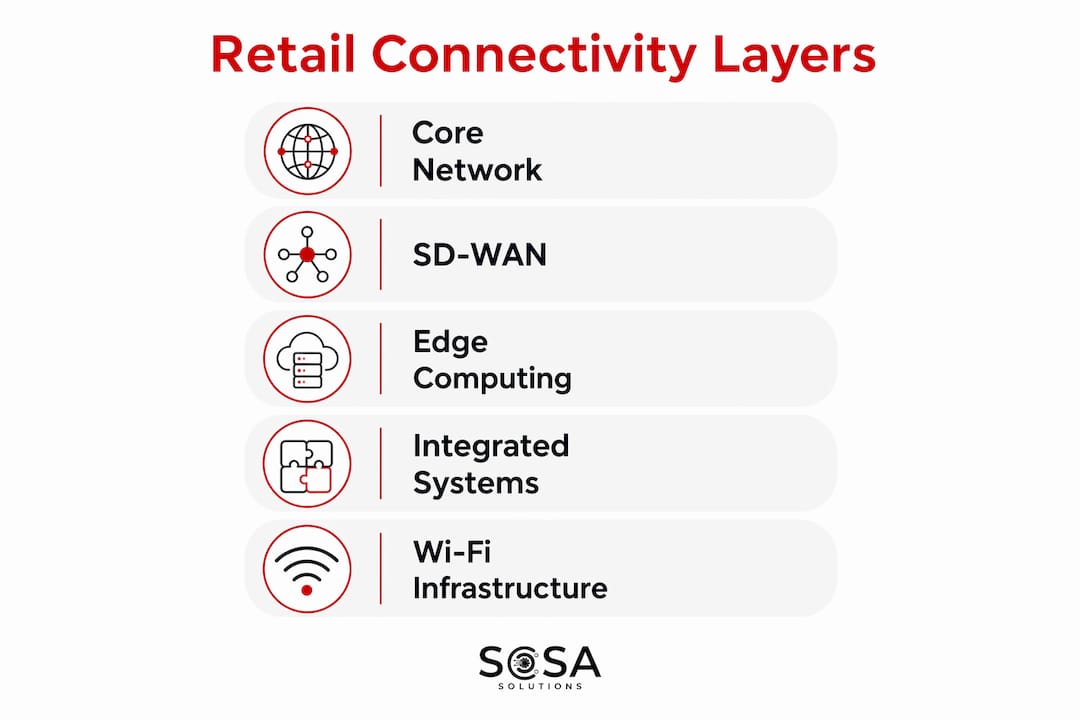
Wi-Fi infrastructure requires deliberate segmentation. Corporate traffic, staff devices, and guest access must run on separate virtual networks to prevent any one group from consuming bandwidth that another group depends on.
Why does store connectivity matter for retail success?
Strong retail store connectivity produces measurable operational and customer-facing results. Deloitte’s connected store research confirms that retailers achieve better customer satisfaction and operational efficiency with reliable, segmented store networks. That finding reflects a straightforward cause-and-effect: when systems talk to each other in real time, decisions get made faster and errors get caught earlier.
Here are the five core benefits that directly affect store performance:
Faster, more reliable transactions. Payment terminals that receive prioritized bandwidth complete transactions without delay. Poor traffic prioritization causes payment terminals to compete with guest Wi-Fi, slowing checkouts and increasing abandoned baskets. Fixing this is a configuration decision, not a hardware purchase.
Real-time inventory accuracy. Edge computing delivers sub-second response times at checkout and inventory lookups, and stores maintain local inventory ledgers synced to the cloud on a schedule. This prevents overselling and supports buy-online-pickup-in-store (BOPIS) and ship-from-store fulfillment models.
Customer Wi-Fi and digital engagement. Nearly 100% of shoppers use smartphones as in-store assistants, expecting fast, stable Wi-Fi and quick transactions. A store that cannot deliver this loses the customer’s trust before they reach the register.
Automated decision-making and workforce coordination. Connected IoT sensors feed foot traffic data, temperature readings, and shelf-level inventory signals into analytics platforms. Store managers act on real data rather than guesswork.
Outage risk mitigation. Stores without centralized monitoring remain unaware of connectivity issues until customers complain or systems fail visibly. Proactive monitoring catches degraded circuits before they become full outages.
Pro Tip: Treat your store network as a revenue-generating asset, not a utility. Every minute of POS downtime during a Saturday rush has a direct dollar value. Calculate it once, and you will never underfund connectivity again.
Common challenges in retail store connectivity
Most connectivity failures in retail are not caused by bad technology. They are caused by predictable oversights in planning and management. Recognizing these pitfalls before deployment saves significant time and money.
Single carrier dependency. This is the most common and most costly mistake. When primary and backup circuits share the same physical infrastructure, a single neighborhood dig or equipment failure takes both offline. True redundancy requires separate carriers with separate physical paths.
No traffic prioritization. Raw bandwidth does not guarantee good performance. A store with a 1 Gbps fiber connection can still experience POS slowdowns if bulk software updates or guest streaming traffic consumes available capacity at the wrong moment. SD-WAN or equivalent orchestration is required to enforce traffic policies.
Fragmented connectivity management. Multi-location retailers often manage each store’s network independently, creating blind spots. Without a centralized view, IT teams learn about outages from store managers or customers rather than from monitoring alerts. This gap costs hours of lost productivity per incident.
Inconsistent hardware standards. When each store runs different routers, switches, or access points, support complexity multiplies. Troubleshooting a network issue at a store running non-standard equipment takes significantly longer than resolving the same issue on a standardized platform.
Underestimating the customer experience impact. Slow Wi-Fi and delayed checkouts feel like minor inconveniences from an IT perspective. From the customer’s perspective, they are reasons to leave and not return. The connected store operating model treats connectivity as a customer experience layer, not just a back-office utility.
Pro Tip: When auditing your store network, start with a carrier diversity check. Pull the physical path documentation for both your primary and failover circuits. If they share a last-mile provider or a common junction point, you do not have true redundancy regardless of what your contracts say.
How to improve retail connectivity: best practices for 2026
Improving connectivity in retail management requires a structured approach. Ad hoc upgrades rarely solve the underlying architecture problems. Follow these steps to build a store connectivity strategy that holds up under real operating conditions.
Audit your current state. Document every circuit, carrier, device, and system dependency across all locations. You cannot prioritize improvements without knowing where the gaps are. Check for retail IT troubleshooting best practices specific to your store format.
Implement dual-circuit diversity with different carriers. Deploy a primary fiber or broadband circuit alongside a 4G or 5G cellular backup from a separate provider. This single change eliminates the most common cause of total store connectivity loss.
Deploy SD-WAN for traffic orchestration. SD-WAN enforces traffic prioritization policies automatically, routes around degraded circuits, and provides visibility into bandwidth usage by application. It is the control layer that makes dual-circuit diversity actually work under load.
Standardize hardware across all locations. Choose a single vendor stack for routers, switches, and access points. Standardization reduces support time, simplifies firmware management, and makes remote troubleshooting far more effective.
Implement centralized monitoring. Deploy a network operations platform that provides real-time visibility into circuit health, device status, and traffic patterns across every store. Centralized management is the most important connectivity layer because it prevents blind spots and enables proactive issue resolution before customers are affected.
Add edge computing nodes for critical workloads. Local edge nodes keep POS, inventory, and loyalty systems running during WAN outages. This is particularly valuable for high-traffic stores where even brief cloud connectivity drops create visible customer impact.
The comparison below shows the difference between a reactive and a proactive store connectivity strategy:
Capability | Reactive approach | Proactive approach |
Circuit redundancy | Single carrier, single path | Dual carrier, diverse physical paths |
Traffic management | Best-effort, no prioritization | SD-WAN with POS traffic priority |
Outage detection | Customer complaint or system failure | Centralized monitoring with automated alerts |
Hardware management | Store-by-store, mixed vendors | Standardized stack, centrally managed |
Edge processing | Cloud-dependent for all workloads | Local edge nodes for critical applications |
Retailers planning new locations should integrate these store connectivity strategies from day one. Retrofitting a poorly designed network is always more expensive than building it correctly. For a broader view of upgrading retail store technology, the infrastructure decisions made at store opening set the ceiling for everything that follows.
Key takeaways
Retail store connectivity requires dual-circuit diversity, SD-WAN traffic prioritization, edge computing, and centralized monitoring to deliver the operational resilience modern retail demands.
Point | Details |
Dual-circuit diversity | Use two separate carriers to prevent simultaneous outages from a single provider failure. |
SD-WAN is non-negotiable | Raw bandwidth without traffic prioritization still allows POS slowdowns during peak usage. |
Edge computing adds resilience | Local edge nodes keep POS and inventory running even when cloud connectivity drops. |
Centralized monitoring prevents blind spots | Without a unified view, stores discover outages from customers rather than from alerts. |
Connectivity is a customer experience layer | Slow Wi-Fi and delayed checkouts directly reduce customer satisfaction and repeat visits. |
Why I stopped treating store connectivity as a commodity
After working with retail IT environments across New York and Florida, the pattern I see most often is not outdated hardware or insufficient bandwidth. It is a fundamental misclassification of what connectivity is. Most retailers budget for it the way they budget for electricity: find the cheapest provider, sign the contract, and move on.
That approach works until it doesn’t. And when it fails, it fails at the worst possible moment. A Saturday afternoon in December, a checkout line backing up, and a POS system that cannot reach the cloud because both circuits share the same carrier’s local node.
The retailers who avoid this are the ones who treat connectivity as a strategic asset. They document their network architecture the way they document their lease agreements. They test failover quarterly, not annually. They know their edge node’s local cache refresh interval the same way they know their inventory reorder points.
The emerging trend worth watching is AI-driven network orchestration. Tools are beginning to predict circuit degradation before it causes visible performance issues, shifting traffic proactively rather than reactively. IoT expansion in retail, from smart shelving to autonomous checkout, will only increase the demand on store networks. The retailers building layered, well-monitored connectivity infrastructure today are the ones who will absorb that expansion without disruption.
Connectivity is not infrastructure you set and forget. It is the operating system of a modern retail store. Treat it accordingly.
— Christopher
How Sosasolutionsnyc helps retail stores build reliable connectivity
Retail connectivity failures cost more than downtime. They cost customer trust. Sosasolutionsnyc works with retail businesses across New York and Florida to design, deploy, and manage store connectivity infrastructure that holds up under real operating conditions.

From dual-circuit setups with true carrier diversity to SD-WAN orchestration and edge computing deployment, Sosasolutionsnyc delivers managed IT services tailored to retail environments. Centralized monitoring across all your locations means your team knows about a circuit issue before your customers do. Whether you are opening a new location or fixing a network that was never built right, Sosasolutionsnyc provides the technical depth and regional expertise to get it done. Contact Sosasolutionsnyc to build a connectivity strategy your store can depend on.
FAQ
What is retail store connectivity in simple terms?
Retail store connectivity is the integrated network infrastructure that links all store systems, including POS terminals, inventory platforms, IoT devices, and Wi-Fi, into a single coordinated environment. It enables real-time data exchange and keeps store operations running reliably.
Why does SD-WAN matter for retail networks?
SD-WAN intelligently prioritizes POS traffic over less critical data, preventing payment terminal slowdowns caused by background processes or guest Wi-Fi usage. Without it, even a well-provisioned connection can produce checkout delays during peak hours.
What is the biggest risk in retail store connectivity?
Single carrier dependency is the most common and costly risk. When both primary and backup circuits come from the same provider, a local outage takes down both simultaneously, leaving the store without any connectivity.
How does edge computing support retail connectivity?
Edge computing runs critical store workloads locally, so POS transactions and inventory lookups continue even when the WAN connection drops. Stores maintain local inventory ledgers synced to the cloud, reducing overselling and supporting fulfillment models like BOPIS.
How can a retail business improve its store network quickly?
Start with a carrier diversity audit to confirm your primary and failover circuits use different providers. Then implement SD-WAN for traffic prioritization and deploy centralized monitoring to catch issues before they affect customers or transactions.
Recommended


Comments