The Real Role of IT Documentation in Business

IT documentation is defined as the organized recording of an organization’s IT configurations, processes, policies, and procedures. The role of IT documentation in business extends far beyond filing technical notes. It directly cuts incident resolution times, accelerates onboarding, and keeps organizations aligned with governance frameworks like ITIL, COBIT, and ISO/IEC 38500. Organizations that treat documentation as a living operational asset gain measurable advantages in efficiency, compliance, and risk control. Those that neglect it pay the price in downtime, staff dependency, and client loss.
How IT documentation improves operational efficiency and reduces risk
IT documentation is the single fastest lever for reducing incident resolution time. Organizations using mature documentation systems report an 87% reduction in resolution times by giving technicians immediate access to configuration details. That number, drawn from over 16,000 organizations, means the difference between a 30-minute fix and a 4-hour outage.
The efficiency gains extend beyond incident response. Well-structured documentation produces 40–50% faster employee onboarding compared to organizations with fragmented knowledge management. Faster onboarding means new IT staff contribute sooner, reducing the burden on senior team members and lowering training costs.
The deeper risk is what IT professionals call “tribal knowledge.” This is the critical operational knowledge that lives only in the heads of specific employees. When those employees leave, the knowledge walks out with them. Runbooks, configuration guides, and process documentation break that dependency. They give any qualified technician the context needed to support any environment without needing to track down a colleague.
Runbooks document step-by-step responses to known incidents, cutting resolution time for recurring issues.
Configuration records capture network topology, hardware specs, and software versions so technicians never start blind.
Process guides standardize how routine tasks get done, reducing errors and repeated questions.
Onboarding documentation gets new hires productive faster without draining senior staff time.
Pro Tip: Treat documentation as a living operational asset, not a one-time deliverable. Embed it into your team’s workflow so updates happen automatically when systems change, not months later during an audit.
Does IT documentation support compliance and governance?
IT governance frameworks require thorough documentation to function. ITIL, COBIT, and ISO/IEC 38500 each depend on documented processes, audit trails, and accountability structures to align IT activity with business objectives. Without that documentation, governance becomes a theoretical exercise with no operational grounding.
Audit trails are the most direct compliance benefit. Regulators and auditors need evidence that controls exist and are followed. Documentation provides that evidence. It shows who made a change, when, and why. That visibility also helps internal teams detect risk before it becomes a problem.
Poor documentation creates the opposite effect. Resources get wasted on repeated troubleshooting. IT teams operate reactively rather than proactively. Business leaders lose confidence in IT’s ability to deliver value. Effective IT governance requires comprehensive documentation and audit trails to meet modern compliance and transparency demands.
Governance benefit | How documentation enables it |
Audit readiness | Provides evidence of controls, changes, and approvals for regulators |
Risk detection | Surfaces configuration gaps and process failures before incidents occur |
Accountability | Records who owns each system, process, and decision |
Business alignment | Maps IT activity to business objectives using documented policies |
Compliance continuity | Keeps records current as regulations and frameworks evolve |
Review and update documentation on a regular schedule. Compliance requirements change. Systems change. Documentation that was accurate 18 months ago may now misrepresent your environment and create audit exposure.
What are the best practices for creating effective IT documentation?
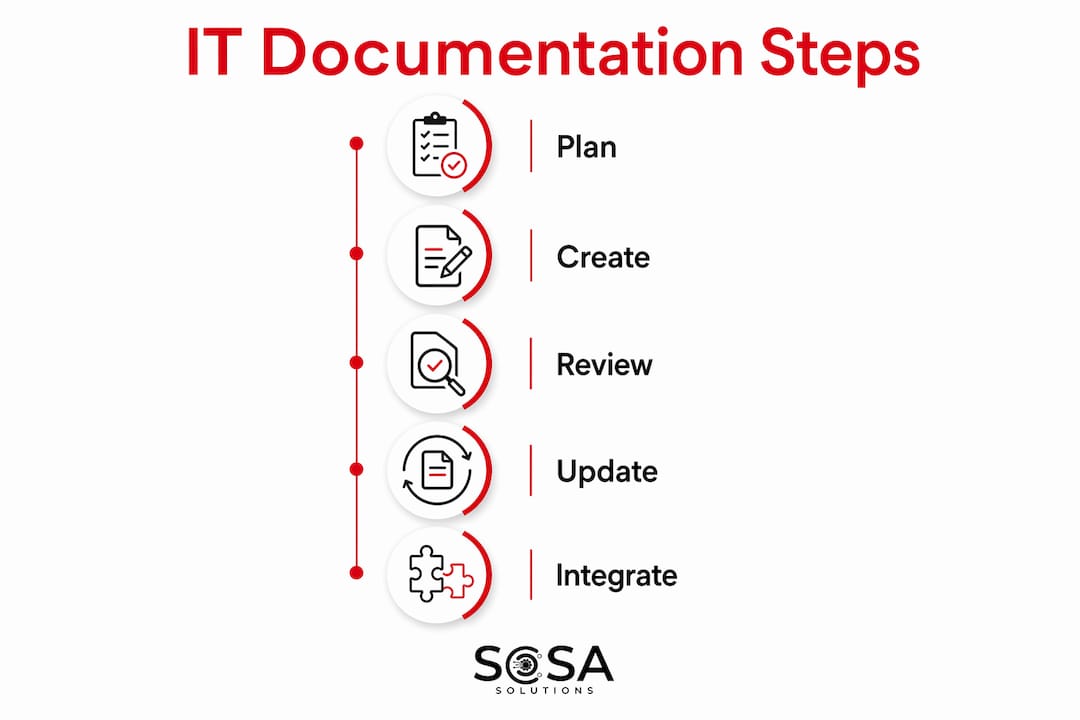
The most effective approach to IT documentation integrates it directly into the development and operations workflow. Defining documentation as part of the “Definition of Done” in agile teams means no task is complete until the relevant records are updated. Architecture Decision Records (ADRs), runbooks, and API specifications become living deliverables rather than afterthoughts.

Ownership is the second critical factor. Documentation without an assigned owner decays. Assigning document owners and scheduling quarterly reviews prevents what practitioners call “documentation rot,” the gradual drift between what the documentation says and what the system actually does. Quarterly reviews catch that drift before it causes real problems.
A sustainable documentation process follows a clear sequence:
Audit existing documentation. Identify what exists, what is missing, and what is outdated before creating anything new.
Define documentation standards. Agree on format, naming conventions, and storage location so documentation is findable and consistent.
Assign ownership. Every document needs a named owner responsible for accuracy and updates.
Integrate into workflows. Add documentation tasks to sprint boards, change management tickets, and project checklists.
Schedule quarterly reviews. Set calendar reminders to review and update critical documents every 90 days.
Measure and report. Track documentation coverage and freshness as operational metrics, not just IT housekeeping.
The shift from treating documentation as administrative overhead to funding it as a strategic tool changes how organizations allocate resources. Technology leaders who view documentation strategically position IT as a value creator rather than a cost center.
Pro Tip: Balance documentation depth against team capacity. A 10-page runbook nobody reads is worse than a 1-page checklist that gets used every time. Match the format to the audience and the urgency of the task.
How does documentation protect business continuity and client retention?
Documentation is insurance against knowledge loss. When a key IT staff member leaves unexpectedly, poor documentation creates immediate service disruption and increased operational costs. Organizations with complete records can reassign support responsibilities the same day. Those without them spend weeks reconstructing what the departing employee knew.
Client retention connects directly to documentation quality, even when clients never see the documents themselves. Consistent service delivery depends on any technician being able to support any client environment reliably. That consistency requires documentation. Without it, service quality varies by who happens to be on shift.
Documented environments allow faster issue resolution, which clients experience as better service.
New technicians can onboard to client accounts without a lengthy handover from the previous support contact.
Scaling a client base becomes possible when support does not depend on specific individuals.
Documented change histories prevent recurring issues caused by undocumented configuration changes.
“Poor documentation is often the silent cause of service failures and client churn, even if not cited explicitly as the reason clients leave.” IT documentation best practices
Documentation integrated into IT workflows yields faster onboarding, better incident management, and sustainable knowledge retention. For IT service providers and internal teams alike, that combination is what keeps clients and reduces the cost of delivering support over time.
Good documentation also supports retail IT operations specifically. When a store opens a new location or upgrades infrastructure, documented configurations mean the next technician on site does not start from scratch. That matters in fast-moving retail environments where downtime directly affects revenue. For a practical look at how documentation reduces retail IT risks, the guide on retail IT troubleshooting covers the operational specifics in detail.
Key Takeaways
Effective IT documentation is the single most direct investment a business can make to reduce incident resolution time, protect institutional knowledge, and maintain compliance alignment.
Point | Details |
Incident resolution | Mature documentation systems cut resolution times by up to 87% across thousands of organizations. |
Onboarding speed | Structured documentation produces 40–50% faster onboarding compared to fragmented knowledge management. |
Governance alignment | ITIL, COBIT, and ISO/IEC 38500 all require documented processes to function as compliance frameworks. |
Knowledge protection | Assigning document owners and scheduling quarterly reviews prevents decay and eliminates tribal knowledge risk. |
Client retention | Consistent, documentation-backed service delivery reduces client churn and supports reliable scaling. |
Why IT leaders undervalue their most important operational asset
Documentation gets treated as busywork because it produces no visible output in the moment. You write a runbook and nothing changes on the surface. The value only appears when something breaks at 2 a.m. and the on-call technician resolves it in 20 minutes instead of 3 hours. That delayed payoff makes it easy for leadership to deprioritize.
What I have seen repeatedly is that organizations with strong documentation cultures do not just resolve incidents faster. They attract and retain better IT talent. Skilled technicians want to work in environments where knowledge is shared and systems are understood. Poor documentation signals a chaotic environment, and experienced people leave those environments.
The mindset shift that matters most is moving documentation from the IT team’s to-do list to the executive agenda. When a CTO or IT director champions documentation as a compliance and risk management tool, budget follows. When it stays a technical chore, it gets cut first. The IT governance frameworks that boards and auditors reference all assume documentation exists. Closing that gap is a leadership decision, not a technical one.
Cross-team collaboration makes documentation sustainable. IT cannot own it alone. Operations, compliance, and HR all depend on documented processes. When those teams share ownership of documentation outcomes, the culture shifts from “IT’s job” to “how we work.”
— Christopher
Sosasolutionsnyc: managed IT services built on documentation and reliability
Sosasolutionsnyc works with retail businesses and small to medium-sized enterprises across New York and Florida to build IT environments that are documented, supported, and ready for growth. Every managed IT engagement includes the configuration records, process guides, and support documentation that keep operations running when staff change or systems fail.
For businesses that need a reliable IT partner who treats documentation as a core deliverable rather than an afterthought, Sosasolutionsnyc’s managed IT services cover everything from infrastructure setup to ongoing support. Whether you are opening a new retail location or upgrading an existing environment, the team brings the structure and documentation discipline that protects your operations long term.
FAQ
What is IT documentation in a business context?
IT documentation is the organized recording of an organization’s IT systems, configurations, processes, and policies. It gives IT teams the information they need to resolve incidents, onboard staff, and meet compliance requirements.
How does IT documentation reduce incident resolution time?
Organizations with mature documentation systems report an 87% reduction in incident resolution times by giving technicians immediate access to configuration details and response procedures.
Which governance frameworks require IT documentation?
ITIL, COBIT, and ISO/IEC 38500 all require thorough documentation to support business alignment, audit readiness, and compliance. Without documented processes, these frameworks cannot be implemented effectively.
How often should IT documentation be reviewed?
Quarterly reviews are the standard recommendation. Assigning document owners and scheduling reviews every 90 days prevents documentation rot and keeps records accurate as systems evolve.
Can poor IT documentation cause client churn?
Poor documentation is a leading silent cause of service failures and client loss. When service quality depends on specific individuals rather than documented processes, consistency breaks down and clients notice before IT teams do.
Recommended


Comments